
Bitcoin Slumps Again to $74K as Bearish Market Structure Intensifies
Bitcoin's price drops to $74K as bearish market trends intensify.
CryptoPotato1 min read
T. Rowe Price is set to launch an active crypto ETF, TKNZ, including XRP and SHIB, alongside BTC and SOL. Bitcoin is testing the $76,500 level, with a potential rise to $96,600, while Dogecoin aims to break the $0.10 resistance after recent inflows.
Mentioned in this story
TL;DR
One of the world's largest asset managers, T. Rowe Price, with $1.71 trillion under management, is moving to the final stage of launching its Active Crypto ETF (TKNZ). The set fee is 0.75%. Eric Balchunas notes that the launch is expected "very soon", calling it a "land rush" among active managers in the crypto space.
The fund's basket, alongside foundational Bitcoin and Solana, officially includes XRP and SHIB. The inclusion of the meme token SHIB in a prospectus from a company with an 85-year history is a final signal that liquidity now outweighs origin.
For a 0.75% fee, investors are offered not just to "buy the market" but to trust the fund's quantitative models, which will select from 5 to 15 of the most promising tokens.
T Rowe Active Crypto ETF filing with 3rd amendment. Ticker $TOKN, fee 75bps. Launch likely very soon. The reason this one is notable imo is because it's by far biggest active manager to apply their active prowess to this space. pic.twitter.com/2QTlfou5nY
The new ETF from T. Rowe Price will include Bitcoin (BTC), Solana (SOL), XRP, and the meme token SHIB.
The expected price target for Bitcoin is $96,600, contingent on holding the $76,500 level.
The target price for Dogecoin is to convert the $0.10 resistance level into support.
Current inflation expectations and rising oil prices are causing temporary outflows from crypto ETFs and price declines.
Bitcoin's price drops to $74K as bearish market trends intensify.

XRP drops to a six-week low of $1.33 as whale activity declines significantly.
Dogecoin price drops to monthly lows, but whales are loading up on DOGE.

Bitcoin's price plummets to $75K amid major sell-offs by Trump Media and Mark Cuban.

Hyperliquid is evolving into a core infrastructure layer for crypto finance with the introduction of HIP-4.

Glassnode reports Bitcoin options traders are defensive as BTC drops below $78K.
See every story in Crypto — including breaking news and analysis.
— Eric Balchunas (@EricBalchunas) April 27, 2026
The launch of TKNZ is taking place against a curious market dissonance. This week, the spot ETF sector saw outflows, with BTC ETFs losing $263.2 million and ETH ETFs seeing $50.4 million in outflows.
This "flight to cash" is not tied to disappointment in crypto but is a classic defensive reaction ahead of "Super Thursday". Tomorrow's Federal Reserve meeting and PCE inflation data on April 30 may confirm a hawkish stance, with PCE expected to rise to 3.2%.
For the market, the entry of T. Rowe Price means that even if inflation data disappoints in the short term, the infrastructure base for the next growth cycle - now including SHIB and other altcoins - is already in place.
After last week's extended rally, at the start of the new week, Bitcoin's price has approached a critical level - the middle line of the Bollinger Bands on the weekly chart by TradingView. How these trading seven days close will determine whether the digital asset market will soon see a move toward historic highs around $96,600.
At the moment, Bitcoin (BTC) is trading around $76,359, down about 3% since the start of the week. Despite the local decline, this pullback looks like a test for bulls, as the SMA 20 line (the middle Bollinger Band) is currently at $76,479.
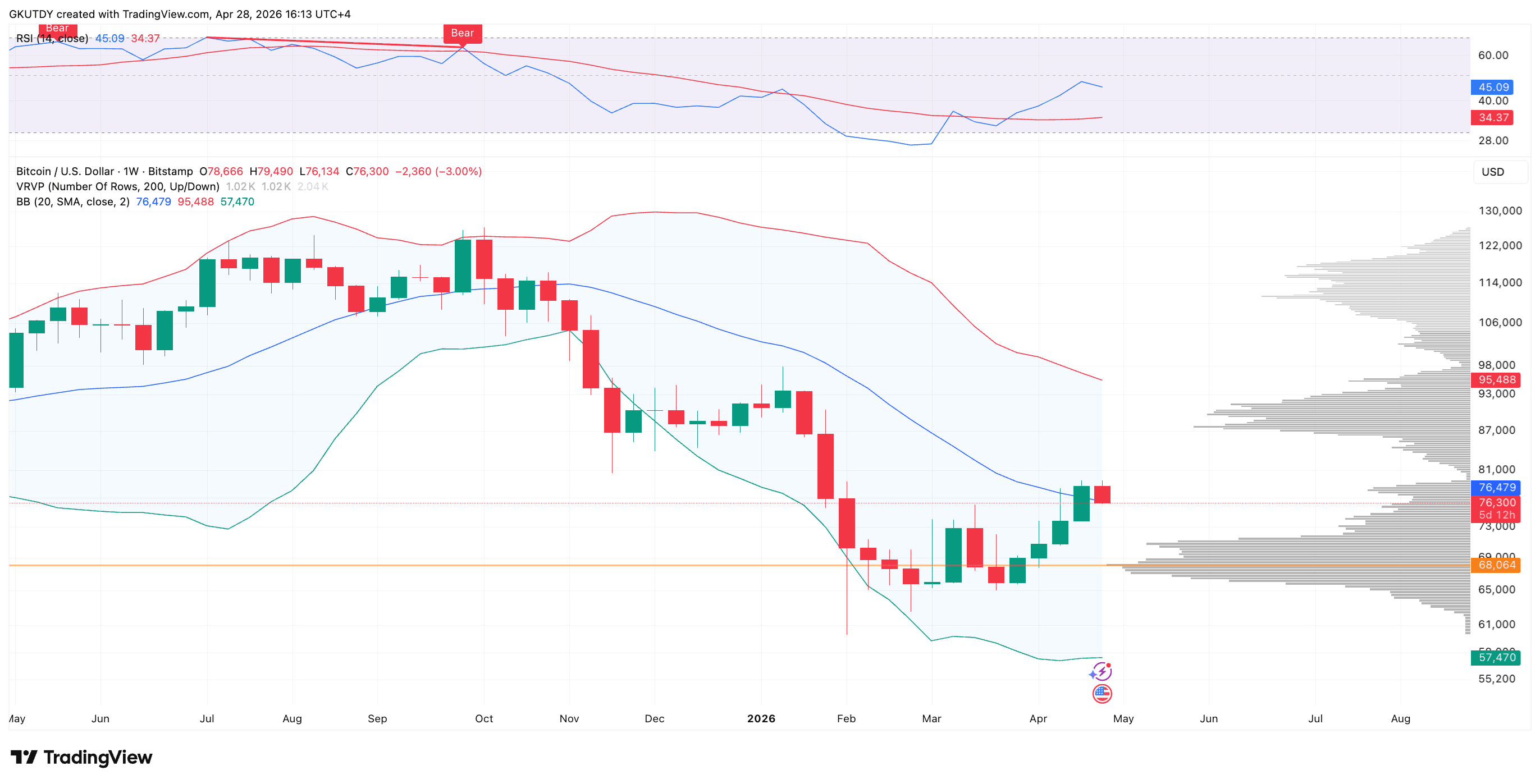
Bitcoin price curve with Bollinger Bands attached, Source: TradingView
If the weekly candle closes above this level, the technical retest will be considered successful. In this case, the upper Bollinger Band, adjusted to $95,500, will become the nearest magnet for the market.
The situation is complicated by external factors that prevent buyers from acting aggressively. Tensions around the Strait of Hormuz have pushed Brent oil prices above $100 per barrel. This has intensified inflation risks, leading some investors to temporarily move into defensive assets.
The market is not "falling" but searching for a base for the next move. The $96,600 target remains valid as long as Bitcoin trades above $76,500. However, losing this level may shift focus to deeper support around $72,000, extending the consolidation phase into May.
The Dogecoin (DOGE) market is showing signs of renewed institutional interest. After a prolonged nine-day pause, during which inflows into spot ETFs remained at $0, financial indicators have finally moved out of the red zone, according to SoSoValue.
The key event on Monday was the return of activity in the ETF sector. The GDOG fund from Grayscale Investments alone delivered the largest capital inflow since early March, breaking a streak of nine "empty" trading sessions.
Despite the headline, the scale of institutional participation remains modest. Net assets (AUM) stand at $11.83 million, with a market share of just 0.08% of Dogecoin's capitalization. This highlights that DOGE ETFs are still more of a niche instrument for hedging or targeted bets than a major market driver.
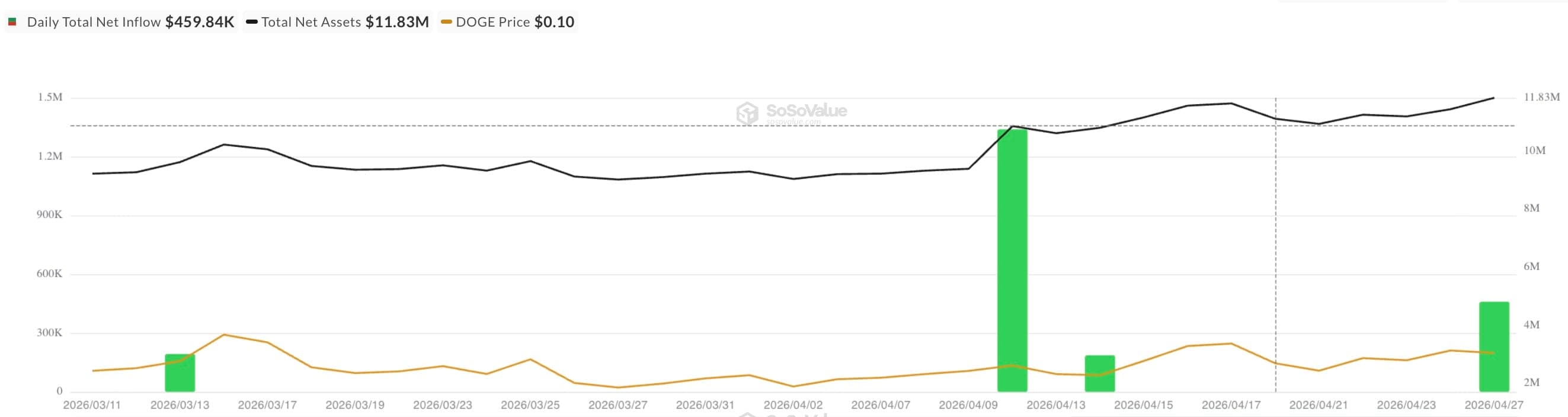
Total DOGE Spot ETF Net Inflow, Source: SoSoValue
On the chart, Dogecoin is now unfolding a classic technical setup. The coin has approached the $0.10 level, trading around $0.09913. DOGE has successfully held above its short-term (23-day) and medium-term (50-day) moving averages, creating a stable base for local buyers.
The main resistance and target for a full recovery lies significantly higher - at $0.12752 (200-day MA). The return of inflows into GDOG at "one step from ten cents" signals that large players see relative stability at current prices. However, to turn this impulse into a real trend, Dogecoin must not just touch $0.10 but turn it from a ceiling into a floor.
Despite a strong background in the tech sector, the crypto market is showing local weakness due to a defensive stance by institutional players ahead of the Fed meeting. A divergence is visible: the stock market is rising on expectations of AI-driven revenue, while crypto reacts to liquidity risk.
Key checkpoints: