
Bitcoin Could Be Entering Critical Pullback Phase Below This Level
Bitcoin may enter a critical pullback phase if it falls below $74,929.
NewsBTC1 min read

Shiba Inu (SHIB) experienced a negative netflow of approximately 260 billion tokens in 24 hours, indicating a significant outflow from exchanges to private wallets. This trend suggests a potential structural change in the market dynamics for SHIB.
Early indicators of a structural change in Shiba Inu are beginning to appear, and this time, the signal is not solely based on price.
SHIB recorded an exchange netflow of about -260 billion tokens over the past 24 hours, suggesting a substantial outflow from centralized exchanges. Coins are being drawn into private wallets, which lessens the pressure to sell right away. That kind of movement usually indicates one thing.
From the perspective of market mechanics, this is one of the better developments SHIB has witnessed in recent weeks. When the metrics are broken down, exchange reserves are still slightly declining, which supports the notion that exchange supply is thinning out. Concurrently, active addresses have increased by more than 1%, indicating increasing engagement rather than a declining user base.
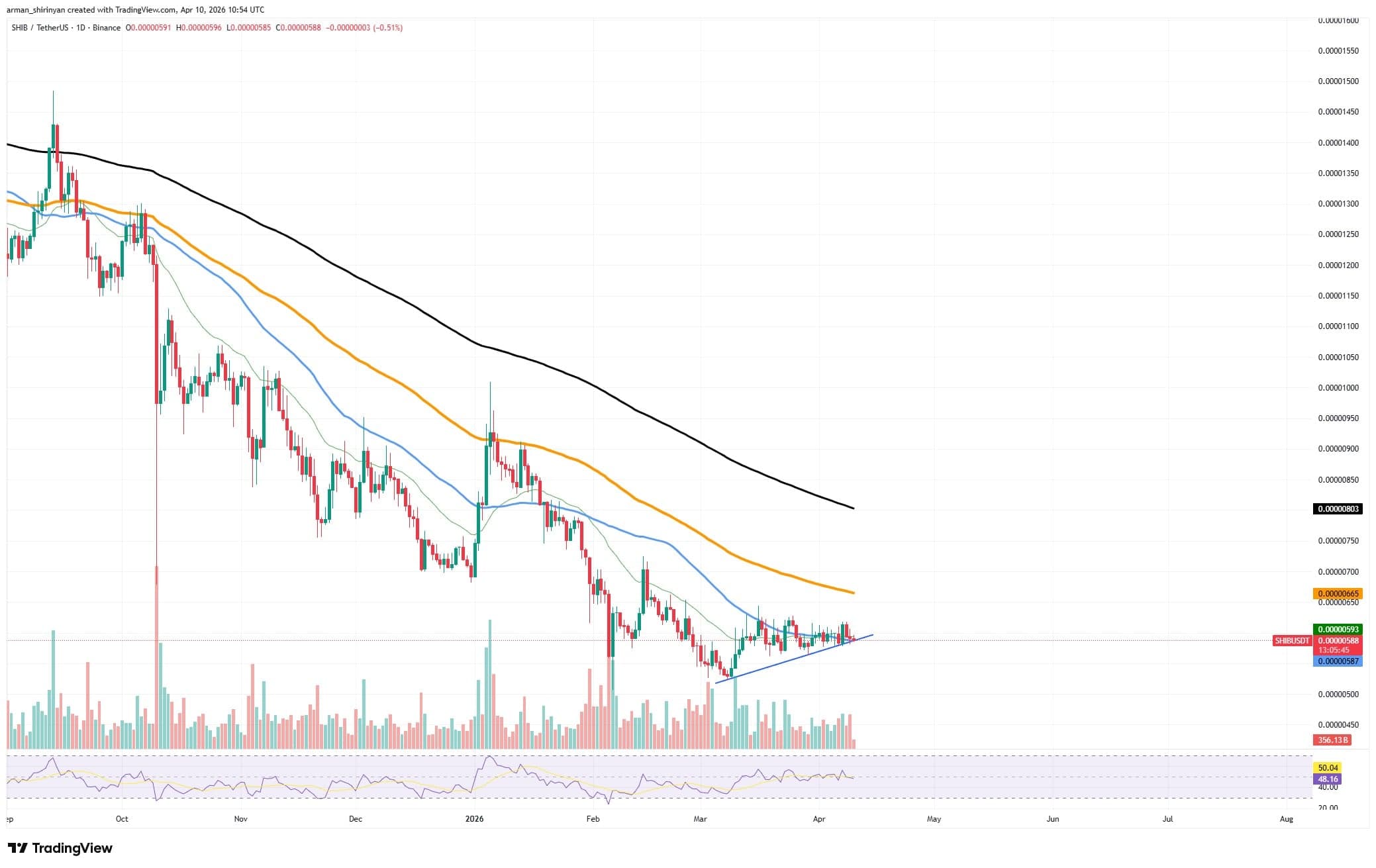
SHIB/USDT Chart by TradingView
This combination of decreasing reserves and increasing activity is typically linked to phases of accumulation. Deeper analysis reveals that while both exchange inflows and outflows have increased, overall outflows are greater than inflows. The netflow figure is negative because total outflows exceed 1.1 trillion SHIB, while inflows fell short.
Larger holders are actively reallocating capital, as evidenced by the elevated movement even in the top 10 transaction brackets. These signals are gradually being matched by price action. After a protracted downtrend, SHIB is forming a mildly ascending structure, compressing under descending resistance while holding higher lows.
Usually, this type of configuration comes before volatility expansion. Since the RSI is currently in neutral territory, there is potential for growth without instant exhaustion. But it is crucial to maintain reasonable expectations. Outflows only lessen downside pressure; they do not, by themselves, ensure a breakout.
A -260 billion netflow indicates that a large amount of SHIB tokens has moved from centralized exchanges to private wallets, suggesting reduced selling pressure.
Active addresses for Shiba Inu have increased by more than 1%, indicating growing user engagement and interest in the token.
Declining exchange reserves for SHIB suggest that the supply on exchanges is thinning, which could lead to upward price pressure if demand increases.
Bitcoin may enter a critical pullback phase if it falls below $74,929.

XRP sees whale accumulation amid market uncertainty, down 5% this week.

Bitcoin may be poised for outperformance against stocks and bonds as inflation persists and bond markets weaken, according to Mark Connors. After a historic 142-day underperformance against the S&P 500, bitcoin is now in a consolidation phase shifting towards outperformance.

Crypto CEO security spending spikes to $7.6M as attacks rise 75%

Is Dogecoin set for another parabolic rally after reclaiming support?

Is Cardano the most overvalued crypto? Analysts discuss ADA's decline.
See every story in Crypto — including breaking news and analysis.
SHIB still requires a catalyst in the form of higher demand or more general market strength for a sustained upward trend. The lesson for investors is pretty obvious. The outflow profile, as it stands now, points to accumulation, as opposed to distribution.
Large holders are active, exchanges are losing liquidity and participation is increasing. It is not a bearish situation. Instead of an abrupt move, one should expect a slow change in momentum. SHIB may move from passive consolidation into a more defined recovery phase if demand keeps up with this trend.