
Bitcoin Wallets See Largest Drop Since 2024, Hinting at Market Rebound
Bitcoin sees largest drop in wallet holders since 2024, hinting at a market rebound.
CryptoPotato1 min read
Aave has experienced a $15 billion drop in deposits following the Kelp DAO exploit. The total value supplied to Aave fell from $45.8 billion to $30.8 billion amid fears of contagion in the DeFi sector.
Mentioned in this story
Aave, the largest decentralized lending protocol, has seen around $15 billion in deposits withdrawn since the Kelp Dao exploit on Saturday.
Total value supplied to Aave fell from $45.8 billion on Saturday to $30.8 billion on Wednesday, according to Aavescan data.
The decline followed an attack that drained about 116,500 restaked Ether (rsETH), worth roughly $293 million, from Kelp DAO’s LayerZero-powered rsETH bridge. The exploiter then used part of the stolen funds to borrow on Aave.
Aave’s incident report said 89,567 rsETH were deposited on the protocol and that the resulting shortfall could range from about $123 million to $230 million, depending on how losses are ultimately allocated.
The outflows reflect fears of contagion from Aave’s bad debt and broader capital flight from decentralized finance (DeFi), according to institutional digital asset trading platform Talos.
The bad debt created by the Kelp exploiter resulted in Aave’s v3 Wrapped Ether (WETH) market temporarily reaching 100% utilization and leaving no liquidity available for immediate withdrawals, Talos said in a Tuesday report.
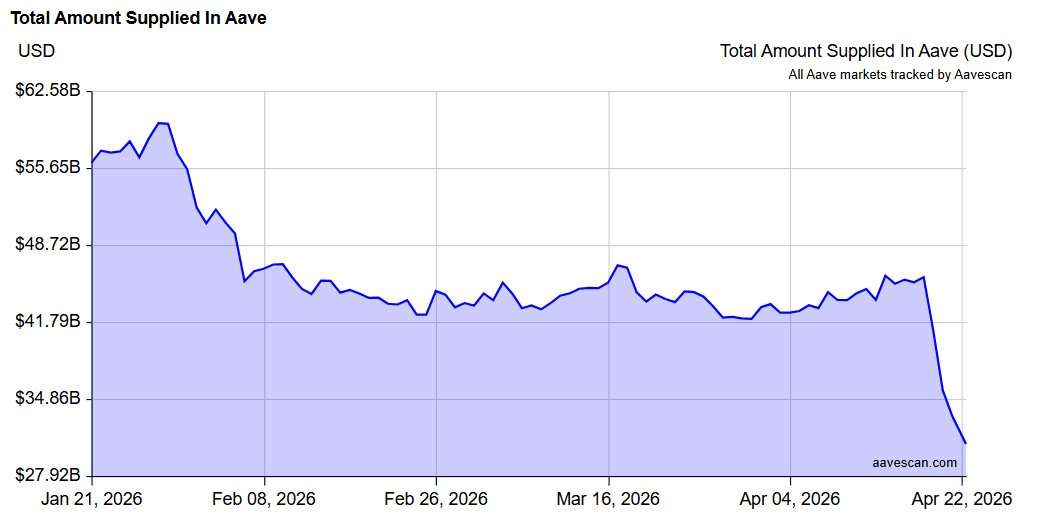
Total amount supplied in Aave, 3-month chart. Source: Aavescan
SparkLend’s total value locked (TVL) rose by $1.3 billion since the Kelp DAO exploit, signaling that the fourth-largest lending protocol was absorbing some of the funds withdrawn from Aave, blockchain analyst EmberCN said in a Wednesday post on X.
Related: Crypto hackers stole $17B over past 10 years: DefiLlama
The withdrawal was triggered by the Kelp DAO exploit, which drained approximately $293 million in funds.
As of Wednesday, the total value supplied to Aave is $30.8 billion, down from $45.8 billion.
The shortfall for Aave could range from about $123 million to $230 million, depending on the allocation of losses.
Bitcoin sees largest drop in wallet holders since 2024, hinting at a market rebound.

Bitcoin stays above $80K, boosting altcoins like Solana and Chainlink.

Barclays slashes Coinbase price target to $107 following Q1 woes.

TeraWulf's Q1 2026 Loss Hits $446 Million, AI Revenue Grows

Intel stock hits record high after preliminary chip deal with Apple.

Ethereum sees a sharp decline in high-leverage long positions. What could this mean for the market?
See every story in Crypto — including breaking news and analysis.
The episode highlights how DeFi’s interconnectedness is a double-edged sword, as the Kelp DAO exploit spread across lending markets and escalated into a “broader liquidity crunch,” Tanay Ved, senior research associate at Talos, told Cointelegraph.
She said the asset bundled risks across restaking, bridging and lending layers, allowing the impact to spread far beyond the initial exploit, adding that the incident reinforces the need for a more robust collateral framework and a more holistic security approach to address the systemic vulnerabilities of yield-bearing assets.
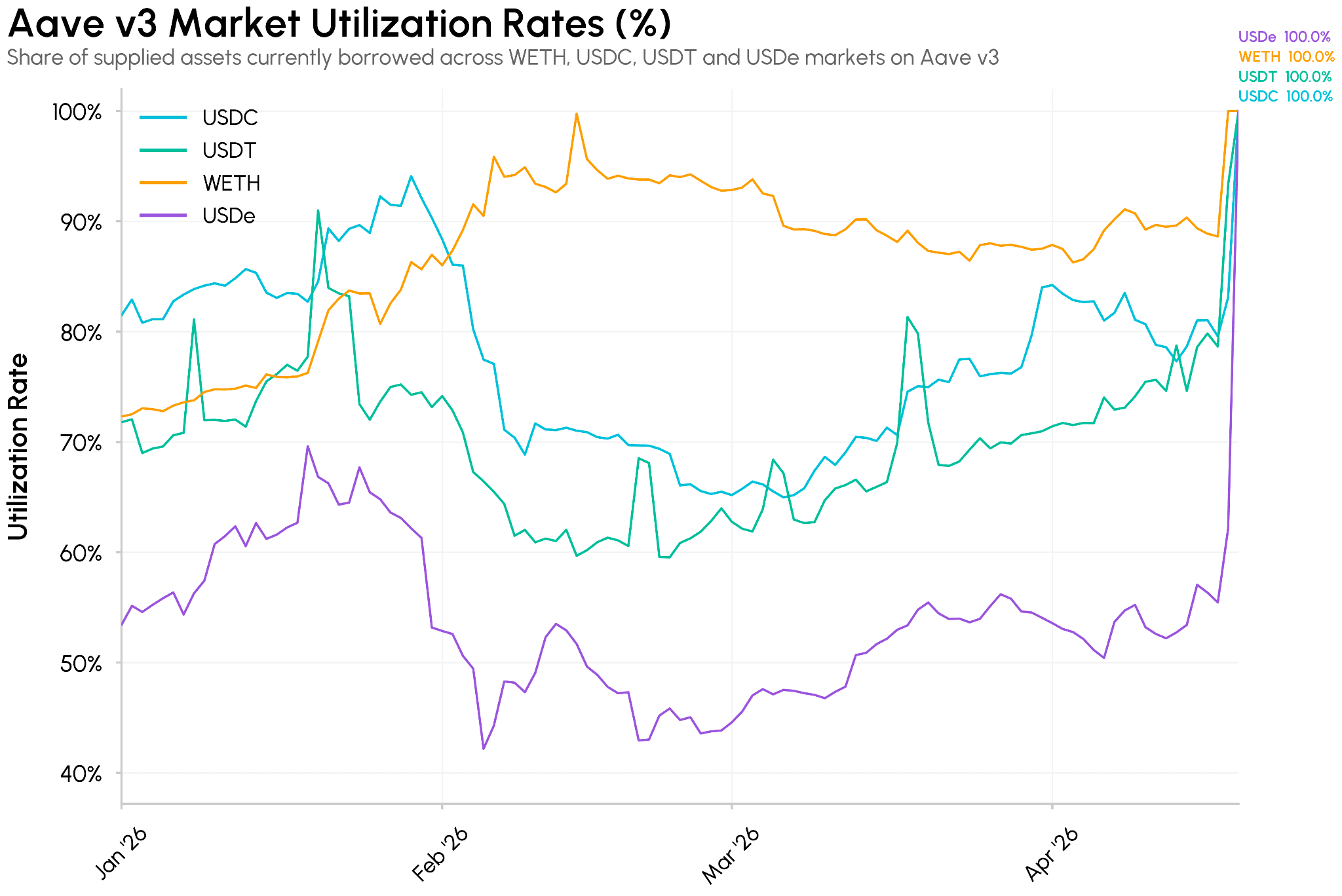
Aave v3 Market Utilization Rate percentage across USDC, USDT, WETH, USDe. Source: Talos
Aave said it had unfrozen WETH reserves on the Ethereum Core V3 market on Tuesday, enabling users to supply WETH to the V3 lending protocol, but WETH reserves across Ethereum Prime, Arbitrum, Base, Mantle and Linea remain frozen.
On Monday, Aave’s risk manager outlined two potential scenarios for addressing the bad debt. The first scenario involves spreading the losses across all rsETH token holders on Ethereum mainnet and layer-2s, leaving about $123 million in bad debt on Aave.
The alternative would shift the shortfall entirely to layer-2 networks, resulting in about $230 million in bad debt on Aave.
Traders took to prediction markets to bet on the outcome, with 20% of traders wagering on Kelp DAO socializing the losses across rsETH holders on mainnet, rather than L2 holders bearing the shortfall, Polymarket data shows.