Adam Back Defines Best Defense to Quantum Risk, Ripple CTO Emeritus Shows Rare Support to XRP Meme Coin, Barry Silbert Co-Signs $1,000 Zcash (ZEC) Prediction - Morning Crypto Report | Cryptalytic
Adam Back Defines Best Defense to Quantum Risk, Ripple CTO Emeritus Shows Rare Support to XRP Meme Coin, Barry Silbert Co-Signs $1,000 Zcash (ZEC) Prediction - Morning Crypto Report
Adam Back emphasizes the need for quiet code development to protect Bitcoin from quantum risks, urging a focus on cryptographic readiness. Ripple's David Schwartz set a trust line for the FUZZY meme coin, reviving interest in XRP's cultural history. Barry Silbert predicts Zcash could reach $1,000, likening it to Bitcoin's early model.
Key points
Adam Back calls for focus on quantum readiness for Bitcoin
David Schwartz sets a trust line for FUZZY meme coin
Barry Silbert predicts Zcash could reach $1,000
FUZZY token ties to XRP's cultural history and community
Adam Back's "Vaccine" Against the Quantum Threat: CEO of Blockstream calls to stop disputes over "Q-Day" dates and focus on code, implementing cryptographic primitives without marketing noise to protect the Bitcoin network without compromising its stability.
Ripple and the FUZZY Meme Coin: David Schwartz set a trust line to the FUZZY token. This revived legends about the anonymous bearableguy123 and the Fuzzybear wallet from 2013, legitimizing the cultural component of the XRP ecosystem.
Barry Silbert Predicts Zcash's Path Like BTC: Founder of Digital Currency Group Barry Silbert confirmed the forecast of ZEC growth to $1000. Silbert believes that Zcash today is "Bitcoin of the 2015 model", which will fill the privacy niche while BTC becomes a transparent institutional asset.
Crypto Market Outlook: BTC holds a channel above $70,000. The main target for bulls remains $82,228, the 200-day EMA. At the same time, a court ban on the movement of $71 million in ETH for Arbitrum puts the status of DAOs at risk.
No panic, but with code: Adam Back proposed a "vaccine" for Bitcoin against quantum marketing
CEO of Blockstream Adam Back called to change the direction of discussion in disputes about the realism of "Q-Day" for Bitcoin. In his view, the best protection against quantum risks is not public debates about timelines, but quiet work on code and a complete rejection of marketing noise.
Back's main thesis today is that disputes about when exactly quantum computers will become a threat to ECDSA are destructive. Instead of seeking consensus on dates, developers are advised to agree to disagree on timelines and focus on quantum readiness.
no, the best defense to quantum risk timing is to agree to disagree, and quietly and calmly do the work to build quantum readiness, as @n1ckler@kudinov\_mikhail and @blksresearch team have been working on. accused us of doing nothing when we'd actually done lots.
Q&A
What is Adam Back's proposed defense against quantum computing risks for Bitcoin?
Adam Back suggests that the best defense is to focus on developing quantum-ready code rather than debating timelines for quantum threats.
Why did David Schwartz set a trust line for the FUZZY token?
David Schwartz set a trust line for FUZZY to engage with the community, although he clarified that it does not constitute an endorsement of the project.
What is Barry Silbert's prediction for Zcash's future value?
Barry Silbert predicts that Zcash could reach a value of $1,000, comparing it to Bitcoin's early growth model.
How does the FUZZY token relate to XRP's cultural history?
The FUZZY token revives interest in XRP's cultural history, particularly linked to the legendary Fuzzybear wallet from 2013 and the figure bearableguy123.

— Adam Back (@adam3us) May 2, 2026
More code and less marketing is key, Back believes, and the best protection is to calmly create solutions, which teams like Jonas Nick and Blockstream Research are already working on, responding to criticism about the alleged slowness of core developers.
While some blockchain projects use "quantum resistance" as a main marketing tool to attract investment, solutions should be implemented softly, without disrupting the current network. Back directly accused promoters of quantum drama of inflating marketing budgets, while the Bitcoin community focuses on architectural changes.
The discussion intensified amid recent advances in quantum computing, which have reduced the theoretical timelines for breaking classical cryptography. However, Back's strategy offers the market an injection of calm: Bitcoin will not rush to change the protocol for headlines, but will implement necessary cryptographic primitives when they are tested and ready for use.
Why David Schwartz set a trust line to FUZZY
By the end of the week, the attention of the XRP community focused on an unusual transaction in the XRP Ledger, where David Schwartz, CTO Emeritus of Ripple, officially confirmed setting a trust line for the meme coin FUZZY.
Schwartz, known for his straightforward communication style, immediately lowered expectations, stating that this in no way constitutes endorsement of the project and that he knows much less about it than people might think, but considers it a fun community.
Setting a trust line is technically necessary for a wallet to receive or trade a specific token on XRPL. The intrigue around FUZZY lies not in price charts, but in the deep roots of the name itself.
As I promised, I have added a trust line for $FUZZY.
This is not an endorsement of the project in any way. I know \much\ less about this project than you probably think. But I do think it's a fun community.
— David 'JoelKatz' Schwartz (@JoelKatz) May 3, 2026
In the XRP ecosystem, "Fuzzybear" is not just an image of a bear, but part of history. A wallet named Fuzzybear was activated by Opencoin, a predecessor of Ripple, in February 2013, just months after the network launch. In 2014, this wallet placed an order on the DEX that became legendary: 1 XRP for 1 BTC.
For many holders, Schwartz's support of FUZZY is an implicit nod to the mythology of bearableguy123. This anonymous figure published cryptograms for years, linking XRP to global financial changes, and many even believe this is Brad Garlinghouse.
Article image
*The last published picture by 'bearableguy123' with multiple XRP mentions, Source:* *X*
At the moment, the meme coin market on XRPL may experience a second wind, as Schwartz essentially legitimizes the fun side of the ecosystem, showing that even fundamental developers are not strangers to meme culture if there is real blockchain history behind it.
Nevertheless, caution is required. The presence of a token in Schwartz's wallet does not guarantee its technological value, but only highlights its status as a cultural artifact.
"Bitcoin of 2015": Barry Silbert sees in the chart of Zcash the beginning of a new four-digit era
Amid Zcash growth, the founder of Digital Currency Group Barry Silbert aligned with the forecast of ZEC price rising to four-digit values. The intrigue lies not in the number $1000 itself, but in the historical context Silbert attached to this movement.
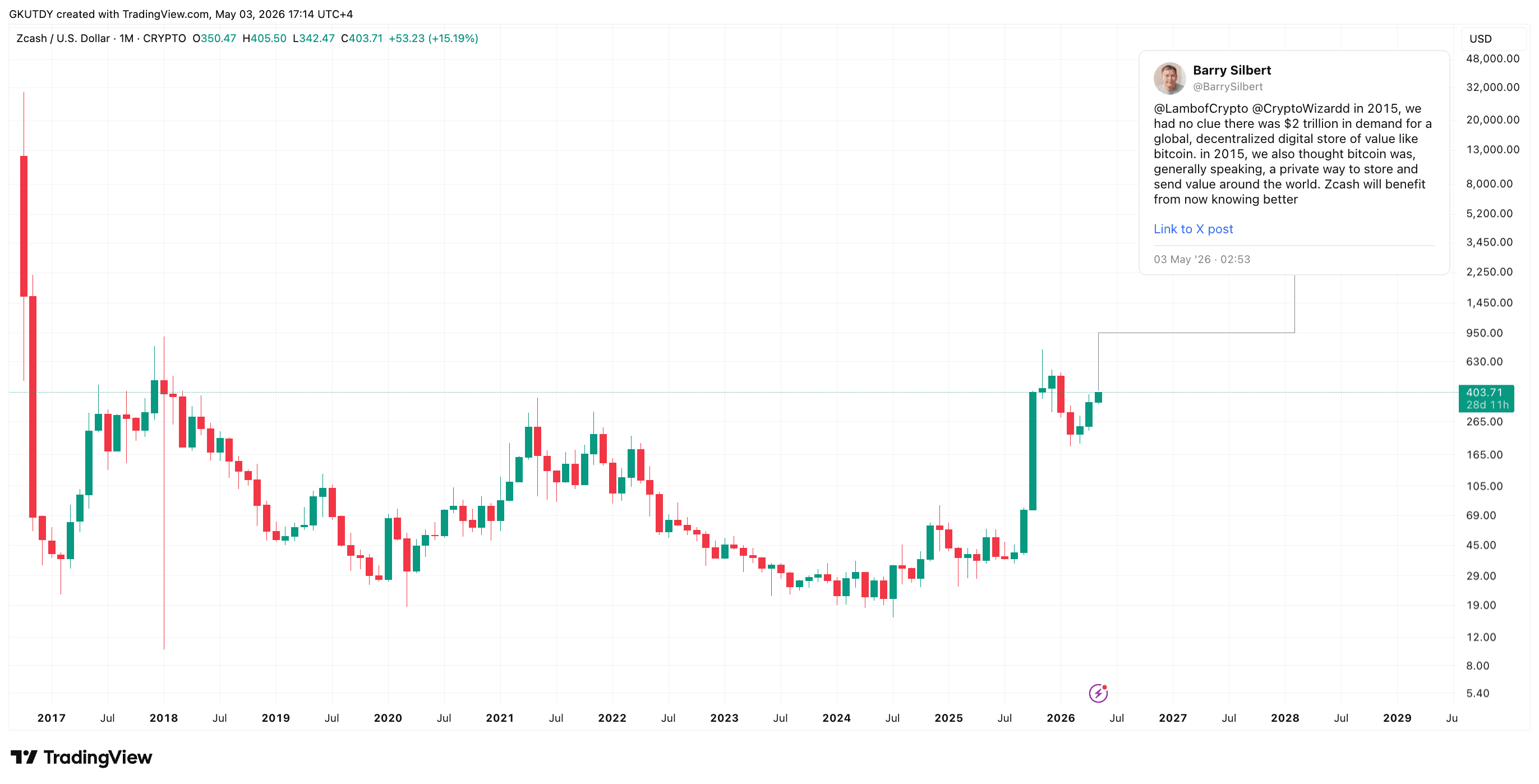
It started with a publication comparing the potential run of ZEC this season to the legendary rally of Dogecoin in 2021. In that view, the recent rise to $700 was only a warm-up before reaching four-digit levels. Silbert briefly confirmed the viability of this scenario, calling the technical picture on the chart "beautiful".
The deeper layer of the discussion opened when Silbert answered whether the current situation resembles 2015 for Bitcoin. At that time, Bitcoin was mistakenly considered a private tool. Now that BTC has become a transparent institutional asset, an empty niche has formed. Zcash will benefit from the fact that we now know better, Silbert emphasized.
Article image
*Zcash (ZEC) price chart with Barry Silbert's fresh post about "2015 Bitcoin", Source:* *TradingView*
Grayscale's boss is betting that history will repeat itself. Just as in 2015 the market underestimated the scale of demand for decentralized money, in 2026 it underestimates the demand for transaction privacy in a world of total on-chain monitoring.
Considering that Silbert's structures have long worked on legitimizing Zcash in the eyes of regulators, such statements may signal preparation for the launch of full-fledged spot ZEC ETFs, particularly by Grayscale Investments.
Crypto market outlook: Bitcoin eyes $82,000 test as Tether goes gold and DAOs face trial
While Bitcoin struggles with technical resistance, the industry faces an existential challenge: increasing regulatory pressure on DAOs and the simultaneous push by major funds like BlackRock toward full asset tokenization.
**Key checkpoints:**
Bitcoin Technicals: BTC quotes continue to hold an ascending channel above the $70,000-$72,000 level. The key target for buyers is the 200-day EMA at $82,228.
Tether's "Gold Standard": Tether reported reaching a record 132 tons of gold, $19.8 billion, as part of the backing of its stablecoin ecosystem.
Arbitrum DAO Legal Precedent: A US court imposed a ban on the movement of $71 million in ETH from the Arbitrum fund. The key concern now is whether the qualification of a DAO as a "partnership" and the assignment of liability to the Security Council will become a critical risk for decentralized structures and the stability of the Layer 2 sector.
BlackRock vs. GENIUS Act: BlackRock submitted a request to the OCC to reconsider the restrictions of the GENIUS Act regarding tokenized reserves.
OPEC+ Macro Boost: OPEC confirmed a plan to increase oil production by 188,000 barrels per day starting in June. The expected decline in energy prices may slow inflation, creating a favorable backdrop for the growth of risk assets, including Bitcoin.