
2 Days Left: XRP Amendment With Rare 100% Consensus Eyes Activation
XRP's 'fixCleanup3_1_3' amendment achieves 100% consensus, activating soon!
U.Today1 min read

Bitcoin's funding rate remains negative despite the price trading above $75K, indicating bear-market losses and forced liquidations. Institutional inflows into Bitcoin ETFs suggest solid spot demand.
Key takeaways:
Bitcoin (BTC) sold off in early trading hours at the US stock market open, briefly losing the $75,000 level before rebounding. This unexpected price swing triggered $120 million in liquidations of leveraged long (buy) BTC futures positions. During this ordeal, the Bitcoin funding rate has remained negative, which could hint at further downside and a potential advantage to the bears.
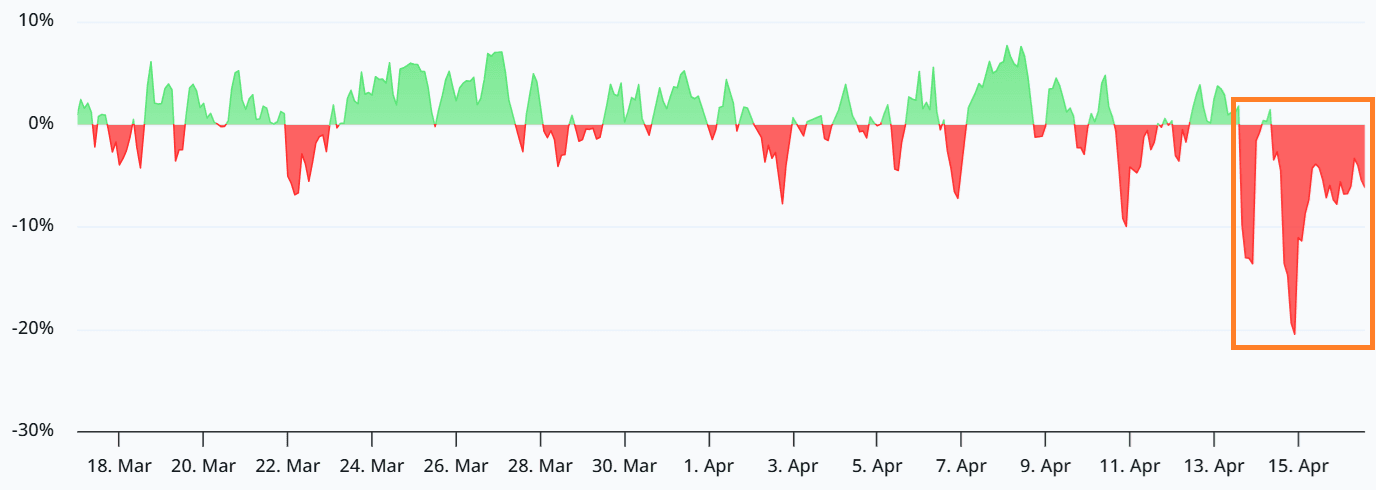
Bitcoin perpetual futures annualized funding rate. Source: Laevitas
The negative funding rate has been the norm since Monday, indicating a lack of demand for bullish leverage. Negative rates mean shorts (sellers) are the ones paying to keep their positions open. Under neutral conditions, the indicator should range between 5% and 10% to compensate for the cost of capital and exchange risks. At first sight, a 20% rate indicates conviction, but that is not the whole story.
The perpetual contract funding rates are calculated every 8 hours on most exchanges. Temporary spikes to 20%, either positive or negative, are not particularly concerning for most traders, as they amount to a 0.05% daily fee. In essence, even if the position has extremely high leverage, such as 20x, the cost is 1%. Unless this issue persists for much longer, it is hardly a burden.
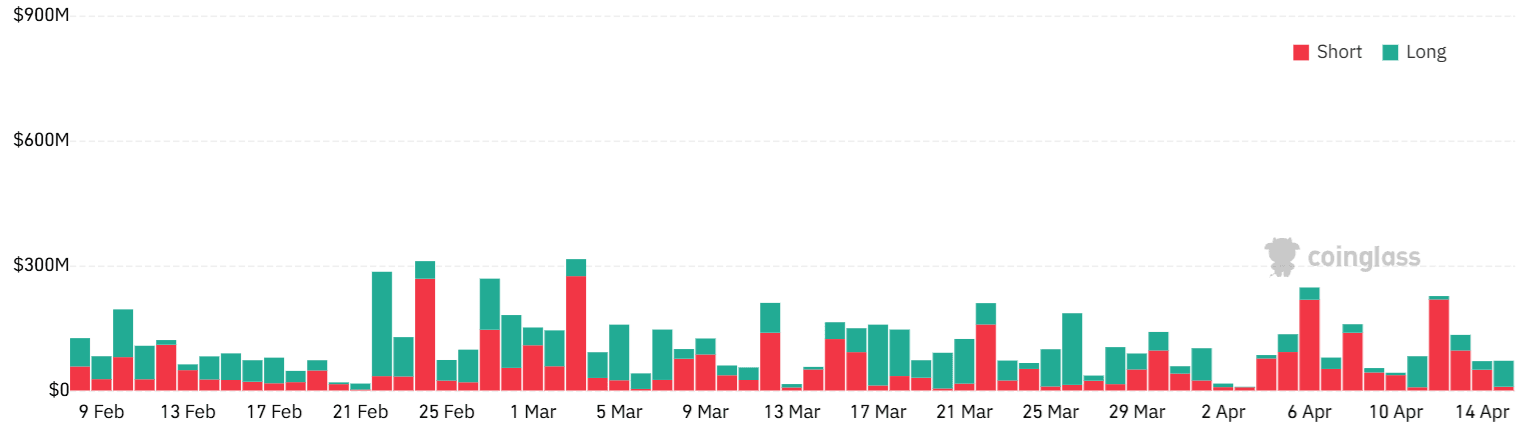
Bitcoin futures aggregate liquidation history, USD. Source: CoinGlass
Bitcoin bearish positions have been forcefully liquidated for $365 million since Monday, which has naturally eroded collateral on short positions. Traders could have opted to sit tight rather than rush to add margin, anticipating that funding rates would adjust on their own. Thus, the negative funding rate reflects losses from bears rather than conviction.
A negative Bitcoin funding rate signals bear-market losses and forced liquidations rather than a positive shift in market sentiment.
$120 million in leveraged long BTC futures positions were liquidated during the recent price swing.
Institutional inflows into Bitcoin ETFs indicate strong spot demand and corporate accumulation, suggesting confidence in Bitcoin's long-term value.
Bitcoin briefly lost the $75,000 level during early trading hours at the US stock market open before rebounding.
XRP's 'fixCleanup3_1_3' amendment achieves 100% consensus, activating soon!
US Treasury imposes sanctions on Sinaloa Cartel associates for crypto money laundering.

Analyst Highlights Ethereum 'Kill Zone' for Optimal Buying

Bitcoin may enter a critical pullback phase if it falls below $74,929.

XRP sees whale accumulation amid market uncertainty, down 5% this week.

Bitcoin may be poised for outperformance against stocks and bonds as inflation persists and bond markets weaken, according to Mark Connors. After a historic 142-day underperformance against the S&P 500, bitcoin is now in a consolidation phase shifting towards outperformance.
See every story in Crypto — including breaking news and analysis.
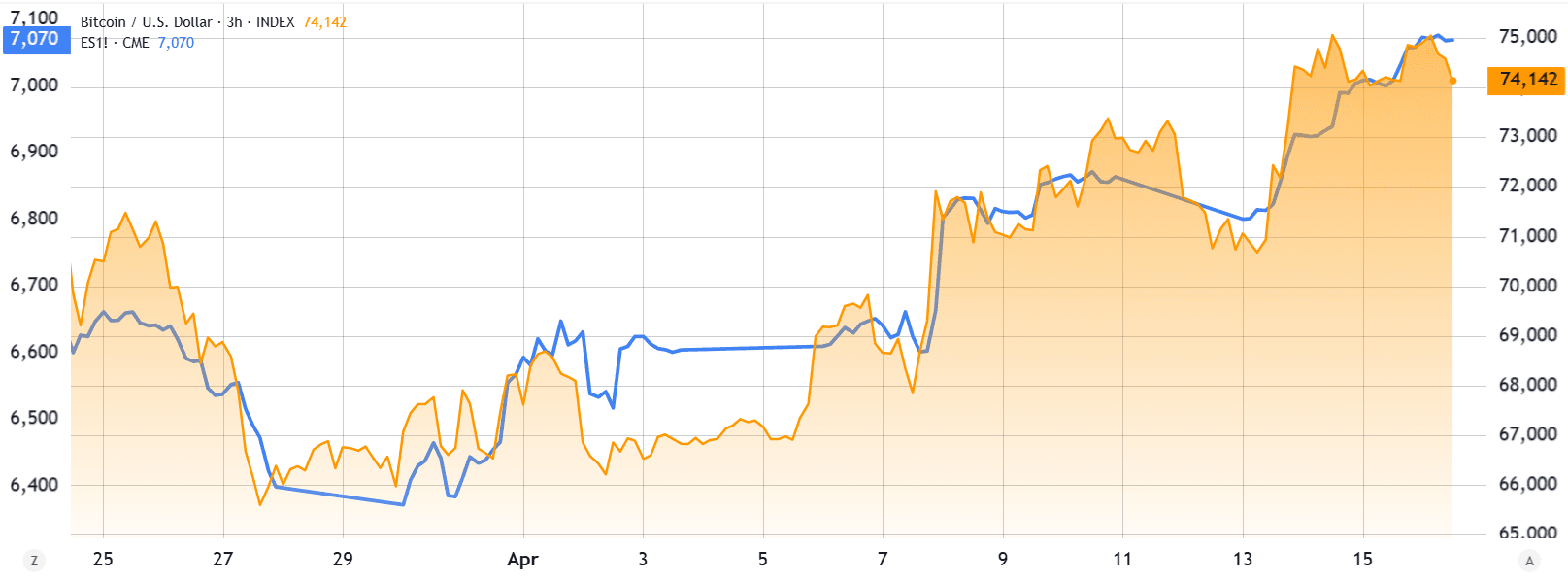
S&P 500 futures (left) vs. Bitcoin/USD (right). Source: TradingView
Bitcoin’s intraday moves have largely tracked the S&P 500 index for the past couple of weeks. The US stock market jumped to an all-time high on Thursday while Bitcoin remains distant from its $126,200 peak. Consecutive failures to re-establish the $76,000 level partially explain the lack of enthusiasm in BTC derivatives markets. Still, the latest round of US economic data is supportive for risk markets, including Bitcoin.
US industrial production decreased by 0.5% in March from the previous month, according to data released by the Federal Reserve on Thursday. Consumer durable goods were the negative highlight, with automotive production down 2.8%. In parallel, the continuing jobless claims increased 31,000 to a seasonally adjusted 1.818 million during the week ended April 4.
While counterintuitive, the S&P 500 benefited from the increased economic recession, which forced the government to accelerate stimulus measures. The upward pressure on inflation, which has also been fueled by the surge in oil prices, reduces incentives to hold fixed-income investments.
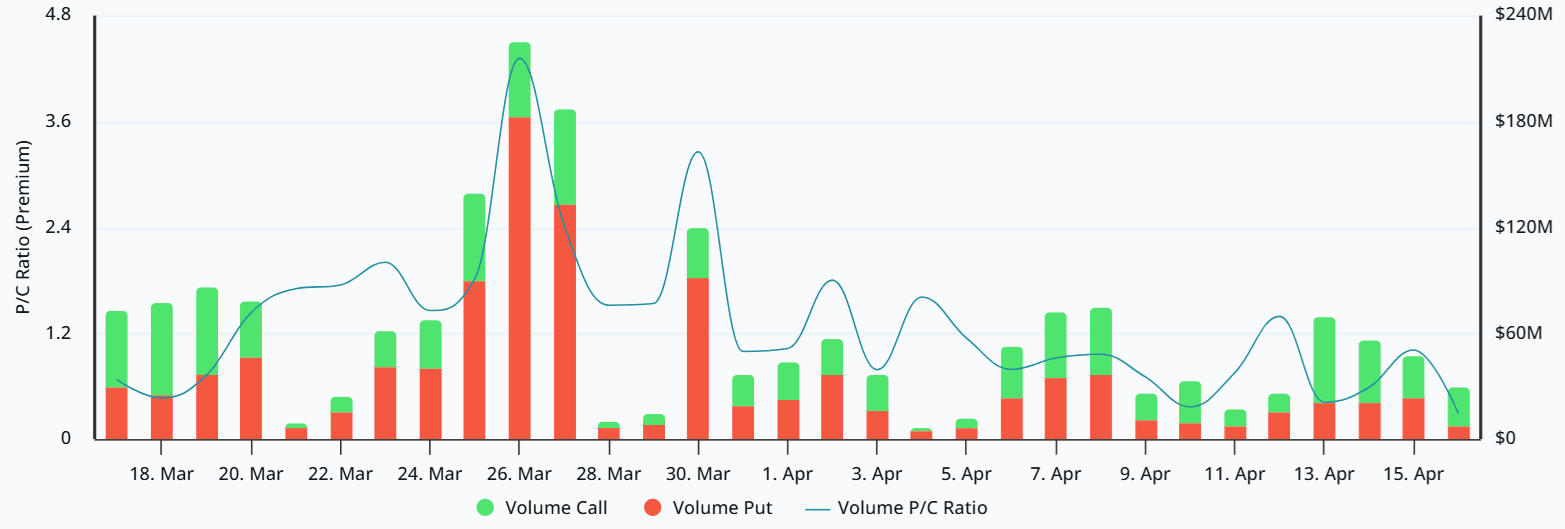
Deribit Bitcoin options premium put-to-call ratio. Source: Laevitas
The Bitcoin options market data provides no signs of excessive demand for downside price protection. The premium paid on put (sell) options on Deribit has lagged behind the equivalent call (buy) instruments over the past week. The $921 million in net inflows into US-listed Bitcoin spot ETFs over five days, along with continued accumulation from Strategy (MSTR US), boosted investors’ confidence.
At the moment, Bitcoin’s negative funding rate does not raise alarms, especially since institutional investor demand remains strong in BTC’s spot markets.