
This Bitcoin Momentum Signal Preceded Last October’s Crash — Another Downturn Incoming?
Bitcoin's recent momentum signals a potential downturn as it weakens. What does this mean for investors?
NewsBTC1 min read

Bitcoin's uptrend remains weak as ETF flows stagnate since their peak in 2025, with limited institutional demand. Recent data indicates a decline in both Bitcoin and gold ETF inflows, highlighting a lack of sustained investor interest.
Establishing a strong Bitcoin (BTC) uptrend in 2026 remains a challenge, as exchange-traded fund (ETF) flows have shown limited growth since peaking above $60 billion in 2025.
At the same time, inflows to gold ETFs also dropped by nearly 25% in Q1 and the lack of a capital rotation into BTC signals muted institutional demand.
A recent report from Ecoinometrics shows a clear shift in the demand and persistence of Bitcoin exchange-traded fund (ETF) flows. Before the October 2025 price peak for BTC, ETF inflows often came in extended streaks, including a 15-day run of $4.4 billion in June 2025, which helped sustain upside momentum.
That consistency has faded in recent weeks. The recent direction of ETF flows changed quickly, with inflow streaks lasting only a few days. Outflows have also clustered, reaching up to 10 consecutive days, totaling $3.2 billion in January, suggesting more reactive positioning.
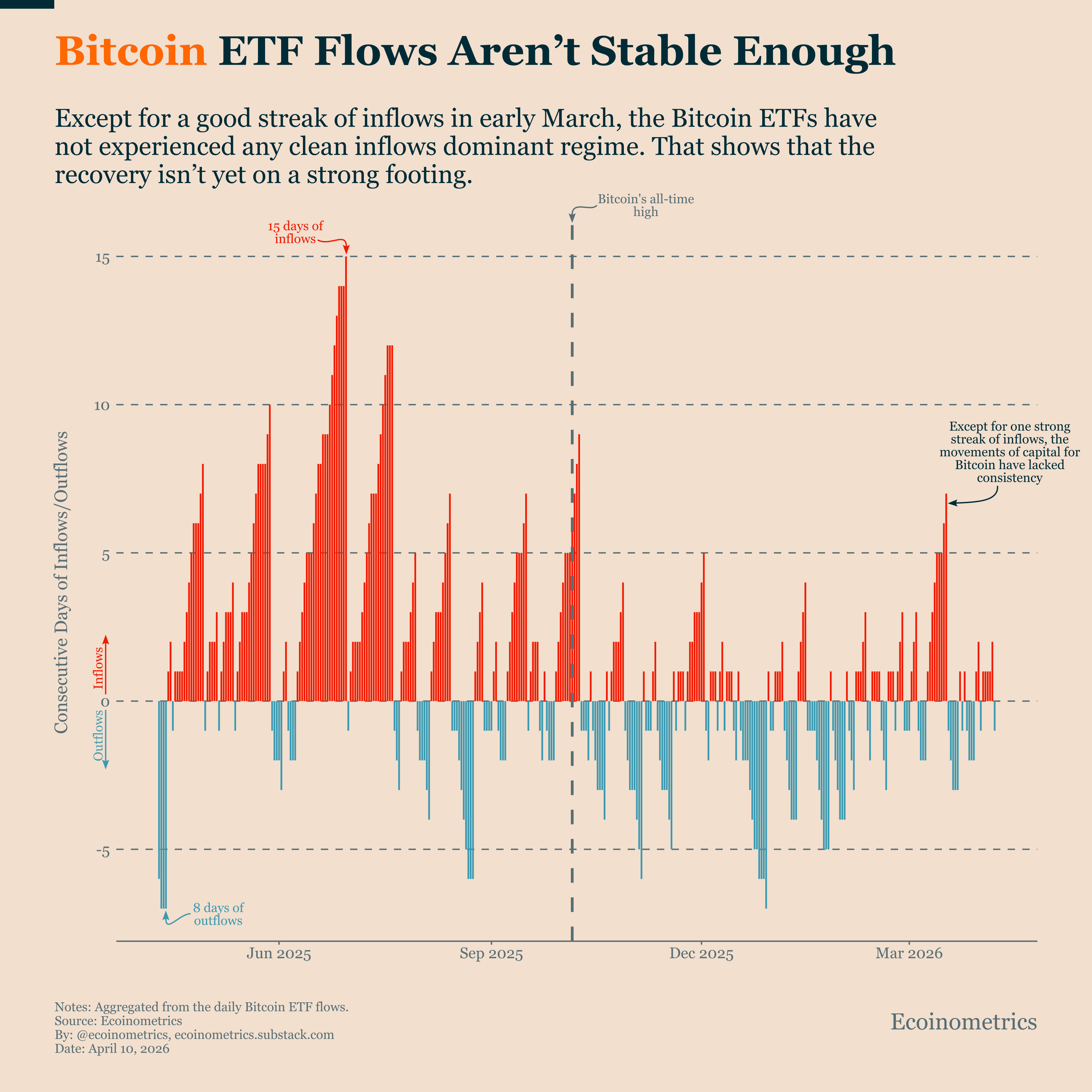
Bitcoin ETF flows comparison 2025 and 2026. Source: Ecoinometrics/X
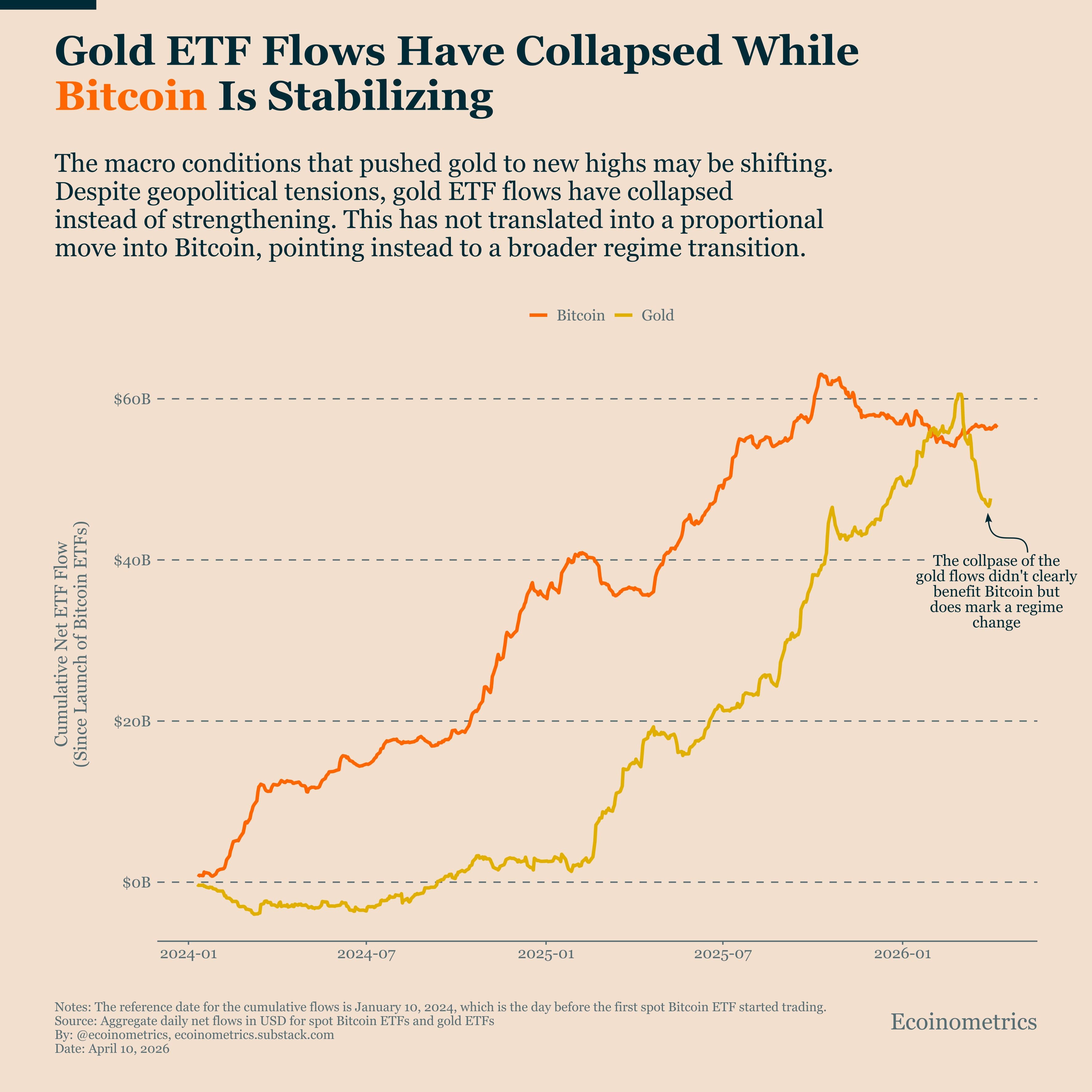
The cumulative data reinforces this slowdown. Bitcoin ETF flows have plateaued at $55–$60 billion in 2026, showing little net growth. Over the same period, gold ETF flows dropped sharply to near $45 billion from around $60 billion, without a corresponding pickup in Bitcoin demand.
Bitcoin is facing challenges in building a strong uptrend due to limited growth in ETF flows since their peak in 2025 and muted institutional demand.
Bitcoin ETF inflows peaked above $60 billion in 2025 but have since shown limited growth and reduced consistency in recent months.
Gold ETF inflows dropped by nearly 25% in the first quarter of 2026, indicating a broader trend of reduced investor interest in both gold and Bitcoin.
The Ecoinometrics report highlights a shift in Bitcoin ETF flows, showing that inflow streaks have diminished and outflows have increased, suggesting a more reactive market position.
Bitcoin's recent momentum signals a potential downturn as it weakens. What does this mean for investors?

Bitcoin drops to over $74,000 and Ethereum dips to $2,000 this weekend.

Bitcoin's price drops to $74K as bearish market trends intensify.

Bitcoin and Ethereum's Sharpe Ratio diverges, hinting at potential price changes.

XRP drops to a six-week low of $1.33 as whale activity declines significantly.

Dogecoin price drops to monthly lows, but whales are loading up on DOGE.
See every story in Crypto — including breaking news and analysis.
Bitcoin, Gold ETF comparison. Source: Ecoinometrics/X
Ecoinometrics explained that the Federal Reserve’s lack of relief reinforces the slowdown in demand. US Treasury yields have shifted higher across maturities, with the 30-year yield rising toward 4.9% from 4.7% six months ago, while the shorter durations (10-year bond yield) also moved to 4.3% from 3.8% in October 2025.
The elevated yields offer competitive returns, reducing the need for sustained ETF-driven exposure to Bitcoin. Ecoinometrics added,
“As long as the bond market holds this view, Bitcoin is operating without a liquidity tailwind. And without that tailwind, sustained upside becomes much harder to build.”

US Treasury yield chart. Source: Ecoinometrics/X
Crypto trader Ardi explained that one reason the current BTC range near $74,000 refuses to break is that retail and professional traders show similar behavior. Long positions drop as the price tests resistance, while the short exposure increases.
Hyblock’s four-hour chart highlights this repeated pattern. Long accounts decline sharply at highs, while short positioning builds at the same levels. These flows treat upward moves as opportunities to exit rather than extend exposure.
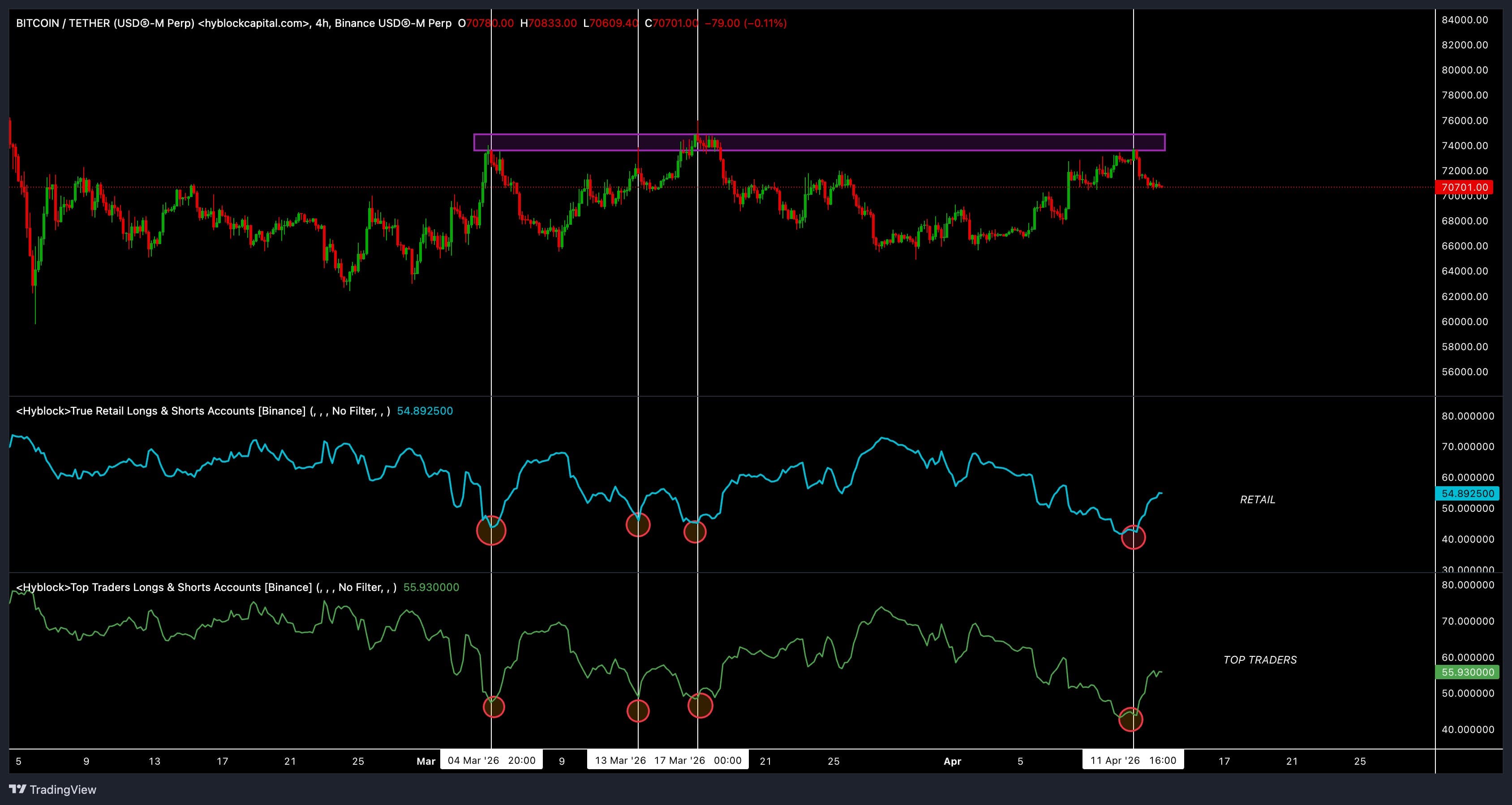
BTC analysis by Ardi. Source: X
The profit-taking from longs meets fresh short entries in the order book. That interaction reinforces the upper boundary and interrupts attempts to retain the uptrend.
Ardi said that a shift would require stronger long-term accumulation near the resistance, where buyers absorb available supply rather than react to it. For now, the positioning data near $75,000 continues to cap each rally.
However, that condition could soon change as early Bitcoin adopter Willy Woo noted the return of capital flows into BTC for the first time since January. In an X post, Woo said,
“Capital flows into BTC just flipped positive, first time since January. Liquidity is repairing... spot remains stable while derivatives after being destroyed 10 Oct is now making its second attempt at rebounding. 80k remains key test level.”