BitMEX pitches ‘canary fund’ alternative to Bitcoin quantum coin freeze
TL;DR
BitMEX Research proposes a 'canary fund' approach instead of freezing quantum-vulnerable Bitcoins. The plan activates a freeze only if a quantum computer capable of stealing Bitcoins is proven to exist.
Key points
- BitMEX Research proposed a canary fund for Bitcoin.
- The fund activates a freeze only if a quantum computer threat is proven.
- Users can donate to a special Bitcoin address as a bounty.
Mentioned in this story
BitMEX Research has proposed an alternative to freezing quantum-vulnerable dormant Bitcoins, advocating a wait-and-see approach and a “canary fund” with a quantum bounty instead.
BitMEX Research proposed a soft fork on Thursday that would only activate a full freeze of vulnerable coins if it is “proven that a quantum computer capable of stealing Bitcoins actually exists.”
The system uses a “canary approach,” creating a special Bitcoin (BTC) address using a “Nothing-Up-My-Sleeve Number” (NUMS). This is a cryptographic proof in which the private key is unknown, but it is a valid address that could theoretically be spent by a powerful enough quantum computer.
Users can donate BTC to this address as a bounty, incentivizing any quantum-capable actor to “ring the alarm” by spending from it. Only if someone spends from this canary address does the freeze automatically activate, as it proves the quantum threat is real.
The solution provides an alternative mechanism to the BIP-361 proposal on Tuesday that suggested freezing dormant, quantum-vulnerable Bitcoin to prevent it from being stolen by bad actors in the future.
BIP-361 drew significant community pushback, with some comments calling it “authoritarian” and “confiscatory.”
Canary watch state prevents automatic freeze
BitMEX’s proposed “canary watch state” would still allow old coins to be spent, provided malicious actors using quantum computers do not attempt to steal from the “canary fund.”
Investors participating in the canary fund can use multisignatures and withdraw their BTC at any time, it explained.
There is also a safety window where quantum-vulnerable transactions could still be allowed after the five-year mark proposed in BIP-361, but with outputs locked for a period.
Related: Bitcoiners propose freezing quantum-vulnerable coins in BIP-361
“While this approach adds complexity and risk, given how controversial any coin freeze is, mitigating the impact of the freeze using this type of system may be worth consideration.”
BIP-361 is a rough idea for a contingency plan
Meanwhile, BIP-361 co-author Jameson Lopp has said his Bitcoin improvement proposal was more of a “rough idea for a contingency plan” than something ready to be proposed for activation.
“I know folks don’t like it. I don’t like it myself. I wrote it because I like the alternative even less,” he wrote on X on Wednesday.
He told Cointelegraph that it was a “rough sketch” to approach the issue of a “looming circulating supply shock” if quantum computing advances to the point that a post-quantum signature scheme achieves consensus for being added to Bitcoin.
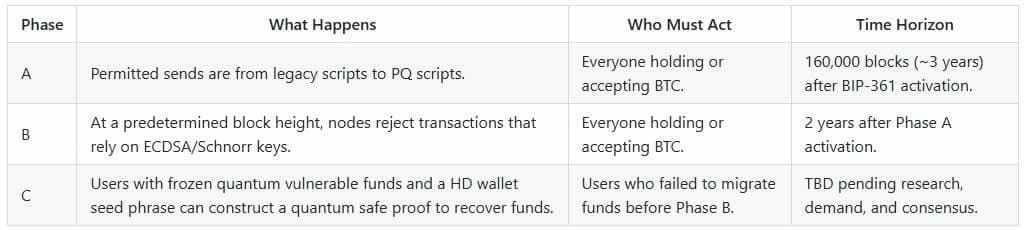
Proposed three-phase solution in BIP-361. Source: GitHub
Magazine: Nobody knows if quantum-secure cryptography will even work
Q&A
What is BitMEX's canary fund proposal for Bitcoin?
BitMEX's canary fund proposal involves creating a special Bitcoin address that acts as a bounty, incentivizing quantum-capable actors to alert the community if they can access it.
How does the canary fund activate a freeze on Bitcoins?
The freeze on Bitcoins activates only if someone spends from the canary address, proving that a quantum threat is real.
What is the difference between BitMEX's proposal and BIP-361?
While BIP-361 suggests freezing dormant Bitcoins to prevent theft, BitMEX's proposal advocates a wait-and-see approach using a canary fund instead.