Circle's Q1 Revenue Jump Fails to Hide Margin Squeeze From Ripple and PayPal

TL;DR
Circle reported a 20% year-over-year revenue growth to $694 million in Q1 2026, but this fell short of Wall Street's expectations of $720 million. The company faces increasing competition from Ripple's RLUSD and PayPal's PYUSD, leading to a margin squeeze.
Key points
- Circle reported $694 million in Q1 2026 revenue
- Revenue growth was 20% year-over-year
- Results fell short of Wall Street's $720 million forecast
- Competition from Ripple and PayPal is increasing
- Cost pressures are impacting USDC's market share
Mentioned in this story
Circle (CRCL), the company behind the 2nd largest stablecoin USDC, revealed a dangerous trend in a fresh Q1 2026 report - maintaining its share of the stablecoin market is becoming increasingly expensive for the company.
While Ripple is aggressively promoting its own stablecoin RLUSD and fintech giant PayPal is steadily capturing a larger share of the retail market with PYUSD, the classic business model behind USDC issuance is beginning to stagnate under the pressure of rising costs.
On one hand, Circle posted 20% year-over-year revenue growth to $694 million. On the other hand, that figure came in weaker than Wall Street forecasts, where expectations stood at no less than $720 million.
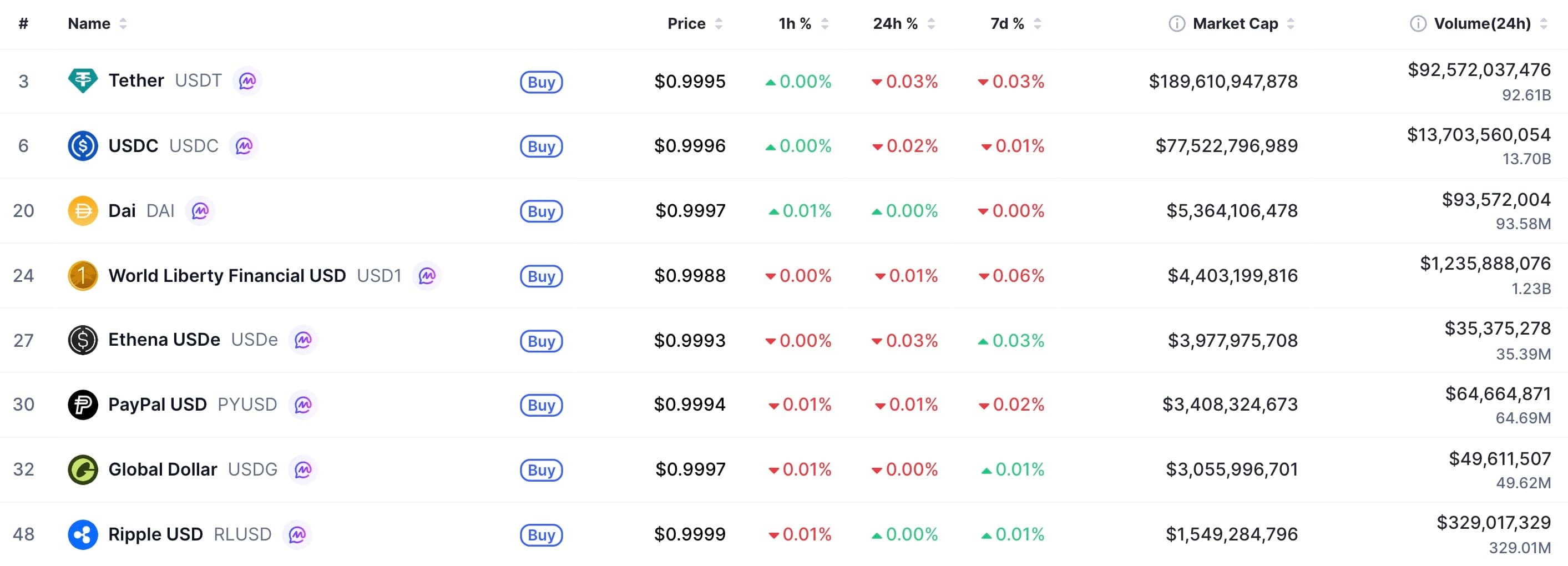
Top USD Stablecoin Tokens by Market Capitalization, Source: CoinMarketCap
The biggest hit came to GAAP net income, which collapsed 59% compared to the previous quarter, falling to a modest $55 million. Adjusted EBITDA also showed a sequential decline of 10%, indicating that Circle's operational efficiency is deteriorating amid intense competitive pressure.
Even earnings per share (EPS) of $0.21, which formally beat the consensus estimate, still failed to reach the targets of the optimistic scenario.
Circle forces AI and token pivot to counter rivals
The situation is becoming even more complicated for Circle because of PayPal USD (PYUSD). In spring 2026, PYUSD's market capitalization surpassed $4.1 billion amid PayPal's large-scale expansion, which brought its stablecoin to 70 international markets and integrated it into institutional funds such as State Street's SWEEP.
PayPal's existing infrastructure of hundreds of millions of users deprives USDC of one of its key advantages in the sphere of real-world payments and cross-border transfers.
Against the backdrop of slowing growth in its core business, Circle is attempting to deploy a defensive strategy through the creation of a new ecosystem, raising $222 million during the ARC Token presale led by a16z with BlackRock, giving the project a fully diluted valuation (FDV) of $3 billion.
ARC. Made in America. Made by a NYSE-listed American public company.
Welcome to 2026. We've come a long way.
CLARITY
— Jeremy Allaire - jerallaire.arc (@jerallaire) May 11, 2026
However, the move itself only confirms that defending USDC's position alone against the growing pressure from Ripple and PayPal is becoming increasingly difficult for the company and requires an AI pivot to stay appealing.
Q&A
What was Circle's revenue in Q1 2026?
Circle's revenue in Q1 2026 was $694 million, marking a 20% year-over-year growth.
How does Circle's revenue compare to Wall Street expectations?
Circle's revenue of $694 million was below Wall Street's expectations of at least $720 million.
What competition is Circle facing in the stablecoin market?
Circle is facing increased competition from Ripple's RLUSD and PayPal's PYUSD, which are capturing larger market shares.