Circle unveils USDC Bridge for native cross-chain stablecoin transfers

TL;DR
Circle has launched the USDC Bridge, allowing native transfers of USDC across 17 blockchains without wrapped tokens. The bridge features a burn-and-mint mechanism, automatic gas fee handling, and live transfer updates.
Key points
- Circle launched USDC Bridge for stablecoin transfers
- Supports native transfers across 17 blockchains
- Uses burn-and-mint mechanism for transactions
- Automatic handling of gas fees
- Live status updates during transfers
Mentioned in this story
Circle
Stablecoin issuer Circle has launched USDC Bridge, enabling users to transfer USDC natively between at least 17 blockchains without needing to rely on wrapped or synthetic tokens.
On Friday, Circle’s USDC X account said the bridge allows users to move the USDC (USDC) stablecoin in a “predictable, transparent way,” citing a native burn-and-mint transfer mechanism and no bridge complexities.
Gas fees will be handled automatically, fees will be shown upfront, and live status updates will be provided throughout the transfer, Circle added.
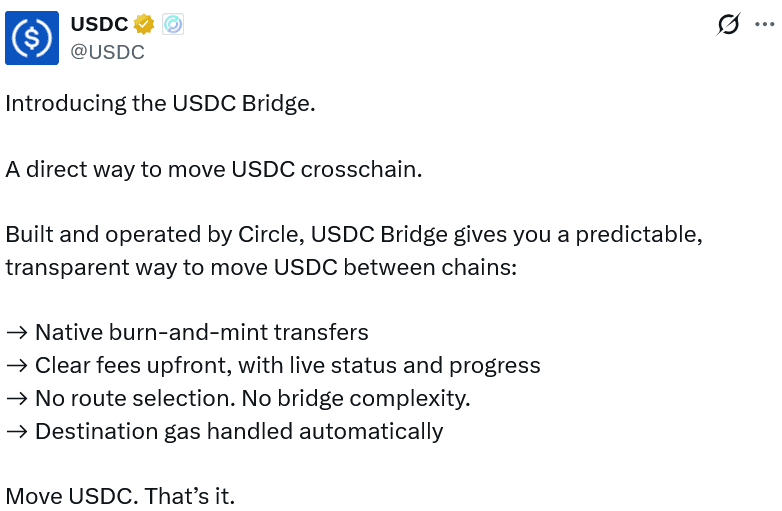
Source: Circle
The USDC Bridge builds on Circle’s Cross-Chain Transfer Protocol (CCTP), which was introduced in April 2023 and facilitates hundreds of millions of stablecoin transfers each day.
Cross-chain bridges seek to make the broader crypto ecosystem interoperable, functioning as a unified network rather than a collection of fragmented, isolated blockchains.
Making bridges as simple and easy to use as possible has been an area of focus for many crypto infrastructure firms.
In the past, bridges have confused users and arguably slowed crypto adoption, especially for beginners struggling to navigate bridge interfaces, trade routes and gas fees.
USDC Bridge supports over a dozen blockchains
Cointelegraph found that USDC Bridge supports USDC transfers between at least 17 Ethereum Virtual Machine-compatible blockchains, including Ethereum, Avalanche, Arbitrum, Base, Monad, Optimism, Polygon, Sonic and World Network.
Q&A
What is the USDC Bridge launched by Circle?
The USDC Bridge is a new feature that enables users to transfer USDC natively between at least 17 blockchains without relying on wrapped or synthetic tokens.
How does the USDC Bridge handle gas fees?
Gas fees for transfers using the USDC Bridge are handled automatically, with fees displayed upfront for users.
What mechanism does the USDC Bridge use for transfers?
The USDC Bridge utilizes a burn-and-mint transfer mechanism to facilitate predictable and transparent transactions.