
Crypto's Long-Sought 'De Minimis' Tax Break Gets a House Markup This Week

TL;DR
House lawmakers will review the Digital Asset Tax Certainty Act this week, aiming to exempt certain crypto transaction fees from capital-gains taxes. Proposed changes include new federal tax rules for stablecoins, staking, and mining, with exemptions starting in 2028.
Key points
- House lawmakers will consider the Digital Asset Tax Certainty Act
- The bill covers transaction fees, stablecoins, staking, and mining
- Proposed exemptions for small fees would begin in 2028
In brief
- House lawmakers will consider the Digital Asset Tax Certainty Act on Wednesday.
- The bill covers transaction fees, stablecoins, staking, mining, lending, and wash sales.
- Proposed exemptions for small fees and simplified accounting would begin in 2028.
The House Ways and Means Committee will consider legislation Wednesday that would exempt some crypto transaction fees from capital-gains calculations and apply new federal tax rules to stablecoins, staking, mining and digital asset trading.
Committee Chairman Jason Smith, R-Mo., introduced the 114-page Digital Asset Tax Certainty Act, or H.R. 10357. The committee has scheduled its markup for 10 a.m. Eastern on Sept. 16.
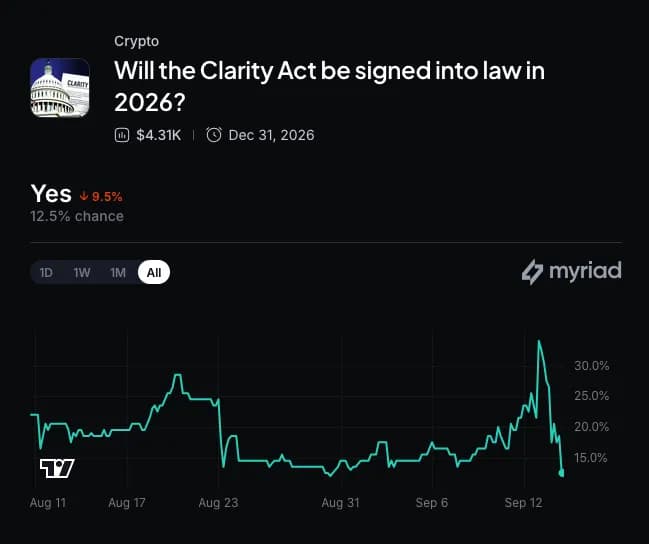
Myriad: Will Congress pass the Clarity Act? Click to make your prediction.
During a markup, committee members debate a bill, propose amendments, and decide whether to advance it to the full House.
The legislation would create a “de minimis” exemption for qualifying network or transaction fees of $10 or less. De minimis refers to an amount considered too small to require standard tax treatment.
Paying a blockchain fee with crypto can create a taxable event because the IRS treats digital assets as property. The exemption would allow taxpayers to disregard gains or losses on eligible fees.
Lawmakers examined small-transaction exemptions and six other crypto tax proposals during a June hearing on digital asset taxation.
The bill would use the redemption value of qualifying dollar-pegged stablecoins as their tax basis when purchased near that value, tax mining and staking rewards as ordinary income, and allow certain investment trusts to stake assets without jeopardizing their tax status.
Q&A
What is the Digital Asset Tax Certainty Act?
The Digital Asset Tax Certainty Act is a proposed legislation that aims to exempt certain crypto transaction fees from capital-gains calculations and introduce new tax rules for digital assets.
When will the House markup for the crypto tax bill take place?
The House markup for the Digital Asset Tax Certainty Act is scheduled for 10 a.m. Eastern on September 16.
What exemptions does the Digital Asset Tax Certainty Act propose?
The act proposes exemptions for small transaction fees and aims to simplify accounting for crypto activities, with changes expected to take effect in 2028.