Ethereum's price is stabilizing after a rebound from the $1.8K support zone, but faces resistance near $2.4K. A breakout above this level could indicate a bullish trend.
Key points
Ethereum is stabilizing after a rebound from $1.8K
The $2.4K level is a key resistance for ETH
A breakout above $2.4K could lead to a bullish trend
Ethereum’s price action has transitioned into a stabilization phase after a strong reaction to this key demand zone shifted short-term sentiment. However, despite this rebound, the broader structure still reflects a market attempting to regain momentum while facing notable resistance overhead.
Ethereum Price Analysis: The Daily Chart
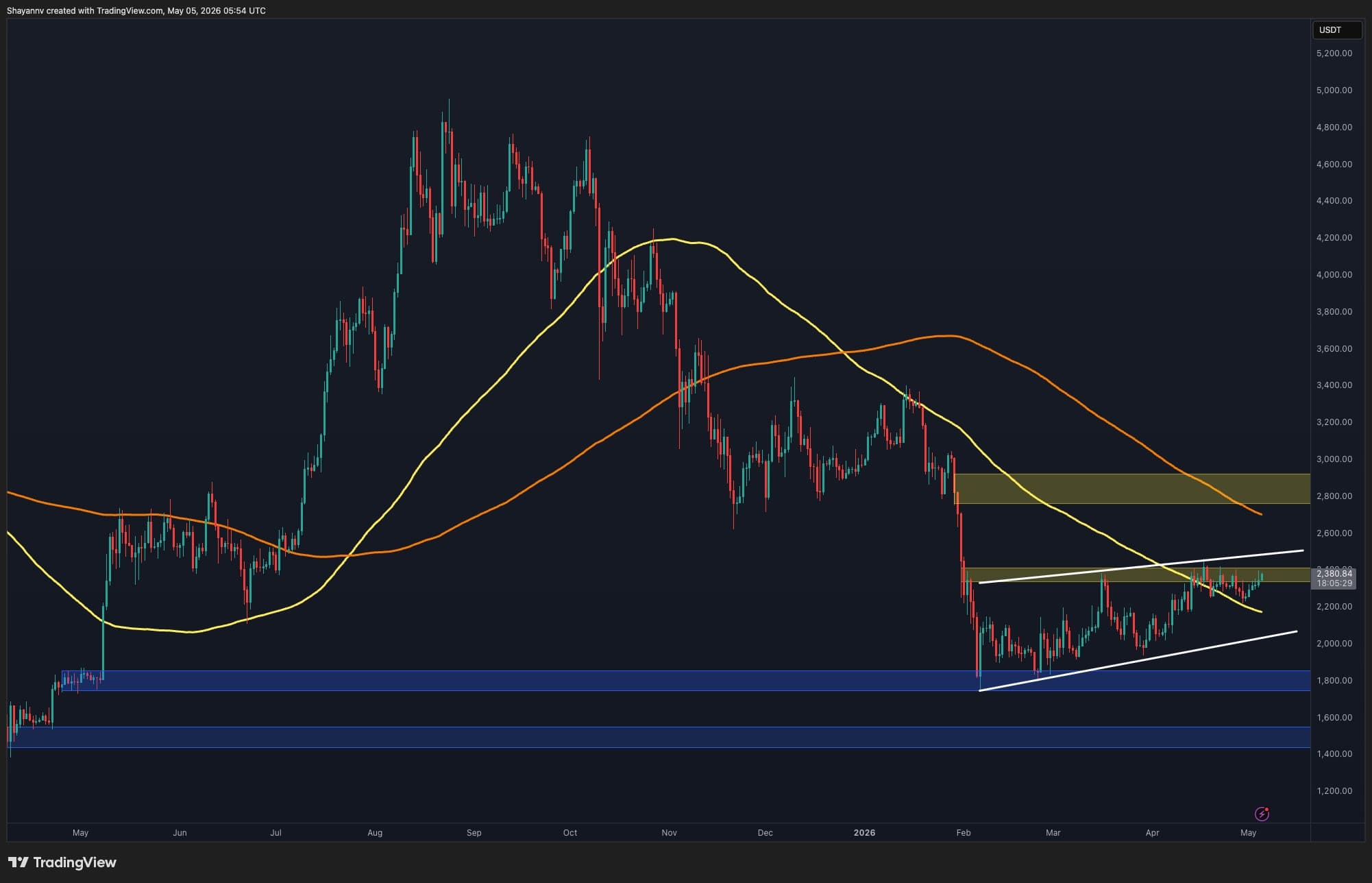
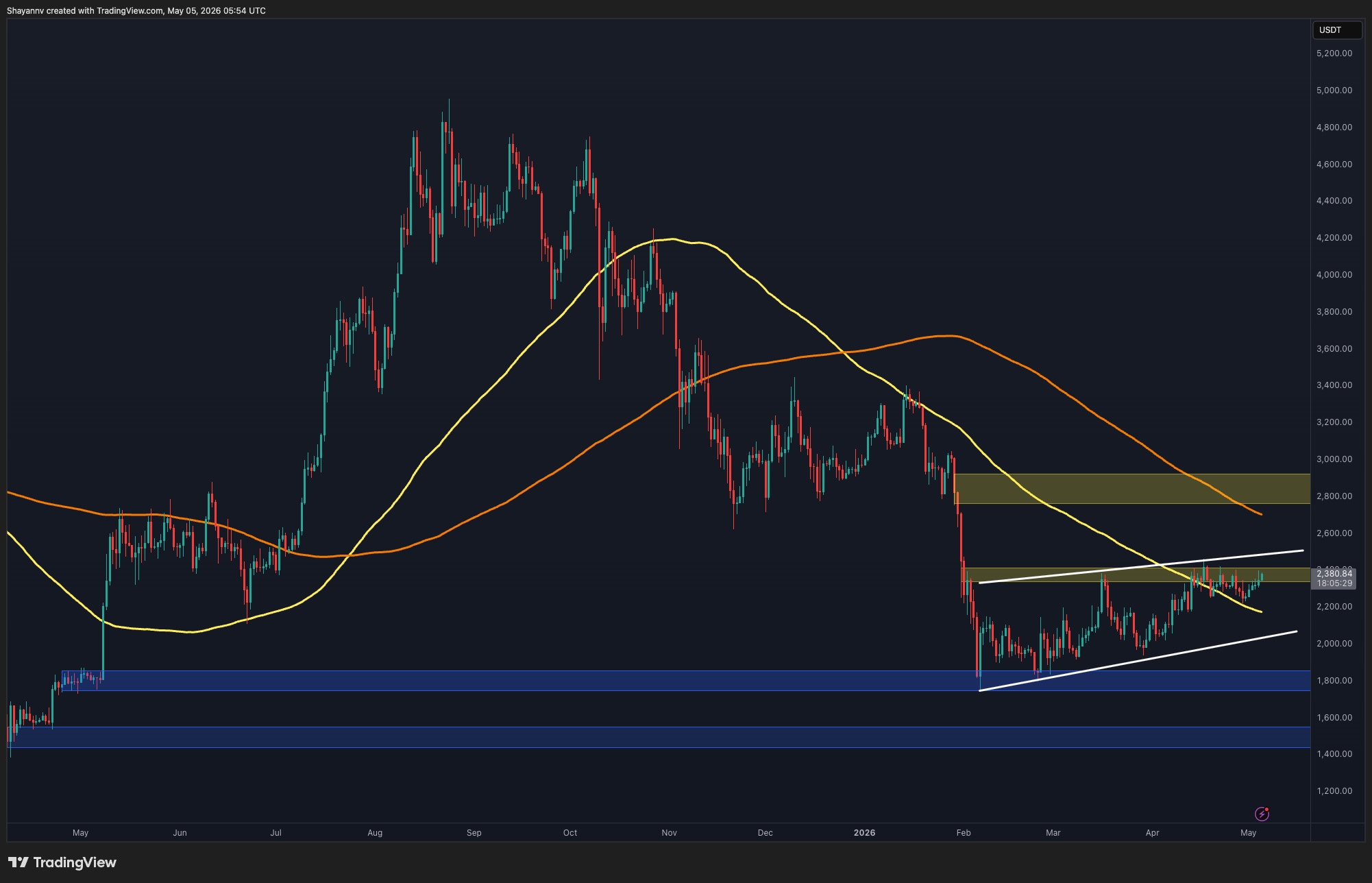
On the daily timeframe, ETH is clearly consolidating after establishing support at the critical $1.8K zone. This level has once again proven its significance, acting as a base for the current recovery phase. Since then, the price has been gradually pushing higher, but the upside remains capped by a confluence of resistance, including the upper boundary of the rising wedge structure and the key $2.4K supply zone.
This overlapping resistance area is currently limiting bullish continuation and forcing the market into a consolidation range. As long as Ethereum remains below this region, it is likely to continue fluctuating within a tightening structure. A decisive breakout above the $2.4K level and the wedge resistance would signal a shift in momentum and could trigger a fresh bullish leg toward higher price levels.
ETH/USDT 4-Hour Chart
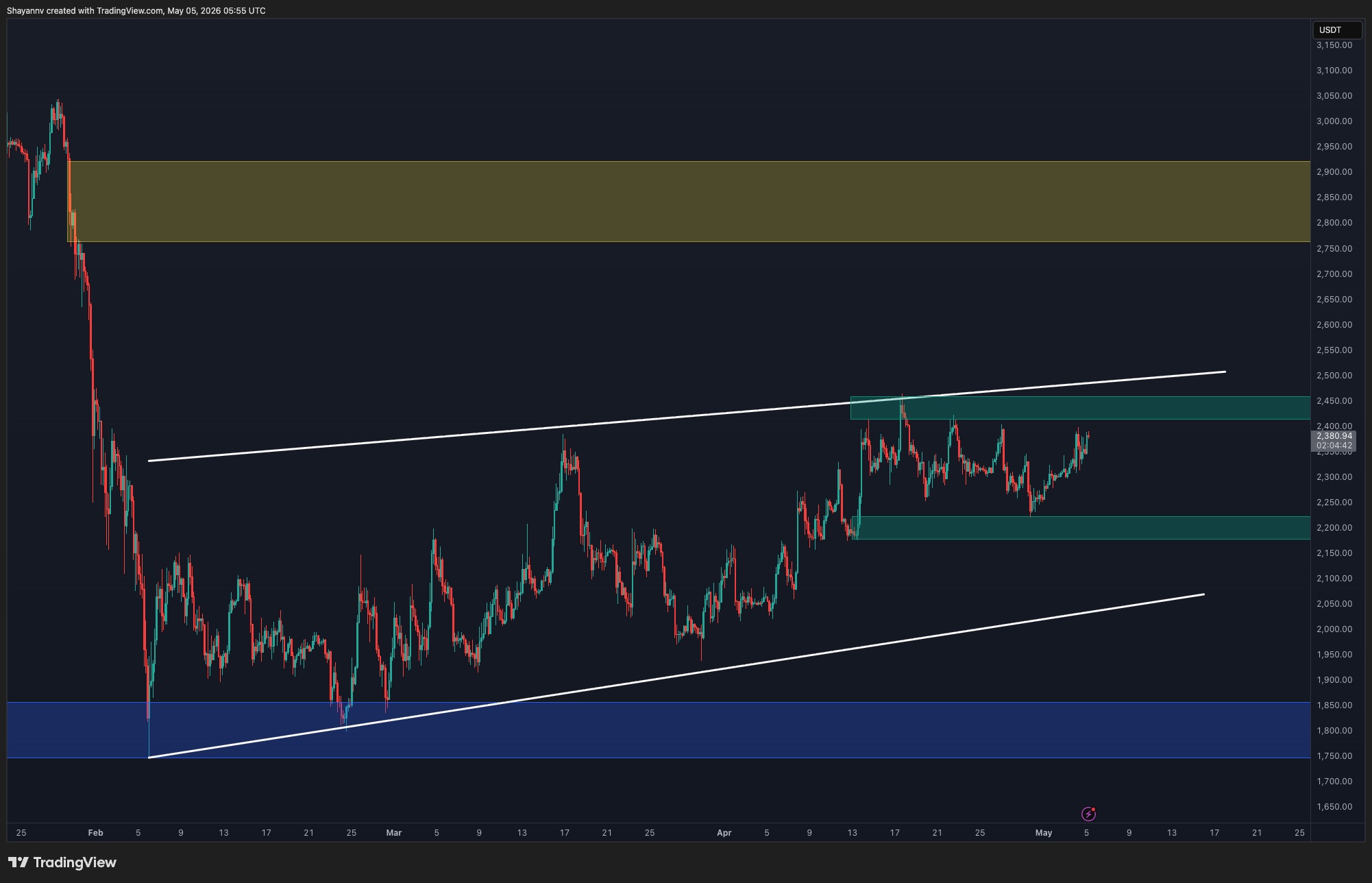
On the 4-hour chart, the price action is more compressed, forming a well-defined short-term range between the highlighted green support and resistance zones. ETH is currently oscillating within this narrow band, reflecting indecision among market participants. A breakout above the upper boundary of this range at $2.4K would likely lead to a continuation move toward the higher resistance cluster around the wedge’s upper boundary.
Conversely, a breakdown below the lower boundary could invalidate the short-term bullish structure and expose the market to another corrective move, potentially revisiting lower support levels. This local range effectively acts as a decision zone, where the next breakout will determine the short-term direction.
Q&A
What is the significance of the $1.8K support level for Ethereum?
The $1.8K support level is crucial as it has proven to be a base for Ethereum's current recovery phase.
What resistance levels is Ethereum facing currently?
Ethereum is facing notable resistance at the $2.4K supply zone and the upper boundary of a rising wedge structure.
What could trigger a bullish trend for Ethereum's price?
A decisive breakout above the $2.4K level and the wedge resistance could signal a shift in momentum towards a bullish trend.
Argentina Launched an AI to Predict the Future. It Couldn't Predict a Typo
Argentina launched the 'Digital Twin' initiative to simulate social policy impacts using AI, but its promotional video was mocked for grammatical errors. Privacy experts raised concerns about governance and potential surveillance issues.
See every story in Crypto — including breaking news and analysis.
Sentiment Analysis
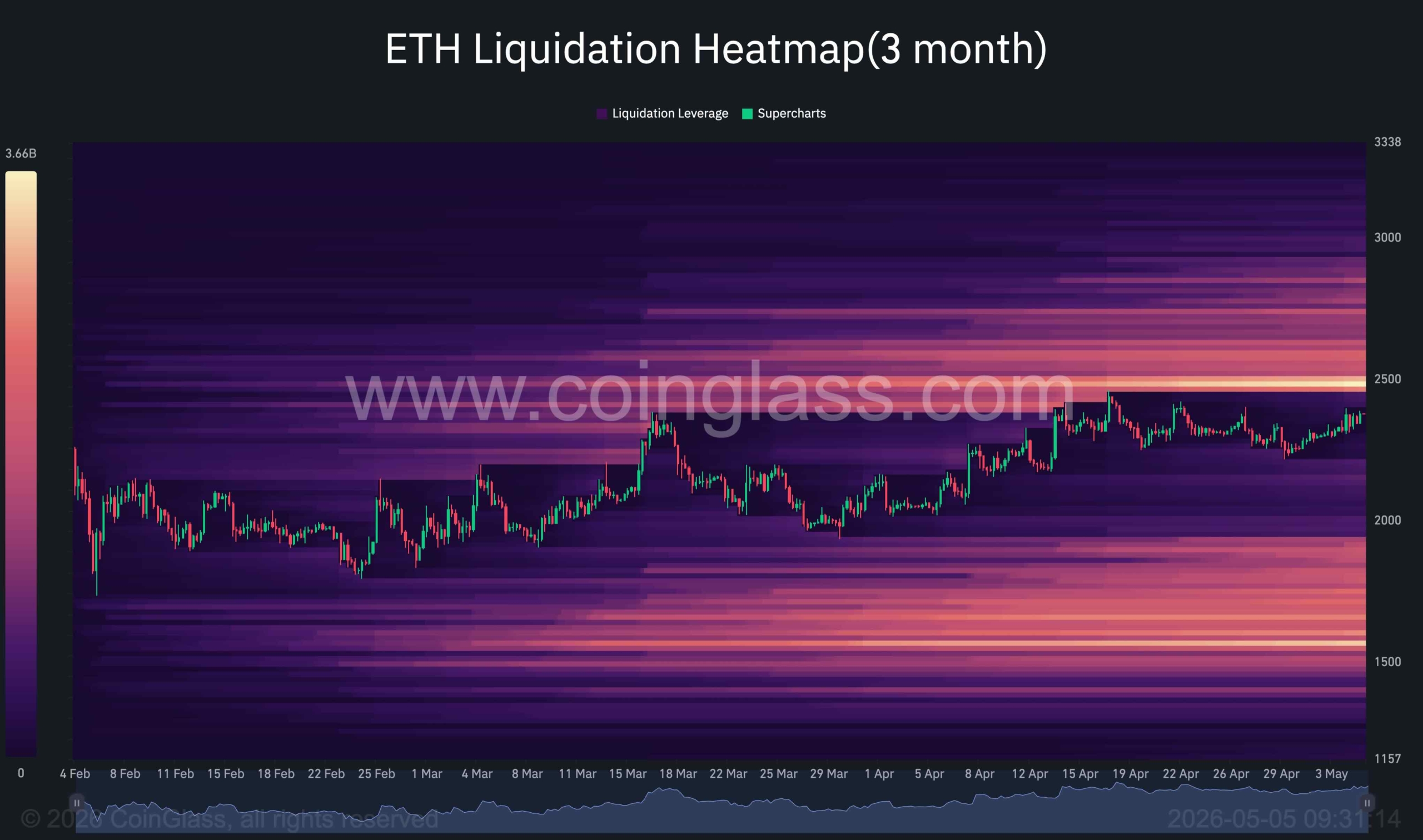
From a liquidity perspective, the heatmap reveals two major liquidity clusters that are likely to influence upcoming price movements. A significant concentration of liquidity is positioned above the current price around the $2.5K region, making it an attractive target for a potential short squeeze. At the same time, another notable liquidity pool exists below the $2K threshold, which could act as a magnet in the event of renewed bearish pressure.
This dual-sided liquidity structure suggests that Ethereum may first attempt to move higher toward the $2.5K region to capture upside liquidity before potentially reversing and targeting the lower liquidity zone near $2K. Such behavior would align with typical market dynamics, where the price seeks to exploit both sides of the order book before establishing a sustained trend.
Overall, Ethereum remains in a consolidation phase within a broader recovery structure, but the presence of strong overhead resistance and balanced liquidity distribution suggests that volatility expansion is approaching. The interaction between the $2.4K resistance, the short-term range boundaries, and the liquidity clusters will likely define the next significant move.