
Ethereum Price Analysis: Is ETH Finally Attempting a Real Breakout?
TL;DR
Ethereum is currently trading above $2.2k but faces resistance at $2.4k. More consolidation is expected as long positions have been unwound and a close below $2k could indicate significant structural damage.
Key points
- Ethereum is trading above $2.2k.
- Resistance at $2.4k has rejected ETH multiple times.
- A close below $2k could cause structural damage.
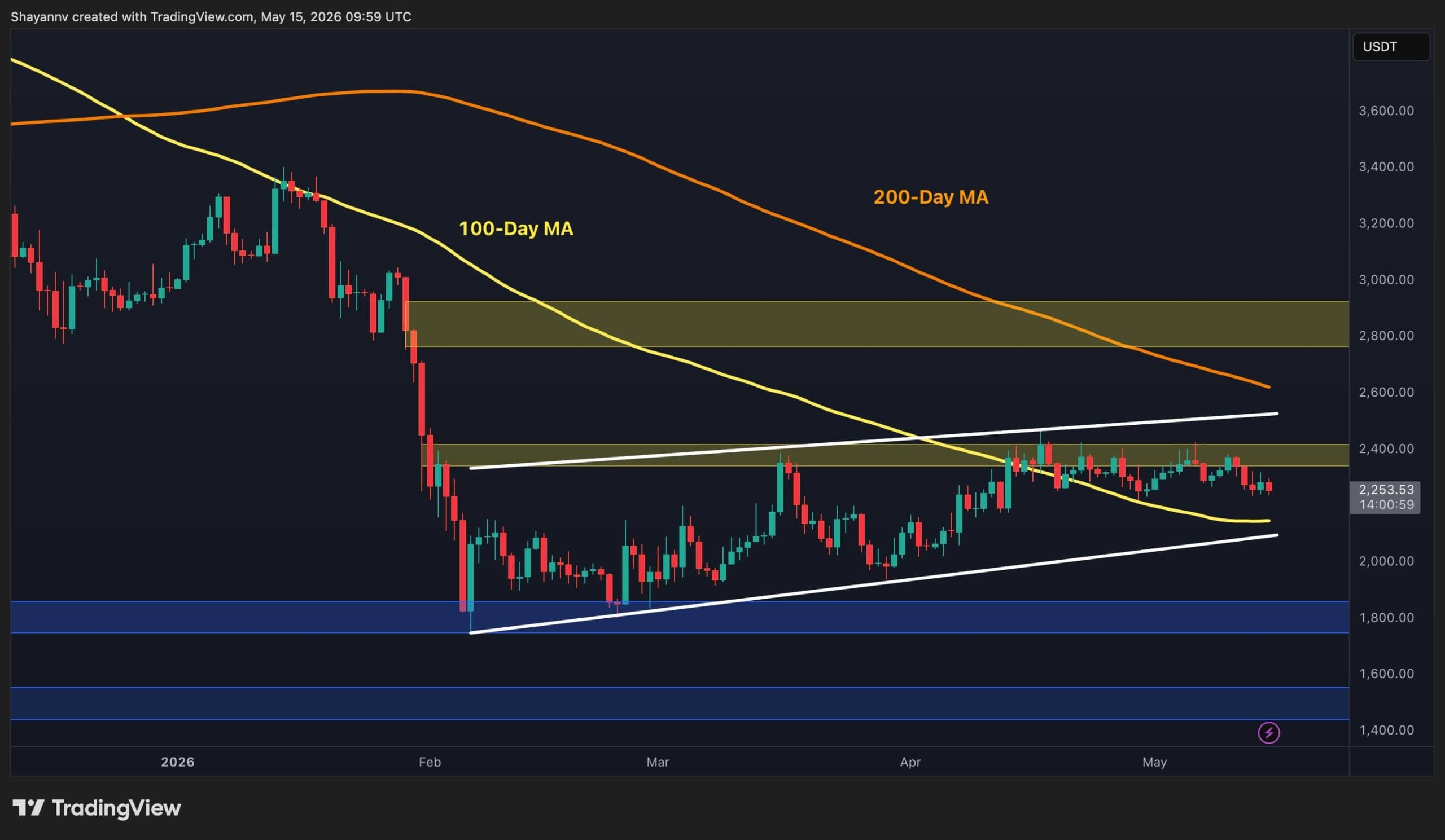
- The 100-day moving average is around $2.15k.
- The 200-day moving average is at approximately $2.6k.
Ethereum is trading above $2.2k as the third week of May gets underway. The asset is on the lower end of its range over the past two weeks after another rejection. The aggressive long positioning that had built up into the $2.4k resistance zone has been unwound, and the price chart indicates that more consolidation is likely to happen in the coming days.
Ethereum Price Analysis: The Daily Chart
On the daily chart, ETH is still trading above the 100-day moving average (~$2.15k), which is currently the only positive sign on this timeframe. The mildly ascending channel from the February low also remains technically intact, and its lower boundary is rising toward $2.1k and will act as another dynamic support level.
The $2.4k supply zone has now rejected ETH several times without a single sustained close above it. The 200-day moving average (~$2.6k) is the next ceiling above the horizontal level and the higher boundary of the channel.
To rebuild the case for a recovery, ETH needs to first stabilize above the $2.4k resistance level and then reclaim the 200-day moving average, but neither of these moves looks straightforward given current momentum. On the downside, a close below $2k would be the massive structural damage that the buyers would have to prevent from happening.
ETH/USDT 4-Hour Chart
The pink descending wedge that had been compressing the price since the mid-April high is resolving to the downside, as the lower boundary near $2.26k is getting broken. The asset is now sitting just above the $2.2k support zone that has held on during recent weeks. The RSI on this timeframe is hovering in the 40–45 range, soft but not yet at the oversold levels that could trigger a bounce from this support band.
The $2.2k zone is the critical level to watch over the next few days. A successful rebound here would keep the short-term bullish structure alive and set up another attempt at reclaiming the $2.4k zone. However, a confirmed break below $2.2k opens the door toward the $2k-$2.1k support zone and the daily channel’s lower boundary as the last meaningful lines of defense before $1.8k.
Q&A
What is the current price of Ethereum?
Ethereum is currently trading above $2.2k.
What resistance level is Ethereum struggling to break?
Ethereum is struggling to break the $2.4k resistance level.
What happens if Ethereum closes below $2k?
A close below $2k could indicate significant structural damage for Ethereum.
What is the significance of the 200-day moving average for Ethereum?
The 200-day moving average, around $2.6k, serves as a key resistance level that Ethereum needs to reclaim for a potential recovery.