
XRP Analyst Reveals The Question No One Asks And Why It’s Important
XRP Analyst Raises Key Question About Demand in Global Settlement System
NewsBTC1 min read
Ethereum is currently testing the critical $2.3k support level amid market tension. A breakthrough above $2.4k is needed for a bullish confirmation.
There is a growing tension in Ethereum’s market structure that is worth addressing directly. On-chain, the supply picture is arguably the most constructive it has been in a while. On the chart, however, ETH is still struggling to clear a resistance zone it has now tested four times in six weeks. The resolution of that tension, one way or the other, is likely coming soon.
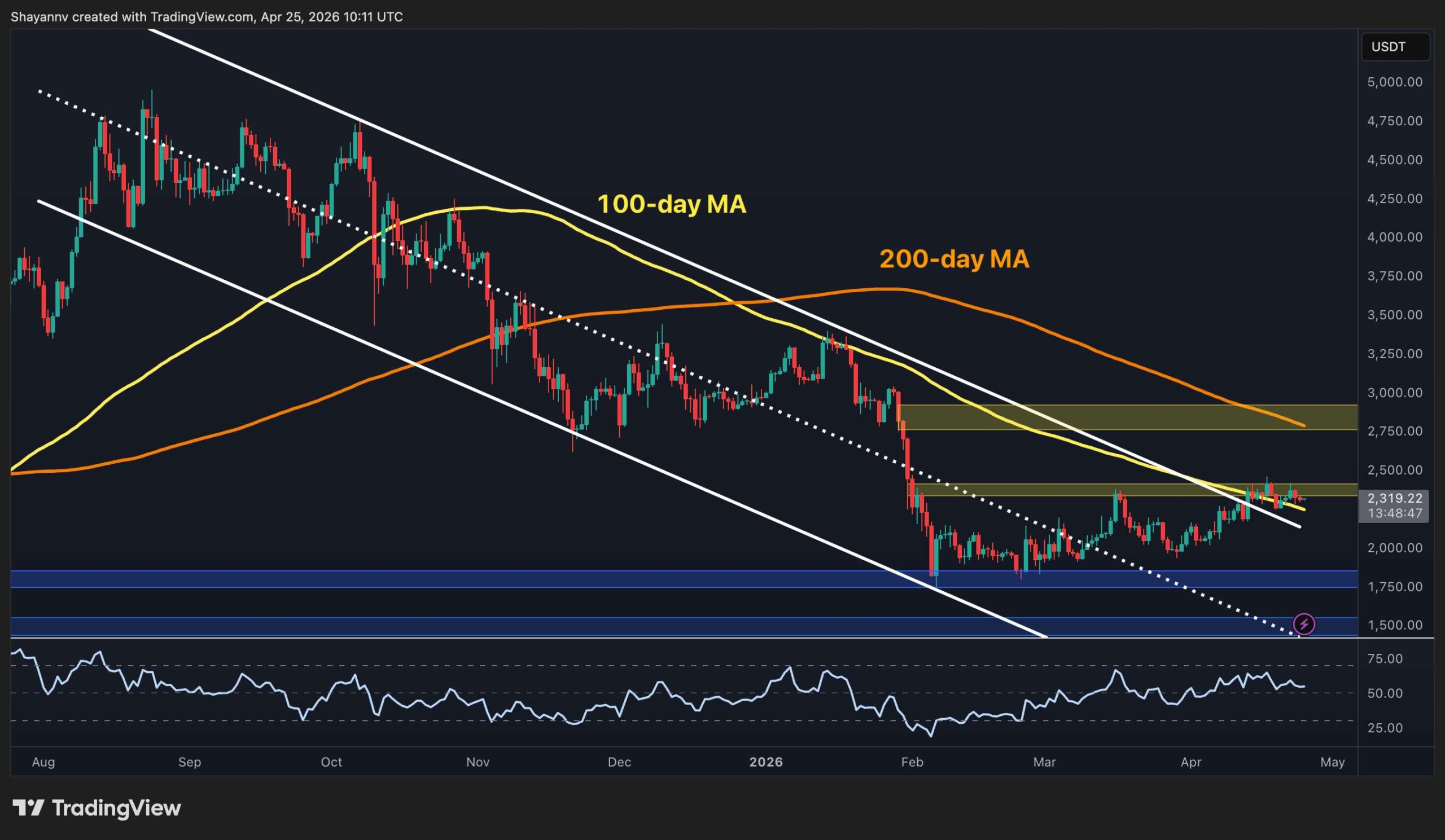
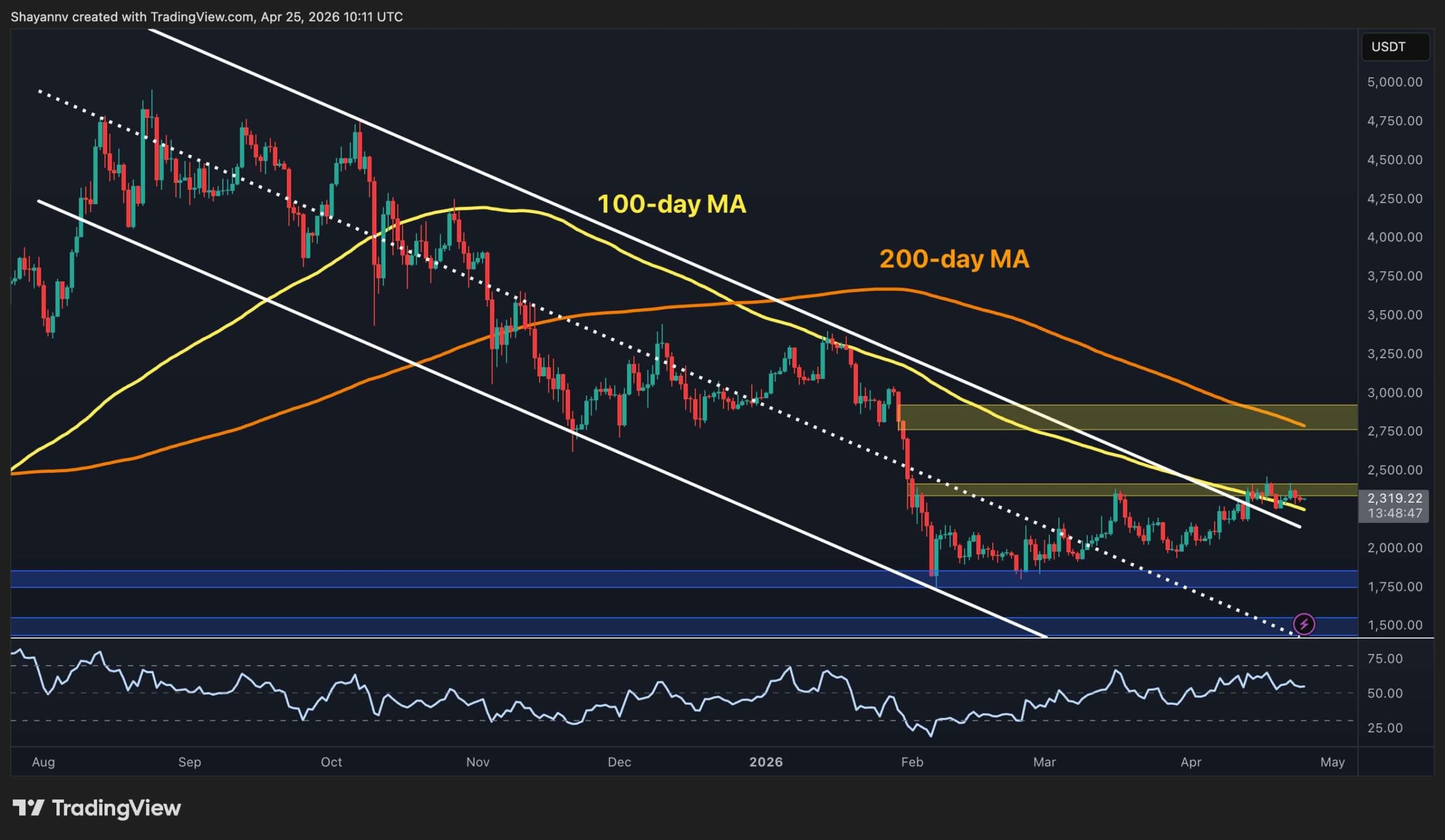
On the daily chart, the story is familiar. ETH is at $2.3k, the descending channel’s upper boundary has been broken, and the price is struggling with the 100-day MA, which is located just below the key $2.4k resistance zone. The 200-day MA (~$2.8k) sits as a distant but important ceiling above this area, and near the $2.8k supply zone.
What has quietly changed, though, is the RSI. It has been holding in the mid-to-high 50s for nearly two weeks now without the kind of sharp rollover that characterized the previous failed breakout attempt back in March.
This sustained momentum reading, modest as it is, suggests the selling pressure at this level is gradually being absorbed rather than immediately overwhelming buyers. Yet, the daily structure will not be confirmed as bullish until ETH closes above $2.4k and defends it on a retest.
The 4-hour chart shows a sharper ascending trendline that has been guiding price since the late-March lows, now providing support near $2.3k. ETH is sitting directly on that trendline at the moment, having pulled back from the recent rejections at $2.4k. These rejections were accompanied by a bearish RSI divergence visible on the chart, where the price made a marginally higher high while RSI printed lower.
That divergence has now largely played out with the pullback to the trendline, and the RSI has cooled to the low-to-mid 40s. The setup is a binary one, as holding the trendline here keeps the sequence of higher lows intact and sets up another attempt at $2.4k, while losing it on a close basis puts the $2k psychological support level in play. In case that level also fails, a rapid decline toward the $1.8k base would be highly probable.
If Ethereum drops below $2.3k, it may indicate increased selling pressure and could lead to further declines.
The $2.4k resistance is crucial for Ethereum as a close above this level could confirm a bullish trend.
The RSI's sustained momentum in the mid-to-high 50s suggests that selling pressure is being absorbed, which may influence future price movements.
XRP Analyst Raises Key Question About Demand in Global Settlement System

Revolut's app showed Bitcoin at just 2 cents due to a pricing glitch. Issue now resolved.

A hacker exploits TrustedVolumes, draining $5.9 million in crypto funds.

Trump Media's Q1 loss widens to $406 million, heavily impacted by crypto markdowns.

Australian police seize $4.2 million in Bitcoin during raids on darknet marketplace operators.

Bitcoin miners have withdrawn 3,400 BTC as prices rise; could this impact recovery?
See every story in Crypto — including breaking news and analysis.
The Ethereum Exchange Netflow chart tells an unexpectedly bullish story beneath the surface of choppy price action. Since late January, the dominant pattern has been persistent net outflows from exchanges. Red bars on the chart indicate more ETH leaving exchanges than entering, with only occasional brief spikes of inflows.
What is particularly striking is the acceleration in net outflows through April. Despite ETH failing to break above $2.4k, holders are continuing to withdraw ETH from exchanges at an elevated pace. This behavior points to conviction accumulation rather than opportunistic profit-taking.
Combined with exchange reserves at multi-year lows, the netflow data paints a picture of a market where the available supply for immediate sale is shrinking steadily, even as price has yet to reflect it. That kind of supply compression, historically, does not stay invisible to the price forever.
