Hyperliquid (HYPE) Nears All-Time High, Shiba Inu (SHIB) Faces Strong Downside Volume, Toncoin (TON) Returns to $2: Crypto Market Review
Hyperliquid (HYPE) approaches all-time high as SHIB struggles with downside volume.
U.Today1 min read

Iran's government has designated Bitcoin as a payment method for oil tolls in the Strait of Hormuz, emphasizing its strategic value. However, US dollar-pegged stablecoins remain the dominant currency for Iran's crypto transactions.
Mentioned in this story
Iran’s government naming Bitcoin (BTC) as a payment method for oil ships crossing the Strait of Hormuz highlights its role as a neutral, strategic asset, according to Sam Lyman, head of research at digital asset advocacy organization Bitcoin Policy Institute (BPI).
The government selected BTC as one of the payment methods for the tolls because of its censorship-resistant qualities, Lyman told Cointelegraph. He said:
“This is one of the most significant situations where Bitcoin is very clearly a strategic asset. The reason why Iran wants to use Bitcoin for these transactions is that no one can freeze Bitcoin. No one can shut down the Bitcoin network.”
Iran is accepting oil tolls in Chinese yuan, US dollar-pegged stablecoins and BTC. However, there is “no onchain evidence” of a BTC toll payment so far, Lyman said, adding that the “majority” of Iran’s crypto transactions are denominated in US dollar stablecoins.
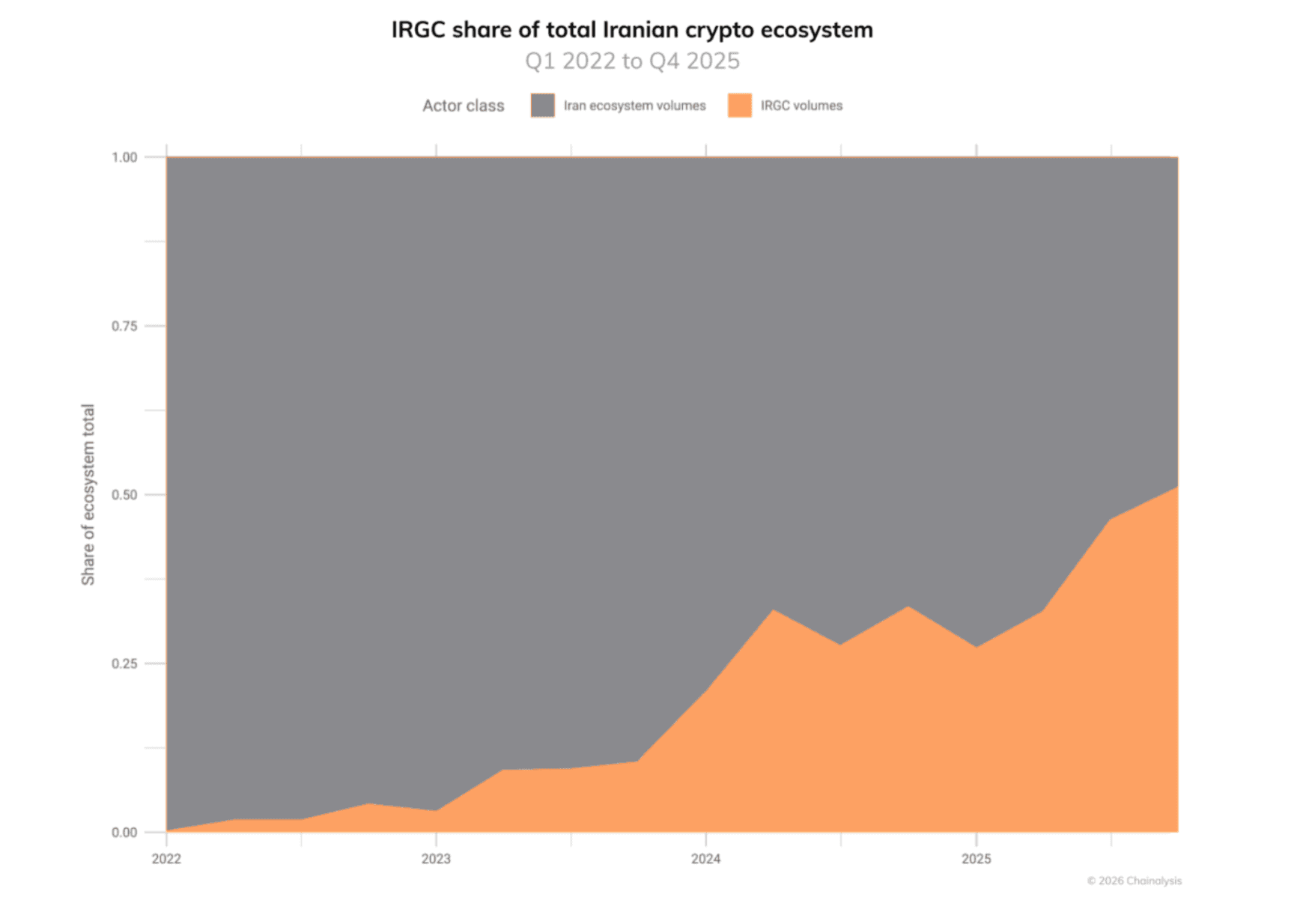
Transactions carried out by the Iranian Revolutionary Guard Corps account for nearly half of the total crypto market volume in Iran. Source: BPI
The announcement from the Iranian government highlights why US lawmakers should recognize and treat Bitcoin as a strategic asset, rather than taking a hostile regulatory stance toward it or dismissing digital assets altogether, Lyman told Cointelegraph.
Related: Bitcoin community weighs in on reports of Iran’s crypto toll for oil ships
Iran is using Bitcoin for oil tolls due to its censorship-resistant qualities and the inability to freeze Bitcoin transactions.
Iran is accepting oil tolls in Chinese yuan, US dollar-pegged stablecoins, and Bitcoin.
Currently, there is no on-chain evidence of Bitcoin being used for oil toll payments in Iran.
Hyperliquid (HYPE) approaches all-time high as SHIB struggles with downside volume.

Bitcoin shows resilience despite bearish pressure below $78,800, with $77,000 as a key support level.
Over $469 billion in Bitcoin is vulnerable to quantum attacks, with 30% exposed.

Ethereum Dev Dankrad Feist proposes a $1 billion ETH organization amid Foundation turmoil.

XRP whale dominance returns to Binance while Coinbase shows a different trend.

Spotify and Universal Music Group introduce AI remix tool for fan-made covers.
See every story in Crypto — including breaking news and analysis.
“Iran has had a digital asset strategy for several years, going back to about 2018, and the majority of transactions that take place there are with USDt,” (USDT), Lyman said. USDt is a dollar-pegged stablecoin issued by the company Tether.
The Iranian government is using stablecoins, despite the ability of stablecoin issuers to freeze wallets, he said. “I think they're rolling the dice,” Lyman told Cointelegraph.
He said that the Iranian government has been able to shift about $3 billion in cryptocurrencies since 2022, with the “majority” of that value denominated in stablecoins.
However, the US Treasury Department was only able to freeze about $600 million in assets, according to Lyman.
“They were able to move $3 billion, and only have $600 million frozen. They were still able to move about $2.4 billion. So, I think that's why stablecoins are still a go-to for the regime,” he said.