Analyst Says Don’t Buy Bitcoin Until This Happens
Crypto analyst Gargoyle advises waiting to buy Bitcoin until high volume signals a bottom.

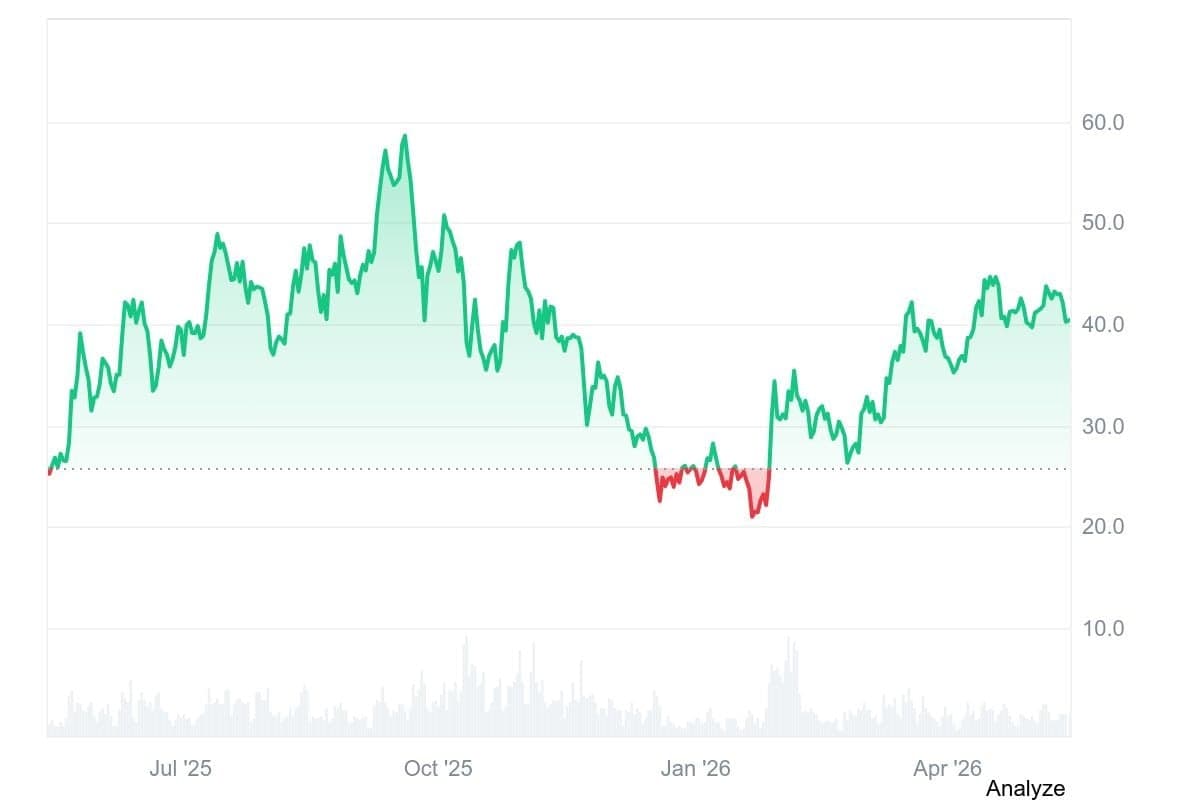
Hyperliquid (HYPE) is a decentralized layer-1 blockchain with a native DEX for perpetual futures, reaching a peak price of over $59 in September 2025. The platform dominates over 70% of on-chain derivatives volume and has seen significant institutional interest, including Ripple's integration and Grayscale's proposed ETF.
Mentioned in this story
Hyperliquid is a high-performance, decentralized layer-1 blockchain with a native DEX for perpetual futures, launched in 2023. The native HYPE token is backed by aggressive revenue-fed buybacks – already hundreds of millions deep. It hit a peak price of over $59 in September 2025 and is known for its high-speed on-chain order book. As of May 2026, the ecosystem supports over $3 billion in TVL. At this point, Hyperliquid dominates over 70% of on-chain derivatives volume across the whole crypto market, regularly clearing $13-15 billion daily and pushing up to $4 million in protocol earnings every 24 hours. In short, Hyperliquid traders low fees, fast transactions, and advanced trading tools like perpetual derivatives.
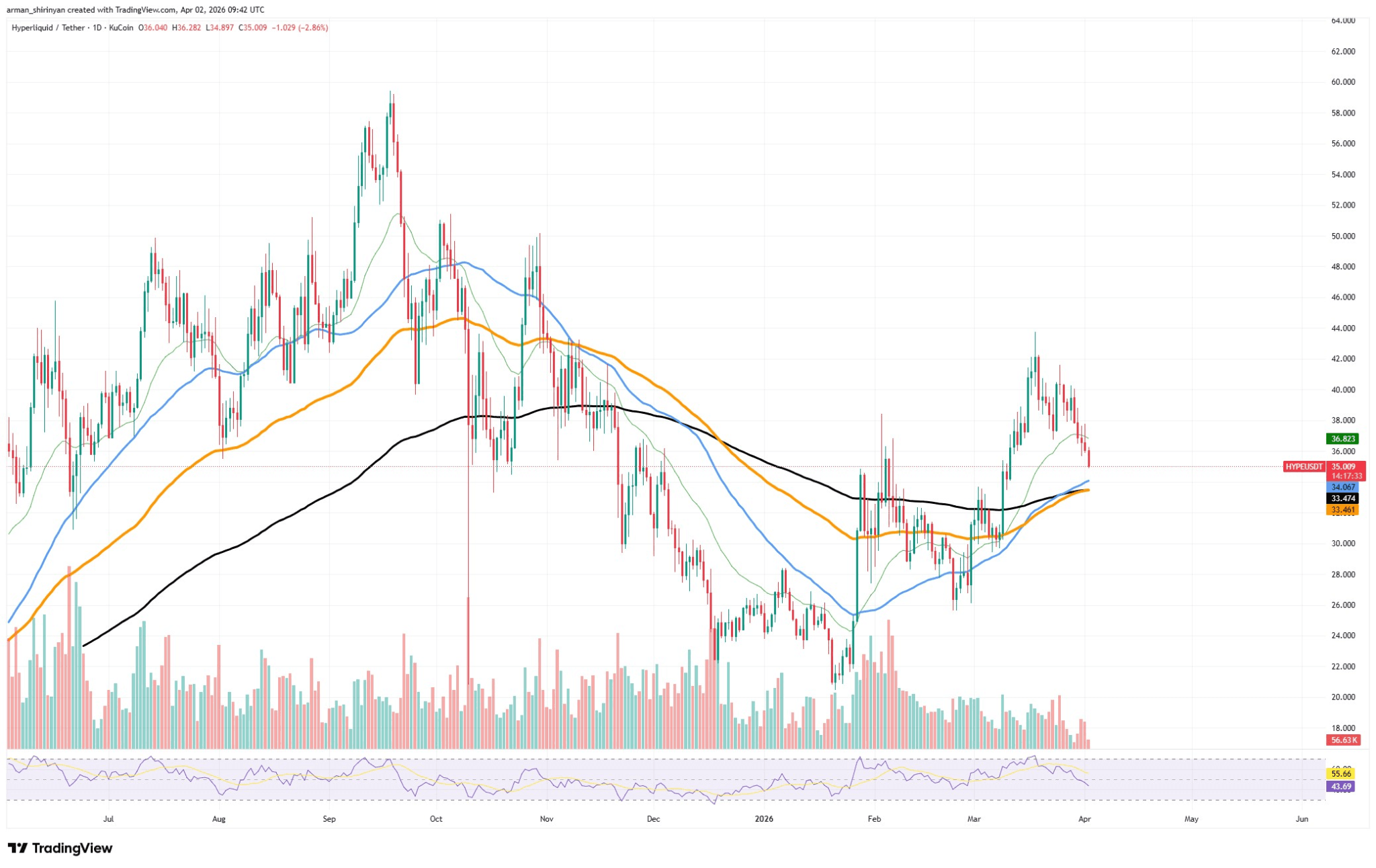
Hyperliquid continued its strong momentum in March after HYPE rallied past key resistance levels and climbed into the Top 10 largest crypto assets by market capitalization, overtaking Cardano.
The rally was largely fueled by technical breakout conditions and growing derivatives activity, which helped drive the token above the $34 range before establishing support around $40. During the move, HYPE briefly reached a local high near $43.
Hyperliquid is a decentralized layer-1 blockchain with a native DEX for perpetual futures, known for its high-speed on-chain order book and low fees.
The HYPE token reached a peak price of over $59 in September 2025 and established support around $40 after a rally in March 2026.
Ripple's integration with Hyperliquid allows institutional clients to access its on-chain perpetual futures ecosystem, significantly enhancing its institutional positioning.
Grayscale's proposed HYPE ETF aims to provide investors direct exposure to the HYPE token without needing to manage the asset, reflecting growing institutional interest in altcoins.


Crypto analyst Gargoyle advises waiting to buy Bitcoin until high volume signals a bottom.

Bitcoin struggles below $80K, signaling potential bearish correction.

Liberland awards Ethereum co-founder Vitalik Buterin its highest honor at ETH Prague 2026.

Senate Banking Committee advances CLARITY Act, but money laundering concerns loom.

Ripple's CTO David Schwartz joins the XRPL Foundation to enhance leadership.

Solana struggles at $98 resistance; a breakout could mean a 30% rally.
See every story in Crypto — including breaking news and analysis.
Part of the recent attention around Hyperliquid also stems from its expanding institutional positioning following Ripple Prime’s integration with the protocol earlier this year. In February, Ripple integrated Hyperliquid into Ripple Prime, creating a bridge between traditional financial infrastructure and decentralized derivatives markets. The integration gives institutional clients access to Hyperliquid’s on-chain perpetual futures ecosystem, which has reportedly reached up to $5.8 billion in open interest. The setup also enables cross-margining capabilities alongside traditional financial products such as fixed income, foreign exchange, and swaps within a unified trading environment.
Hyperliquid, meet Ripple Prime:
We’re now enabling institutions to access onchain derivatives liquidity through @HyperliquidX in a streamlined and secure way. Customers can also efficiently cross-margin crypto with all asset classes supported by our prime…
— Ripple (@Ripple) February 4, 2026 The partnership is increasingly being viewed as a significant institutional milestone for decentralized finance infrastructure. By integrating institutional access rails into one of crypto’s largest on-chain derivatives venues, Ripple effectively positions itself as a gateway between Wall Street capital and decentralized perpetual futures markets. Supporters of the move argue that it provides institutional investors with exposure to on-chain liquidity and derivatives trading without many of the operational frictions traditionally associated with decentralized finance platforms.
On May 11, 2026, Grayscale Investments filed Amendment No. 2 to its Form S-1 registration statement with the United States Securities and Exchange Commission, formally advancing plans for its proposed Grayscale HYPE ETF. According to the filing, the ETF is designed to provide investors with direct exposure to Hyperliquid’s native HYPE token without requiring them to directly custody or manage the asset themselves. The proposed structure would hold actual HYPE tokens inside the fund, operating similarly to spot Bitcoin and Ethereum ETFs already trading on U.S. markets. The filing comes as competition among issuers seeking exposure to major altcoins continues to intensify, with institutional demand increasingly extending beyond Bitcoin and Ethereum into newer crypto ecosystems. The Grayscale filing follows another major milestone for Hyperliquid-related investment products. On May 12, 21Shares launched the first U.S. spot Hyperliquid ETF, trading under the ticker THYP on Nasdaq. The product reportedly generated around $1.8 million in first-day trading volume and attracted approximately $1.2 million in net inflows. The ETF also launched with a 0.30% management fee, currently the lowest among proposed HYPE ETF products. Market observers described the debut as solid, though more modest compared with the launches of spot Solana and XRP ETFs, both of which reportedly exceeded $50 million in first-day trading volume. Supporters argue that ETF products tied to HYPE could further legitimize the ecosystem among traditional investors by creating regulated market access to the token through familiar financial products.
Hyperliquid recently delivered one of the strongest moves in the crypto market after decisively breaking through a major cluster of moving averages in the $30-$32 range.
That zone had previously acted as dynamic resistance on the daily chart. Once HYPE cleared it, momentum accelerated rapidly as breakout traders, algorithmic buying systems, and stop orders amplified the move higher.
The breakout pushed the asset into the low-$40 range and briefly established HYPE as one of the market’s strongest-performing large-cap crypto assets.