
Could Chainlink (LINK) Triple In 5 Years? Why A $20B Market Cap Is Possible
Is Chainlink (LINK) on track to triple in value and hit a $20B market cap in 5 years?
NewsBTC1 min read

The US Department of Justice has initiated a compensation process for victims of the $4 billion OneCoin Ponzi scheme, offering over $40 million in forfeited assets to those who suffered net losses between 2014 and 2019.
The US Department of Justice has launched a compensation process for victims of the $4 billion crypto Ponzi scheme OneCoin, using forfeited assets taken from some of the scheme's architects.
The Justice Department said on Monday that more than $40 million in forfeited assets is available to compensate anyone who purchased OneCoin between 2014 and 2019 and recorded a net loss.
Jay Clayton, the US Attorney for Manhattan, said the compensation process was “an important step toward returning funds to those harmed.”
OneCoin was launched in 2014 with the goal of surpassing Bitcoin (BTC), and despite rising to become the second-largest cryptocurrency by market capitalization, it later collapsed as users discovered the coins had no utility, and authorities worldwide started investigations into the operation.
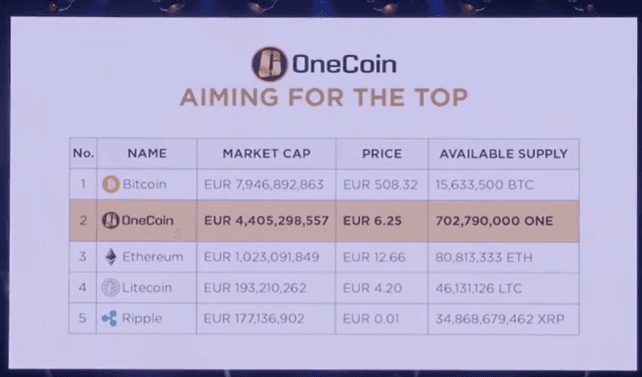
Before it collapsed, OneCoin rose to become the second-largest cryptocurrency by market capitalization. Source: YouTube
“Between 2014 and 2019, OneCoin’s founders sold a lie disguised as cryptocurrency, costing victims more than $4 billion worldwide,” Clayton said. “While no recovery can fully undo the damage, our Office will continue working to seize criminal proceeds and prioritize getting money back into the hands of victims.”
OneCoin was launched by Ruja Ignatova and Karl Sebastian Greenwood in Bulgaria and began operating in the United States around 2015.
The Justice Department estimates that between 2014 and the end of 2016, the scheme stole more than $4 billion from around 3.5 million victims. However, some estimates for worldwide losses reach $19 billion.
Victims of OneCoin can apply for compensation through the process announced by the US Department of Justice, which utilizes forfeited assets.
More than $40 million in forfeited assets is available to compensate OneCoin fraud victims.
OneCoin was a cryptocurrency launched in 2014 that aimed to surpass Bitcoin but collapsed after users realized the coins had no utility and investigations were initiated.
Is Chainlink (LINK) on track to triple in value and hit a $20B market cap in 5 years?

Crypto expert warns Ethereum could plummet to $800 or $400.

Ethereum's social sentiment collapses as price retests $2,100

BitGo and Galaxy Digital are in court over a failed $1.2 billion merger, with BitGo seeking $100 million in damages.

Based Apparel, linked to Kash Patel, goes offline after malware warnings.

How Kevin Warsh's Fed Chairmanship Could Change Bitcoin Forever
See every story in Crypto — including breaking news and analysis.
Prior to OneCoin's collapse, several central banks, including those of Latvia, Sweden and Norway, warned investors against the cryptocurrency, flagging it as a possible Ponzi scheme.
Bulgarian police eventually raided OneCoin's headquarters in 2018 and arrested Greenwood.
He was sentenced to 20 years in prison in September 2023 for his role in the scheme.
Ignatova was last seen in 2017, boarding a flight to Athens. She is one of the FBI’s “Ten Most Wanted Fugitives,” and the agency is offering $5 million for information leading to her capture and conviction.