Justin Sun presses WLFI to identify wallets behind freeze powers

TL;DR
Justin Sun has called on World Liberty Financial to reveal the identities behind the wallets controlling its smart contracts, claiming they were used to blacklist his wallet. The governance structure of WLFI has faced criticism for concentrated power among a few wallets.
Key points
- Justin Sun urged WLFI to disclose wallet controllers
- Claims of unilateral power to freeze token holders
- WLFI governance criticized for concentrated voting power
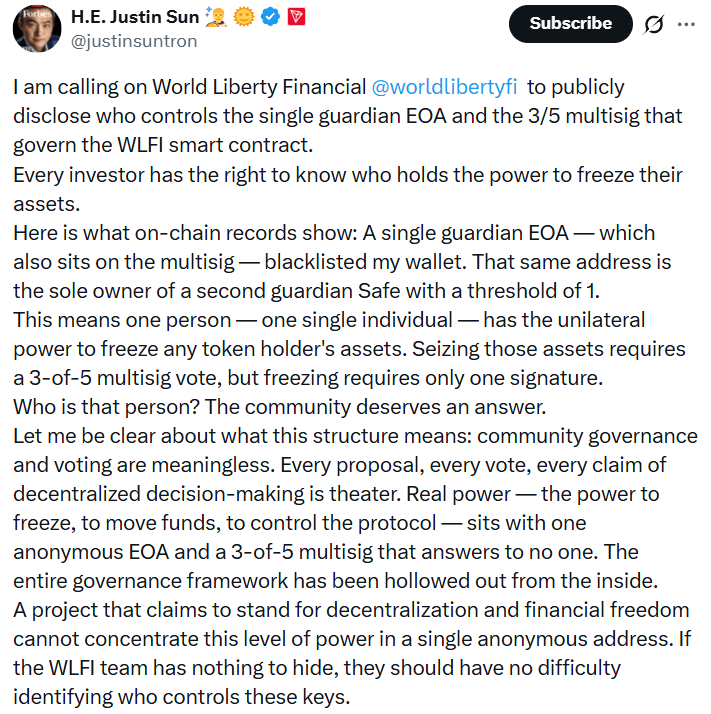
Justin Sun, the co-founder of layer-1 blockchain network Tron, has urged the Trump-linked crypto platform World Liberty Financial to publicly disclose who controls the guardian Externally Owned Account (EOA) and multisignature wallets governing its smart contracts, after alleging the setup was used to blacklist his wallet.
Sun said a single guardian EOA tied to the WLFI multisig structure appeared to be the sole owner of a second guardian safe, giving one individual unilateral power to freeze token holders, according to a Monday X post.
WLFI has not publicly responded to the substance of Sun’s latest claims.
The dispute adds to criticism of WLFI’s governance after a March vote showed that 76% of voting power came from 10 wallets. Sun, an early investor in the project, called that an alarming sign of concentrated influence. In a Sunday X post, WLFI accused Sun of spreading baseless allegations to cover up his own misconduct and threatened legal action.
Sun’s WLFI token address was blacklisted in September 2025 after blockchain data platforms flagged it for a roughly $9 million transfer. Sun said his presale tokens were unreasonably frozen and urged the team to unlock his investment.
Cointelegraph has contacted World Liberty Financial for comment.
Source: Justin Sun
WLFI faces fresh scrutiny over collateral use
Sun’s latest allegations come as WLFI is already under pressure after project-linked wallets deployed substantial token holdings as collateral on Dolomite, a decentralized lending platform linked to WLFI chief technology officer Corey Caplan.
Onchain data flagged by Arkham showed WLFI-linked wallets deposited about 5 billion WLFI tokens on Dolomite, borrowed about $75 million in USD1 and USDC (USDC), and transferred more than $40 million to Coinbase Prime.
Multiple DeFi analysts said the loan raises concerns for lenders on Dolomite if WLFI’s price falls near liquidation levels. WLFI acknowledged the lending position and assured investors that the WLFI token trades well above the liquidation threshold.
WLFI fell to a new low of about $0.077 on Saturday, extending losses as concerns around governance, collateral use and treasury transparency mounted, according to CoinGecko.
Related: Trump Organization to tokenize Maldives resort development for early investors
WLFI whales restart accumulation ahead of Mar-a-Lago reception
Other Trump-family-linked coins have also sunk to new all-time lows, including the Official Trump (TRUMP) and the Official Melania (MELANIA) memecoins.
However, some large token holders have restarted their TRUMP token accumulation ahead of the luncheon at US President Donald Trump’s Mar-a-Lago residence in Florida on April 25, where the top 297 token holders are invited.
Magazine: Quitting Trump’s top crypto job wasn’t easy: Bo Hines
Q&A
What did Justin Sun allege about World Liberty Financial's wallet governance?
Justin Sun alleged that a single guardian wallet within WLFI's multisig structure has unilateral power to freeze token holders, which he claims was used to blacklist his wallet.
How did the governance structure of WLFI come under scrutiny?
WLFI's governance faced criticism after a March vote revealed that 76% of voting power was concentrated in just 10 wallets, raising concerns about centralized influence.
What actions did WLFI take against Justin Sun's wallet?
WLFI blacklisted Justin Sun's wallet in September 2025 after it was flagged for a $9 million transfer, leading Sun to claim that his presale tokens were unreasonably frozen.