XRP Ledger Enters Next Phase With Incoming XRPL Update
XRP Ledger Foundation hints at upcoming version 3.2.0 release.
U.Today1 min read

Pakistan's central bank has lifted an eight-year ban, allowing banks to open accounts for licensed virtual asset service providers. This change follows the passage of the Virtual Assets Act 2026, signaling a new regulatory framework for digital assets.
Mentioned in this story
Pakistan’s central bank has allowed banks to open accounts for licensed virtual asset service providers (VASPs) and their customers, replacing an eight-year-old prohibition on dealing in virtual currencies.
In a circular dated April 14, the State Bank of Pakistan (SBP) said regulated entities may open bank accounts for entities licensed by the Pakistan Virtual Assets Regulatory Authority (PVARA), the statutory body responsible for licensing, regulation and oversight of virtual asset activities in the country.
The move follows Pakistan’s passage of the Virtual Assets Act 2026 in March and marks a shift toward a more formal regulatory framework for digital assets after years of restrictions following an outright ban in 2018.
Authorities have recently signaled a more structured approach to the sector, including holding discussions with major exchanges such as Binance and HTX in December 2025, as part of efforts to attract regulated trading platforms.
In parallel, Pakistan has also explored blockchain-based financial infrastructure through engagements with affiliates of World Liberty Financial, including discussions around the use of stablecoins for cross-border payments.
Under the new framework, regulated entities shall not invest, trade or hold virtual assets using their own funds or customer deposits, the circular states, emphasizing that banks’ role is limited to providing banking services to licensed firms.
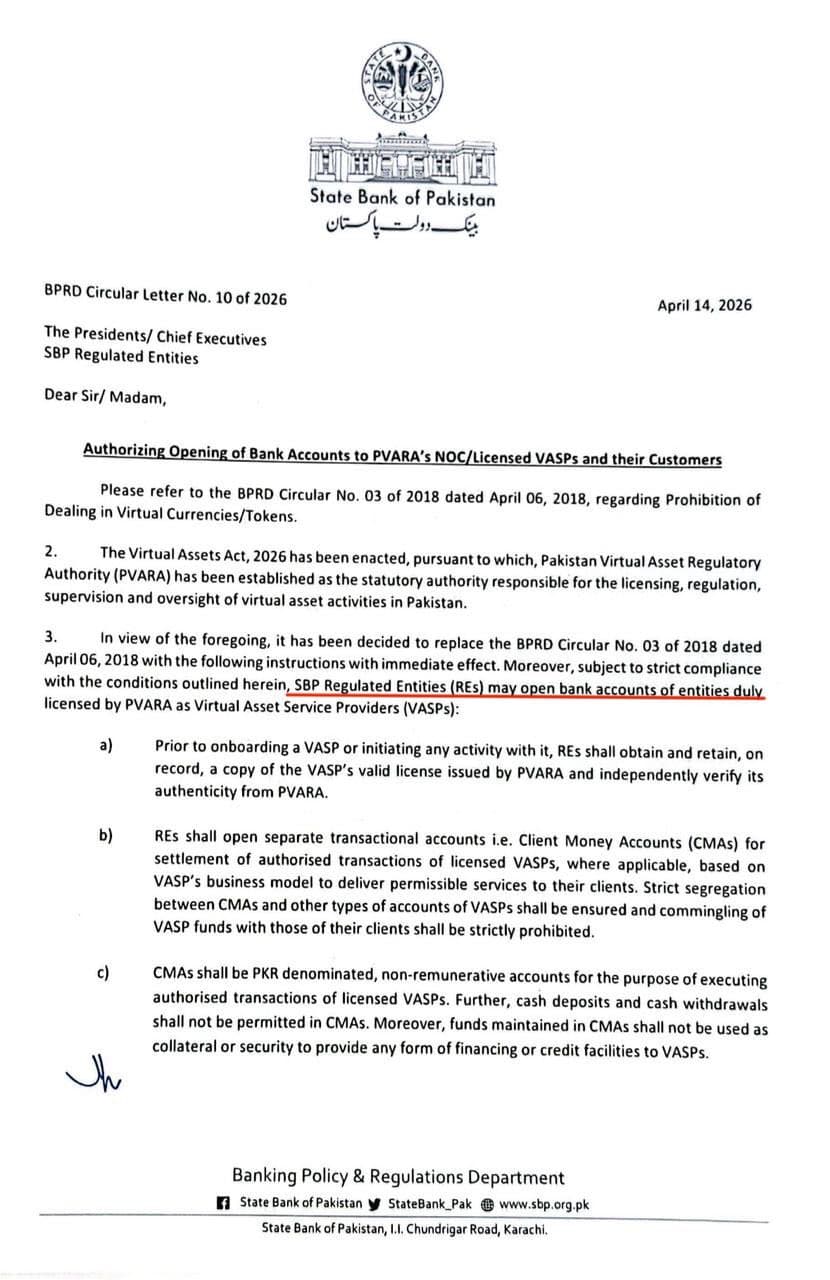
BPRD circular letter. Source: Pakistan VARA
The SBP added that banks remain responsible for complying with all applicable central bank regulations, including foreign exchange rules, and that any arrangement with a VASP does not absolve them of those obligations.
The Virtual Assets Act 2026 establishes a regulatory framework for virtual asset activities, allowing licensed entities to operate legally in Pakistan.
The ban on dealing in virtual currencies lasted for eight years, from 2018 until the recent policy change by the State Bank of Pakistan.
Licensed virtual asset service providers (VASPs) approved by the Pakistan Virtual Assets Regulatory Authority (PVARA) can now open bank accounts.
XRP Ledger Foundation hints at upcoming version 3.2.0 release.

Bitcoin's recent momentum signals a potential downturn as it weakens. What does this mean for investors?

Bitcoin drops to over $74,000 and Ethereum dips to $2,000 this weekend.

Bitcoin's price drops to $74K as bearish market trends intensify.

Bitcoin and Ethereum's Sharpe Ratio diverges, hinting at potential price changes.

XRP drops to a six-week low of $1.33 as whale activity declines significantly.
See every story in Crypto — including breaking news and analysis.
Banks are required to open separate transactional accounts denominated in Pakistan rupees, described as Client Money Accounts (CMAs), for settlement of authorized transactions of licensed VASPs, with strict segregation between CMAs and other VASP accounts and a prohibition on commingling VASP funds with client assets.
In addition to existing customer due diligence rules under SBP’s anti-money laundering (AML) and counter financing terrorism (CFT) rules, regulated entities must conduct full due diligence on each VASP, amend their customer risk profiling models to capture VASP-related risks, and risk-rate VASPs accordingly.
Banks are directed to monitor their relationships with VASPs on an ongoing basis and report any suspicious transactions to Pakistan’s Financial Monitoring Unit.