Phishing, deepfakes, supply chain attacks to fuel 2026's biggest crypto hacks: CertiK

TL;DR
CertiK predicts that phishing, deepfakes, and supply chain attacks will drive major crypto hacks in 2026, with losses already exceeding $600 million this year due to North Korea-linked thefts.
Key points
- Phishing and deepfakes will fuel major crypto hacks in 2026
- Over $600 million lost to hacks this year
- North Korea-linked attacks are significant contributors
Mentioned in this story
CertiKZerion
North Korea
Real-time deepfakes, phishing attacks, supply chain compromises and cross-chain vulnerabilities will likely be the root of some of the biggest hacks in 2026, according to CertiK senior blockchain investigator Natalie Newson.
The industry has already lost over $600 million to hacks in 2026, owed largely to two North Korea-linked crypto thefts in April, including the $293 million Kelp DAO exploit on Saturday involving a single point-of-trust failure in cross-chain messaging protocol LayerZero’s infrastructure, and the $280 million exploit of the Drift Protocol.
Another DPRK-linked attack involved the use of AI for social engineering. Crypto wallet Zerion revealed on April 15 that North Korean-affiliated hackers used AI in a long-term social engineering attack to steal about $100,000 from the company’s hot wallets.
Newson warned that, in “some aspects,” the acceleration of AI will only worsen crypto attacks.
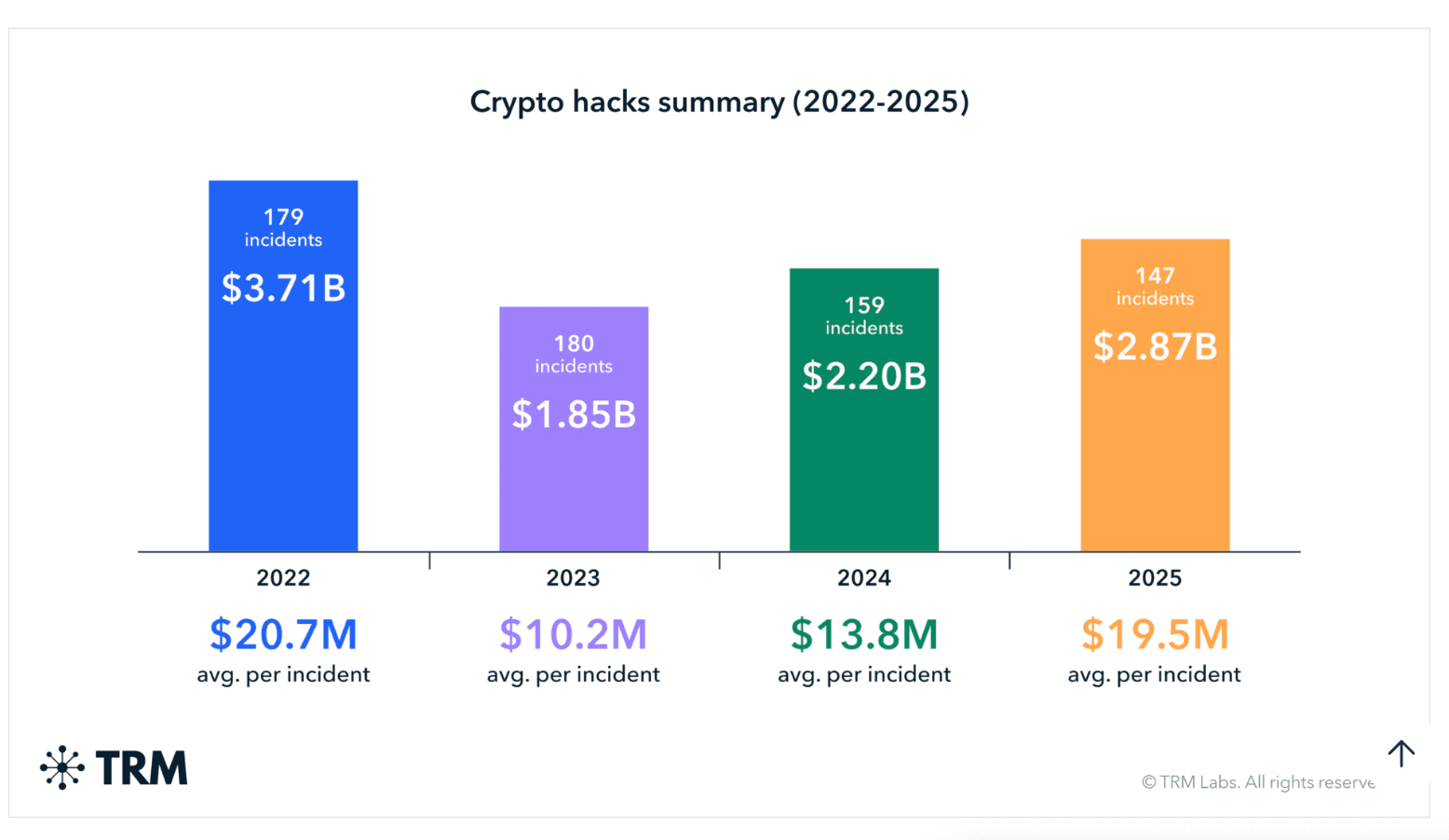
The average size of crypto hacks rose to $19.5 million in 2025. Source: TRM Labs
“The best way for investors to protect themselves is to be aware of the current threats they may face... For instance, to protect yourself against phishing, always verify the authenticity of URLs and smart contracts,” Newson said.
Newson said that as exploits become more sophisticated, retail investors should explore storage options outside of crypto exchanges.
“Using cold wallets can help keep assets that you don’t use regularly safe and allows you to sign transactions without ever exposing your private keys,” she said.
AI could be used to defend against attacks
“There are now more convincing deepfakes, autonomous attack agents, and ‘agentic AI’ that can autonomously scan smart contracts for bugs, draft exploit code and execute attacks at machine speed," she said.
On April 6, Cointelegraph reported that a threat actor known as “Jinkusu” was allegedly selling cybercrime tools designed to bypass Know Your Customer (KYC) checks at banks and crypto platforms, using deepfakes and voice manipulation.
Q&A
What are the main causes of crypto hacks predicted for 2026?
The main causes include real-time deepfakes, phishing attacks, supply chain compromises, and cross-chain vulnerabilities.
How much money has been lost to crypto hacks in 2026 so far?
Over $600 million has been lost to hacks in 2026, primarily due to two major North Korea-linked thefts.
What role does AI play in recent crypto attacks?
AI has been used in social engineering attacks, as demonstrated by North Korean-affiliated hackers stealing approximately $100,000 from Zerion's hot wallets.