Ripple (XRP) News Today: May 13

TL;DR
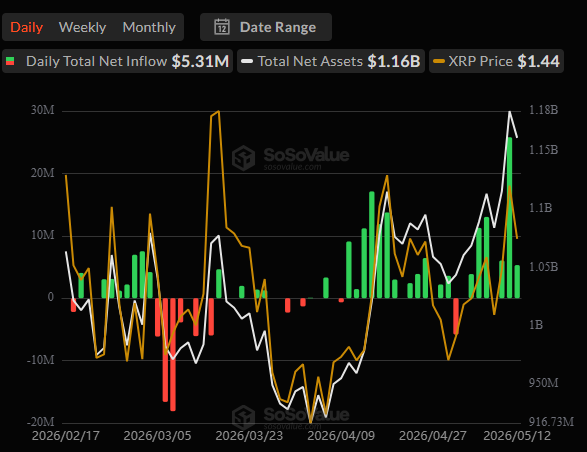
Ripple has secured a $200 million debt facility to enhance its institutional services, contributing to a 9% rise in XRP's price over the past month. The company aims to meet growing demand for large-scale financing solutions.
Key points
- Ripple secured a $200 million debt facility
- XRP price increased by 9% over the past month
- Funds managed by Neuberger Specialty Finance
- Ripple Prime aims to expand services for institutional clients
- Growing demand for large-scale financing solutions
Mentioned in this story
RippleNeuberger BermanNeuberger Specialty Finance
The company behind the popular cryptocurrency XRP made headlines again by collaborating with some well-known names.
The price of its native token has risen by 9% over the past month, while the sustained institutional interest suggests a further ascent could be on the way.
Partnerships and More
Earlier this week, Ripple announced the successful closing of a $200 million debt facility from funds managed by Neuberger Specialty Finance, the dedicated asset-based division within the global investment management firm Neuberger.
The new capital will help Ripple Prime (formerly known as Hidden Road) to expand its services and support more institutional clients. Ripple also noted that demand for reliable, large-scale financing solutions continues to grow across both traditional and digital markets. Speaking on the matter was Noel Kimmel, President of Ripple Prime:
“This facility enables us to grow alongside our clients by delivering increased margin capacity, greater responsiveness, and improved capital efficiency. Neuberger Specialty Finance has deep expertise in asset-based finance and a strong understanding of our business model, and its support reflects the differentiated prime services platform we have built and the many growth opportunities available to us.”
For his part, Peter Sterling (Head of Neuberger Specialty Finance) applauded Ripple Prime for building an innovative brokerage platform that combines “fintech-grade technology and agility with bank-level compliance and operational rigor.”
The initiative caught the eye of numerous crypto commentators. The popular X user Vincent Van Code claimed this has marked Ripple’s jump into “financial liquidity.”
“Land wait til this $200m number becomes $20BN on chain. And then wait for XRP to become not only the bridge but a margin facility,” they added.
In the meantime, the Brazilian fintech and blockchain infrastructure company Levery joined Ripple UDAX and the local research and educational foundation FGV “to bring institutional on-chain liquidity” to LatAm banks. UDAX stands for the University Digital Asset Xcelerator – a mutual initiative between Ripple’s University Blockchain Research and UC Berkeley.
Q&A
What is the significance of Ripple's $200 million debt facility?
The $200 million debt facility will enable Ripple Prime to expand its services and better support institutional clients.
How much has XRP's price increased recently?
XRP's price has risen by 9% over the past month, indicating growing investor interest.
Who is managing the funds for Ripple's debt facility?
The debt facility is managed by Neuberger Specialty Finance, a division of Neuberger Berman.
What does Ripple Prime aim to achieve with the new capital?
Ripple Prime aims to expand its services and meet the increasing demand for reliable financing solutions in both traditional and digital markets.