
Solana To $500? Why Bulls Think AI Could Change The SOL Story
Investors believe Solana (SOL) could hit $500 as AI changes the game.
NewsBTC1 min read

Russia's lower house of parliament passed a bill to establish a legal framework for digital currency, allowing crypto trading through licensed intermediaries. The bill aims to ban unlicensed platforms by July 2027.
Mentioned in this story
Russia’s lower house of parliament passed a bill in first reading on Tuesday that would create the country’s core legal framework for digital currency, moving Moscow closer to a system that channels crypto trading through licensed intermediaries under Bank of Russia oversight.
The draft bill No. 1194918-8, titled “On Digital Currency and Digital Rights,” passed its first reading in the State Duma on Tuesday, according to official records.
The bill would allow Russians to buy and sell crypto through approved intermediaries as early as July, while banning unlicensed crypto platforms beginning in July 2027, if the draft becomes law.
The bill is part of a new comprehensive legislative package aimed at restricting crypto trading to regulated platforms in Russia, alongside at least three other related bills introduced. One of them, bill No. 1194929-8, also passed the first reading on Tuesday.
Together, the bills would push Russia’s crypto market toward a licensed, state-supervised structure, though key enforcement pieces are still unresolved.
Bill 1194918-8 “On Digital Currency and Digital Rights,” would introduce investment limits for retail investors, allowing purchases only of the “most liquid digital currencies,” as defined by the Bank of Russia.
Those assets would have to meet several thresholds, including an average market capitalization of more than 5 trillion rubles ($66.6 billion) over the two years before listing, average daily trading volume of more than 1 trillion rubles ($13.3 billion) over the same period, and a trading history of at least five years.
The legislation would require retail investors to pass a test and would cap purchases through a single intermediary at 300,000 rubles ($4,000) per year.
The bill also allows residents to buy crypto abroad through foreign accounts, provided those transactions are reported to tax authorities.
The legislation also maintains a strict prohibition on crypto payments, a core provision of the crypto law “On Digital Financial Assets,” which took effect in 2021.
Apart from the two draft bills that passed their first reading, lawmakers have introduced two separate measures establishing liability and criminal penalties for violations of the new rules, including bills No. and No. .
The bill creates a legal framework for digital currency, allowing trading through licensed intermediaries under Bank of Russia oversight.
Unlicensed crypto platforms will be banned starting in July 2027 if the bill becomes law.
Russians could start buying and selling crypto through approved intermediaries as early as July.
The legislation aims to restrict crypto trading to regulated platforms, moving towards a state-supervised crypto market.
Investors believe Solana (SOL) could hit $500 as AI changes the game.

XRP stabilizes near $1.46 as Ripple secures $200 million funding.

Will Pi Network's PI token crash to $0 or rise to $1 this year? AI weighs in.

Dogecoin (DOGE) is on the rise but faces hurdles near $0.1120.

MultiBank Group's mb.io brings Ghana gold on-chain with new partners.

Bitcoin briefly hits $82K as Michael Burry warns of a stock crash.
See every story in Crypto — including breaking news and analysis.
The latter proposes criminal penalties for unlicensed digital asset services and mandates registration with the Bank of Russia, with fines and prison terms for non-compliance.
But the Supreme Court declined to support that measure in its current form, saying the proposal depends on a broader digital currency framework that has not yet been adopted and therefore appears premature.
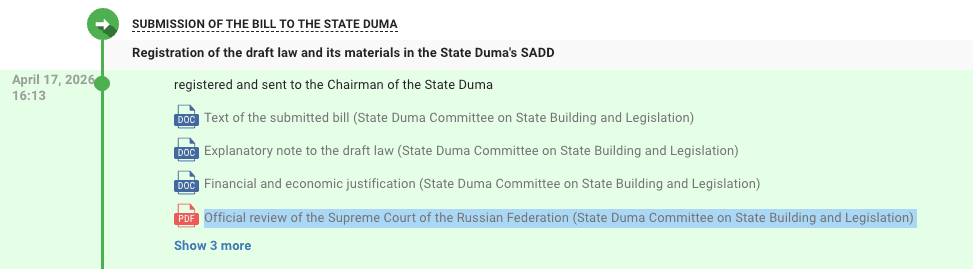
Draft bill No. 1209607-8 development (translated by Google). Source: The State Duma
“The proposed article is drafted as a blanket provision, the application of which is not possible in isolation from rules directly established by regulatory acts,” the court said in an official review of the bill released last week, adding:
“Meanwhile, the draft federal law ‘On Digital Currency and Digital Rights,’ aimed at regulating issues related to the organization of digital currency circulation, is currently under development. Until the relevant federal law is adopted, the initiative in question appears premature.”
That means Tuesday’s first-reading vote is important not because it advances the base law that other enforcement measures still depend on.
Several local industry participants have repeatedly warned that the proposed legislation could backfire, pushing the sector further underground instead of bringing it out of the grey zone.