Satoshi-Era Whale Challenges Michael Saylor With Sudden Bitcoin Move, XRP Hits Record 2026 Bollinger Bands Squeeze, Binance Delists Batch of BTC and ETH Pairs: Morning Crypto Report
TL;DR
A Satoshi-era whale moved 1,000 BTC worth $74 million to exchanges, but Michael Saylor's strategy absorbed 17 times that volume, stabilizing BTC at $74,100. XRP's Bollinger Bands are experiencing a record squeeze, and Binance is delisting 10 trading pairs, including BTC/TUSD and ETH/TUSD, on April 17.
Key points
- Satoshi-era whale moved 1,000 BTC to exchanges
- Michael Saylor's strategy absorbed 17 times that volume
- XRP Bollinger Bands hit a record tight squeeze
- Binance delisting 10 trading pairs on April 17
- U.S. PPI report could impact Bitcoin's price
Mentioned in this story
TL;DR
- 2012 Bitcoin whale vs. Saylor: A Satoshi-era whale moved 1,000 BTC ($74 million) to exchanges, but Michael Saylor’s Strategy absorbed 17x that volume in 48 hours, stabilizing BTC at $74,100.
- XRP volatility squeeze: Bollinger Bands have hit a record 2026 tight squeeze. Watch for a breakout from the $1.35-$1.38 range pending the U.S. Senate’s CLARITY Act decision.
- Binance delisting: 10 trading pairs, including BTC/TUSD and ETH/TUSD, will be removed on April 17 at 3:00 a.m. UTC.
- Crypto Market Outlook: U.S. PPI came in soft at 4.0% YoY, shifting focus to the Beige Book. A positive report could catalyze a Bitcoin rally toward the $76,000 resistance.
Satoshi-era whales vs. “Saylor machine”: Who is driving Bitcoin’s price in April 2026?
Earlier today, activity was recorded on legendary wallet 15MZvK, which had remained dormant for more than 14 years. After waking up eight months ago, this Satoshi-era whale continued its gradual distribution, transferring another 1,000 BTC (about $74.03 million) to exchange wallets via an intermediary address.
Despite prolonged selling, the “ancient” investor still holds 1,833 BTC ($135.6 million), creating a potential supply overhang in the coming weeks. Notably, while first-generation Bitcoin whales are locking in historic profits, Michael Saylor’s corporate structures are aggressively absorbing every move.
Yesterday’s price increase allowed Michael Saylor’s portfolio to finally return to profit territory, surpassing the psychologically important average purchase price of $75,577.

Wallet 15MZvK activity, Source: Arkham
The scale of absorption is significant. Through the STRC mechanism, Strategy raised and converted 17,204.73 BTC into Bitcoin in just two days via a specific equity issuance structure. Saylor’s purchases over 48 hours exceeded the Satoshi-era whale’s current sell-off by 17 times.
What is unfolding is a fundamental transition in asset holders. Early adopters, who acquired or mined BTC at negligible cost, are gradually passing control to public companies.
Where once the sale of 1,000 BTC could trigger panic and price collapse, institutional algorithms now enter the market. For every “ancient” Bitcoin sold, there is a buyer in the form of Strategy, converting a volatile asset into a corporate reserve and effectively removing it from liquid circulation.
XRP braces for volatility with major 2026 squeeze by Bollinger Bands
The XRP market has entered a phase of extremely low volatility, clearly reflected in the compression of the Bollinger Bands, as displayed on TradingView. While the price remains confined within a narrow $1.35-$1.38 range, this technical compression is not simply a lack of interest but a balance of forces.
Sellers have exhausted the supply after an extended correction earlier this year, while buyers are accumulating positions, awaiting resolution in the U.S. Senate regarding the CLARITY Act.
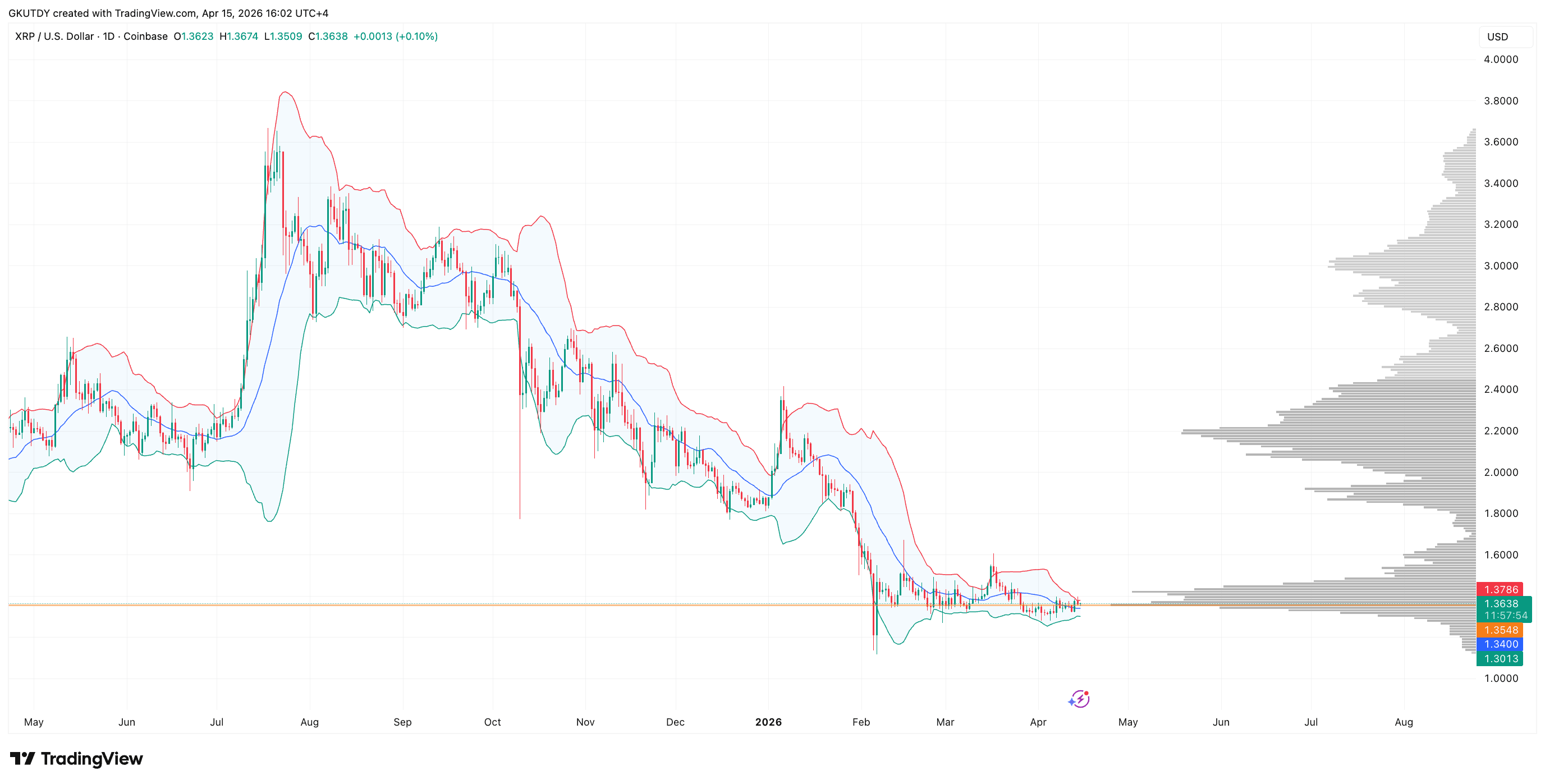
XRP/USD daily price chart with Bollinger Bands, Source: TradingView
The last time a similar compression occurred on the daily chart was in 2024, after which a move followed that reshaped market structure for several months.
Resistance: The upper boundary of the range at $1.42 for XRP. A breakout above this level would confirm an upward expansion, while support is at a dense zone around $1.30, defended by institutional holders for the past three weeks.
Binance removes several BTC and ETH trading pairs: What you need to know before April 17
Binance continues its planned optimization of trading instruments. This time, 10 spot pairs are being removed, including combinations with BTC and ETH. The delisting is scheduled for April 17, 2026, at 3:00 a.m. UTC.
The exchange is removing pairs that have either lost liquidity or become redundant under current market conditions. The primary focus is on optimizing instruments involving the TUSD stablecoin and fiat currencies.
Binance is fully discontinuing:
- BTC/TUSD and ETH/TUSD pairs, continuing its strategy of phasing out this stablecoin in favor of more liquid alternatives such as United Stables (U).
- Fiat pairs ARB/EUR and WIF/EUR are also being removed, along with niche combinations, such as CYBER/BTC, TIA/BTC and RLC/ETH.
Unlike token delistings, removing trading pairs is purely a technical adjustment. The assets themselves remain listed and tradable via USDT, FDUSD or USDC.
This update is critical for users running automated strategies. Binance will forcibly disable Spot Trading Bots for these pairs at the moment of delisting. If positions are not closed manually, the system will execute them at market price, which may result in unintended losses.
If assets are held in these pairs, there is no need for panic. Tokens remain safe. However, it is necessary to review open orders and bot configurations involving TUSD and EUR pairs, as these are directly affected by the optimization.
Crypto Market Outlook: BTC anchors at $74,000 as PPI miss shifts all eyes to Beige Book
Driven largely by the strong STRC activity, Bitcoin has managed to stabilize above $73,500 despite rising inflation, though below expectations, and there is ongoing uncertainty on energy markets.
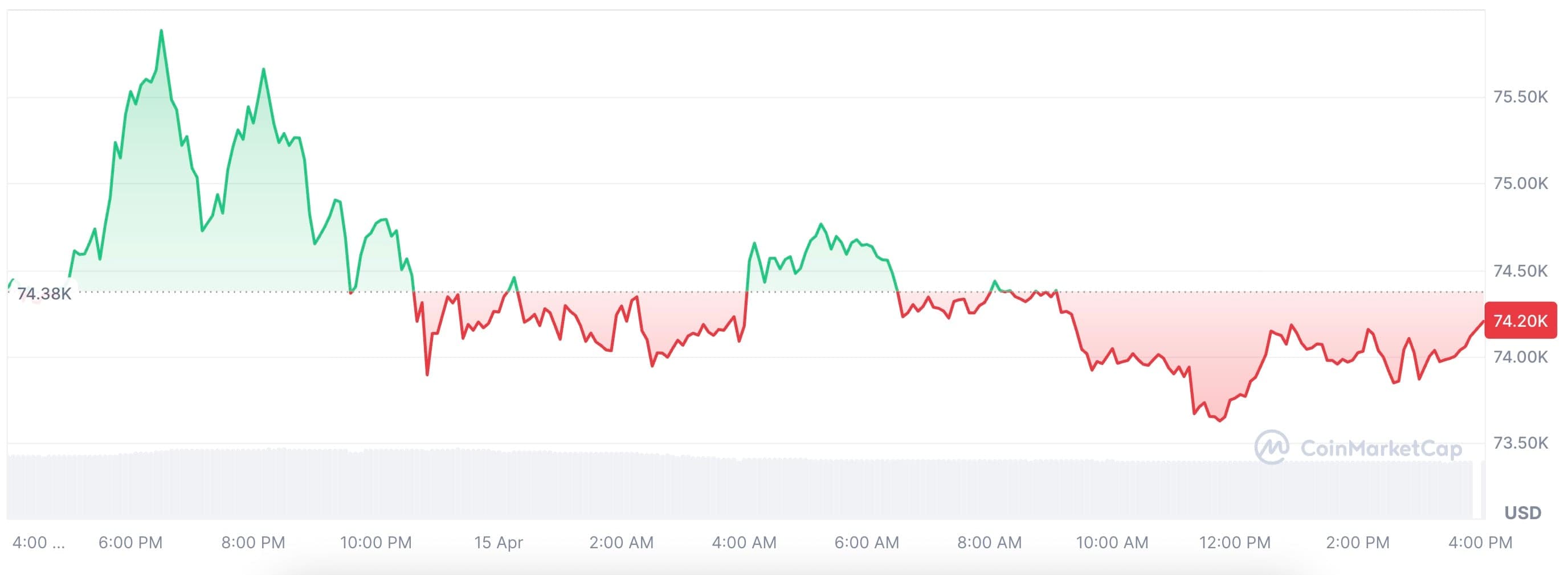
Bitcoin price in 24 hours, Source: CoinMarketCap
Key checkpoints:
- Bitcoin (BTC) is trading around $74,100, correcting after an attempt to break above $76,000. Local support is formed at $72,000.
- The CLARITY Act is expected to be signed, defining the framework for stablecoin operations within the U.S. banking system.
- March U.S. PPI came in significantly below expectations: +0.5% month-over-month (vs. 1.1-1.2% forecast) and 4.0% year-over-year (vs. 4.6-4.7% forecast).
- The market is awaiting the Beige Book release. If the Federal Reserve confirms cooling prices and labor conditions across regions, this could reduce pressure from energy markets and provide Bitcoin with the necessary catalyst to break above $76,000 amid expectations of a softer regulatory stance.
Q&A
What happened with the Satoshi-era whale and Michael Saylor's Bitcoin strategy?
A Satoshi-era whale transferred 1,000 BTC to exchanges, but Michael Saylor's strategy absorbed 17 times that amount, stabilizing Bitcoin's price.
What is the significance of the XRP Bollinger Bands squeeze?
The XRP Bollinger Bands have reached a record tight squeeze, indicating a potential breakout from the $1.35-$1.38 range depending on the U.S. Senate’s CLARITY Act decision.
Which trading pairs is Binance delisting on April 17?
Binance will delist 10 trading pairs, including BTC/TUSD and ETH/TUSD, effective April 17 at 3:00 a.m. UTC.
How could the U.S. PPI report affect Bitcoin's price?
A soft U.S. PPI report at 4.0% YoY may shift focus to the Beige Book, and a positive report could catalyze a Bitcoin rally toward the $76,000 resistance.