SEC proposes certain crypto interfaces don’t need to register as brokers

TL;DR
The SEC has clarified that certain software interfaces for crypto transactions may not need to register as broker-dealers if they meet specific criteria. This applies to interfaces that facilitate user-initiated transactions using self-custodial wallets without soliciting specific trades.
Key points
- SEC clarifies broker-dealer registration for crypto interfaces
- Certain interfaces may not need to register if criteria are met
- Exemption applies to self-custodial wallets under specific conditions
The US Securities and Exchange Commission (SEC) has issued a staff statement clarifying how the agency plans to interpret software interfaces facilitating crypto transactions in its broker-dealer regulations.
In a Monday statement, the SEC’s Division of Trading and Markets staff said that under certain circumstances, interfaces that “assist users engaging in user-initiated crypto asset securities transactions on blockchain protocols [...] utilizing the user’s self-custodial wallet” may not necessarily be required to register as a broker-dealer with the agency.
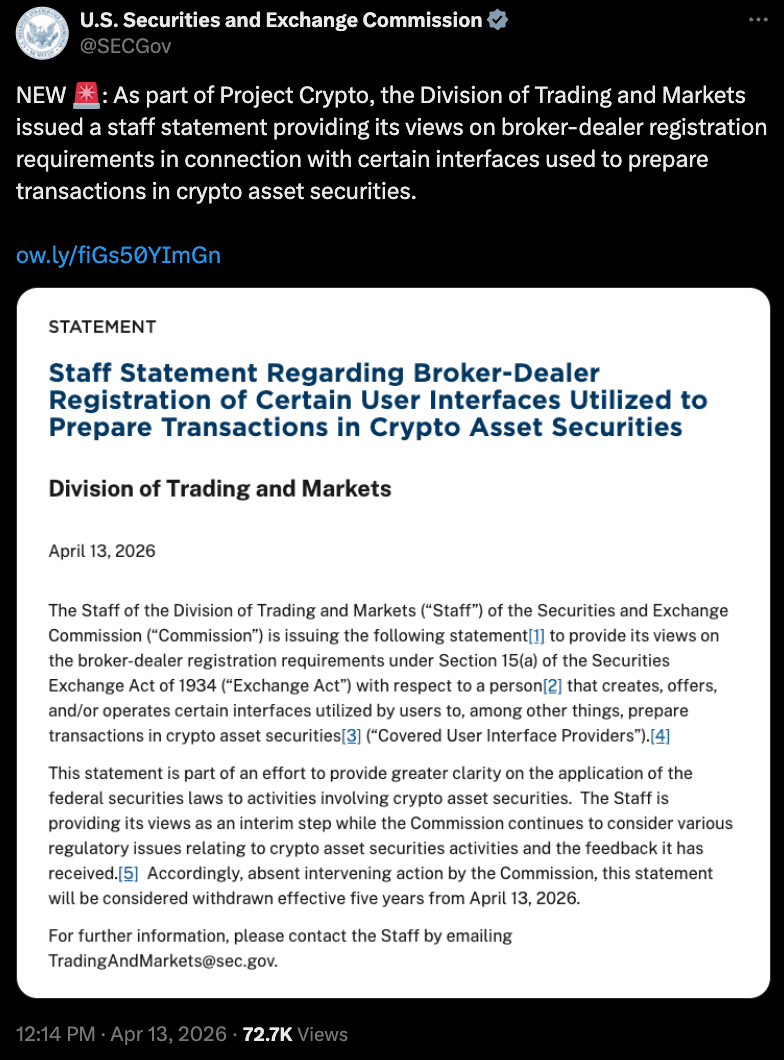
Source: SEC
The SEC statement specified that self-custodial wallets with such user interfaces may be exempt from registration requirements, provided they do not “solicit investors to engage in any specific crypto asset securities transactions,” provide commentary on “any potential execution [routes] displayed to a user,” and other circumstances.
Although the staff statement does not carry the same weight as a proposed SEC rule subject to public comment and review, it was intended to “provide greater clarity on the application of the federal securities laws to activities involving crypto asset securities.”
It follows several others that the SEC has issued following the inauguration of US President Donald Trump in January 2025, leading to new leadership at the agency in what many have seen as friendlier to the crypto industry.
Related: Ex-SEC, Coinbase staffer becomes Securitize president
“While the staff expressing its view is helpful, I favor a more permanent regulatory approach that addresses the broker definition in light of current market circumstances,” said SEC Commissioner Hester Peirce, adding:
“Crypto is forcing the Commission to confront its inner demons that have driven it toward ever more expansive readings of the securities laws.”
SEC leadership is still entirely Republican and understaffed
Although Trump announced several new nominations for various federal positions on Monday after a month of silence on the matter, no additional picks for the SEC or Commodity Futures Trading Commission (CFTC) were among the president’s names. Both financial regulators responsible for overseeing crypto regulation in the country face a dearth of leadership amid resignations and lack of nominations from the White House.
At the SEC, only three Republican commissioners out of five remain, while only CFTC Chair Michael Selig, also a Republican, serves at the commodities regulator following the departure of Caroline Pham in December.
Some lawmakers have proposed attaching a provision to a market structure bill under consideration in the Senate to require a minimum level of staffing at the SEC and CFTC before the legislation can take effect.
Magazine: Bitcoin quantum-safe without upgrade? CZ’s 2031 crypto vision: Hodler’s Digest, April 5 – 11
Q&A
What did the SEC clarify about crypto transaction interfaces?
The SEC clarified that certain software interfaces facilitating crypto transactions may not need to register as broker-dealers if they do not solicit specific trades and allow users to engage with their self-custodial wallets.
Under what conditions can crypto interfaces be exempt from SEC registration?
Crypto interfaces can be exempt from SEC registration if they do not solicit investors for specific transactions and do not provide commentary on execution routes.
How does the SEC's statement affect self-custodial wallets?
The SEC's statement indicates that self-custodial wallets with compliant interfaces may be exempt from broker-dealer registration requirements, easing regulatory burdens for certain crypto transactions.