
XRP Breaks $1.46 Despite $434M In Futures Selling – Discover What Comes Next
XRP breaks $1.46 despite futures selling; market dynamics reveal complexities.
NewsBTC1 min read

Singapore Gulf Bank has launched a service for institutional clients to mint and redeem stablecoins directly from their accounts, utilizing the Solana blockchain for 24/7 settlement. Initially supporting Circle USDC transactions over $100,000, the service includes temporary fee waivers.
Mentioned in this story
Singapore Gulf Bank (SGB) has introduced a service that lets institutional clients mint and redeem stablecoins directly from their bank accounts, using the Solana layer-1 blockchain network to enable round-the-clock settlement between fiat and digital assets.
The service will initially support Circle USDC (USDC) transactions above $100,000 and includes temporary fee waivers for minting and redemption on the Solana network, according to SGB’s announcement.
Additional assets such as Tether’s USDT (USDT), Ethena’s USDe (USDe) and Global Dollar (USDG) are expected to follow, the company said.
The new feature is integrated into the bank’s internal clearing system, allowing funds to move between onchain and traditional balances without relying on intermediary banking networks, SGB said.
The launch comes as payment networks, regulators and banks around the world move to integrate stablecoin settlement and blockchain infrastructure into the traditional financial system to reduce costs and settlement times.
Related: Related:Euro stablecoins dominate non-dollar market, Visa-backed report finds
In March, Mastercard agreed to acquire stablecoin infrastructure company BVNK in a deal valued at up to $1.8 billion.
Jorn Lambert, Mastercard’s chief product officer, said “most financial institutions and fintechs” are moving toward services built around stablecoins and tokenized deposits.
Separately, Visa began operating validator nodes on the Tempo network on Tuesday. Validators on the network can earn stablecoin-based rewards for processing transactions.
A Visa spokesperson told Cointelegraph the company is focused on the technical and strategic aspects of operating a validator, rather than generating revenue.
Regulatory frameworks around the world are also beginning to catch up. In April, Pakistan’s central bank allowed banks to serve licensed crypto firms, ending years of legal restrictions.
Initially, the service supports Circle USDC, with plans to include Tether's USDT, Ethena's USDe, and Global Dollar.
The service allows institutional clients to mint and redeem stablecoins directly from their bank accounts, integrating with the bank's internal clearing system for seamless transactions.
The service requires a minimum transaction amount of $100,000 for minting and redeeming stablecoins.
XRP breaks $1.46 despite futures selling; market dynamics reveal complexities.

Bitcoin remains strong against inflation, eyeing $93,500 as buyers dominate.
21Shares' $THYP Hyperliquid ETF Debuts with $1.8M in Volume
XRP reaches a milestone with 332,230 wallets holding at least 10,000 XRP!

Ray Dalio argues Bitcoin lacks qualities of a true safe haven like gold.

BTC rebounds from CPI dip while a viral token plunges 17% daily.
See every story in Crypto — including breaking news and analysis.
Earlier this year, the country signed an exploratory agreement to assess World Liberty Financial’s USD1 (USD1) stablecoin and its potential use for cross-border payments.
Meanwhile in Europe, where euro-denominated stablecoins still lag far behind dollar-backed tokens, a consortium of banks including ING, UniCredit and BBVA is developing a euro-pegged stablecoin.
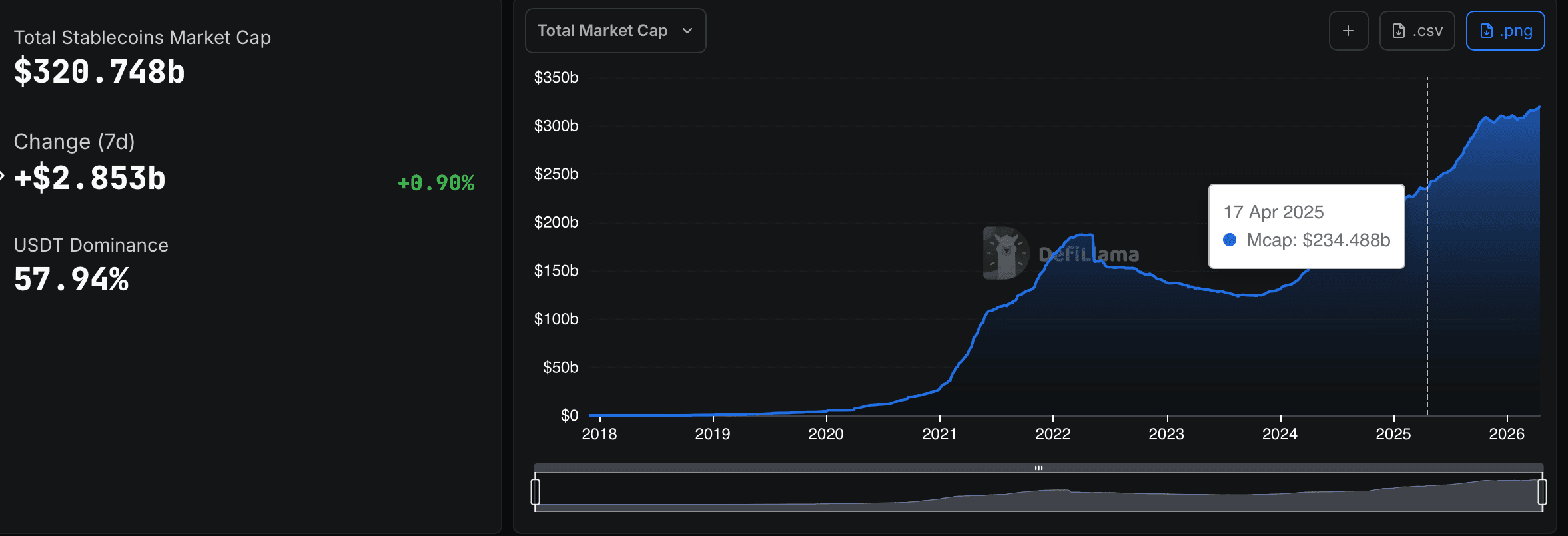
The total stablecoin market cap. Source: DefiLlama
The banks plan to distribute the stablecoin across crypto exchanges and banking channels, with a launch targeted for the second half of 2026.
The moves come as the stablecoin market cap, which exceeds $320 billion at the time of publication, according to data from DeFiLlama, continues to grow.