
News
Young Adults Involved in AI Romance Hide Full Use From Partners 69% of the Time
Study: 69% of Young Adults Hide AI Romance Use from Partners
Decrypt1 min read

Stablecoins are increasingly resembling a fragmented foreign exchange market, with liquidity spread across various blockchains, leading to price discrepancies. This complexity results in a challenging user experience, particularly for large transactions.
Mentioned in this story
Stablecoins behave like a fragmented foreign exchange market, where liquidity is spread across blockchains and pools, creating price differences and uneven access to dollar liquidity.
Moving stablecoins looks simple on the surface. But under the hood, it’s often a multi-step transaction routed across chains and pools.
“It’s a very special case of a foreign exchange market onchain, and that leads to bad user experience, with unexpected slippage, transaction reversion and unfamiliar information when moving your dollar from point A to point B,” Ryne Saxe, CEO at stablecoin infrastructure company Eco, told Cointelegraph.
Stablecoins now have a market capitalization above $320 billion, led by Tether’s USDt (USDT) and Circle’s USDC (USDC).
But as institutions and large traders enter the market, moving large sums of stablecoins becomes harder to execute cleanly.
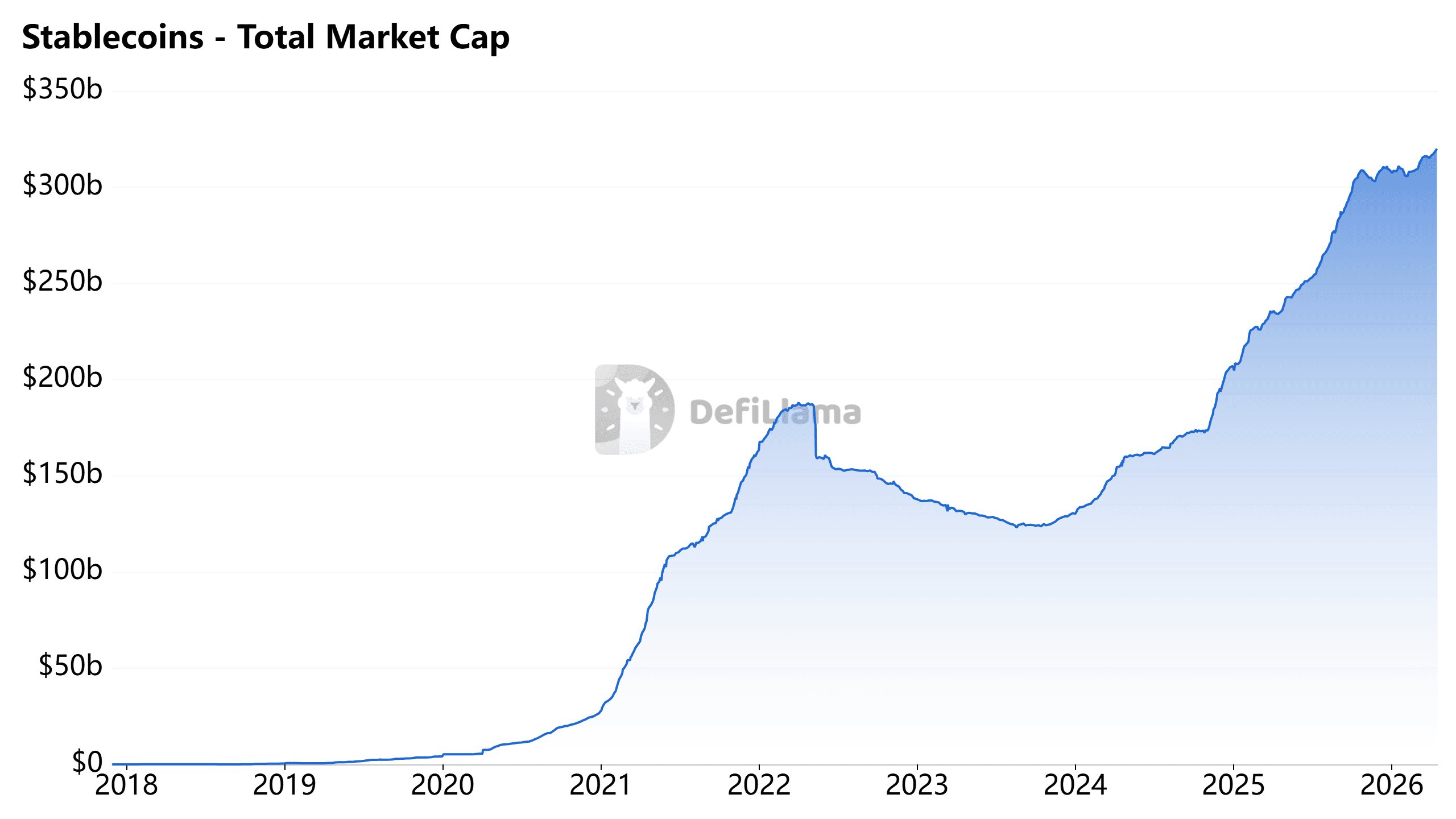
Stablecoins have continued to grow despite bearish crypto market sentiment. Source: DefiLlama
A stablecoin may be pegged to the dollar — or other fiat currencies — but it does not trade as a unified asset, with liquidity split across issuers, blockchains and decentralized finance (DeFi) venues, each with its own depth, pricing and access conditions.
“Stablecoins, between them, aren’t very fungible,” said Saxe. “The different profiles between those markets mean pricing and moving stablecoins seamlessly and efficiently across them is actually a hard problem that people take for granted.”
In practice, a dollar stablecoin on one chain may not be equivalent to the same asset elsewhere. Differences in collateral backing, market access and liquidity depth create pricing gaps that widen with size or in thinner markets.
Those differences are typically negligible in liquid markets and for smaller transactions. But as trades get larger, the gaps become bigger.
Stablecoins operate similarly to foreign exchange markets due to fragmented liquidity across different blockchains and pools, causing price differences.
Users often encounter unexpected slippage, transaction reversion, and complex multi-step processes when transferring stablecoins.
Stablecoins currently have a market capitalization exceeding $320 billion, with Tether's USDt and Circle's USDC leading the market.
As institutions and large traders enter the market, the complexity of executing large stablecoin transactions cleanly increases due to fragmented liquidity.
Study: 69% of Young Adults Hide AI Romance Use from Partners

Analyst Highlights Key Bearish OB Level for Bitcoin's Future

NHL and CFTC Sign MOU to Enhance Prediction Market Integrity

WLFI token holders cash out 1.8 billion tokens in record profit event linked to Binance.

Mark Cuban has sold most of his Bitcoin, citing disappointment in its performance as an inflation hedge.

Experts say Satoshi's 1.1M bitcoin can be secured against quantum attacks
See every story in Crypto — including breaking news and analysis.
“The more major DeFi markets focus on stablecoins, the more chains focus on stablecoins, the more stablecoin assets there are, the more fragmented,” Saxe said. “People think these are just dollars, but they’re actually not.”
In a March report, payments startup Borderless found that pricing divergence in stablecoins depends largely on where liquidity is sourced.
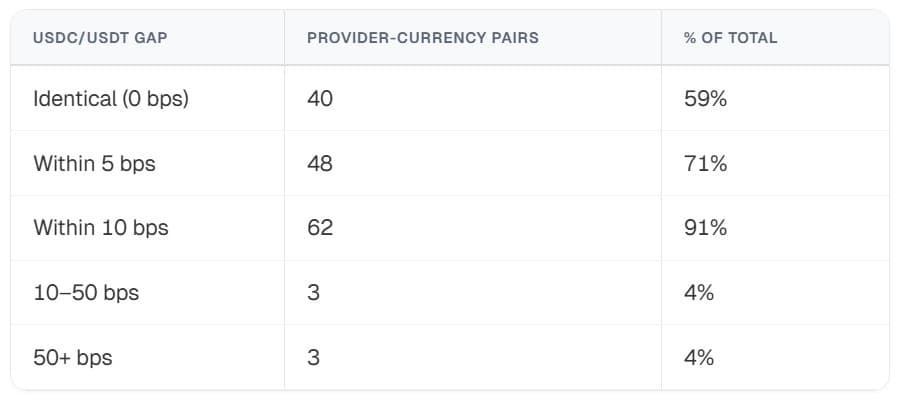
USDC and USDT trade at near-identical prices in most corridors, with 91% of pairs within 10 basis points. Source: Borderless
The report collected hourly buy and sell rates throughout February across 66 stablecoin-to-fiat corridors — or conversion routes such as USDC to Mexican pesos — covering 33 currencies and seven blockchains. The data showed that USDC and USDT traded almost identically in most cases.
Larger differences emerged at the provider level, where pricing gaps in the same corridor could exceed hundreds of basis points, making execution quality dependent on access to liquidity and routing across venues.
As stablecoins currently stand, their market structure resembles foreign exchange, where dollar proxies circulate across disconnected markets, according to Saxe. That becomes more visible in larger stablecoin movements across chains.
Stablecoins have become a centerpiece for institutions moving into digital assets, used for trading, cross-border payments and onchain treasury management. Firms rely on them to move capital between venues, settle trades and access yield opportunities across DeFi markets.
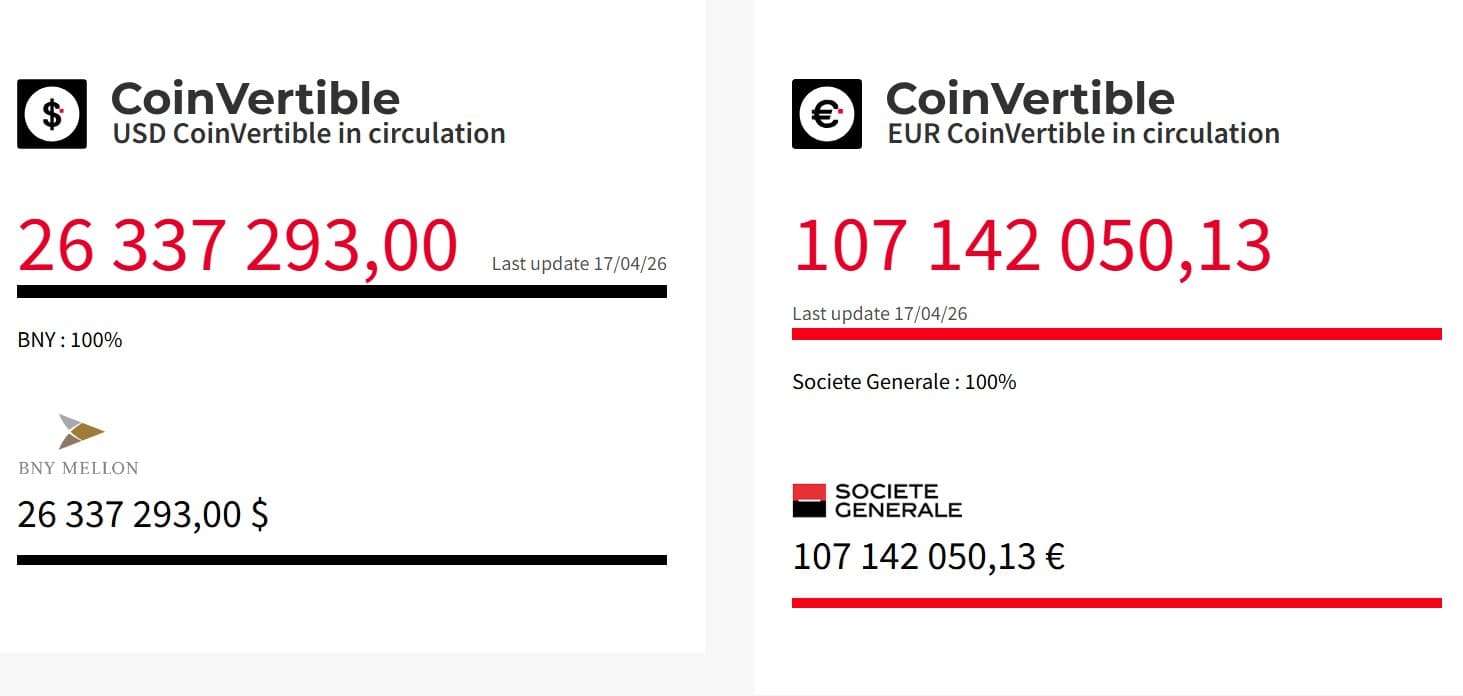
Some banks have begun issuing their own stablecoins, such as Societe Generale’s euro-backed token. Source: Societe Generale
Unlike retail users, institutions often move tens of millions of dollars at a time, where execution needs to be fast, predictable and efficient.
“If liquidity is spread out, trying to sell $10 million of one stablecoin and buy $10 million of another in a single step will move the market,” Saxe said. “What usually needs to happen is breaking that transaction into multiple branches, which may route differently and converge at the destination.”
In such cases, fragmentation becomes a constraint. Instead of drawing from a single pool of dollar liquidity, institutions must navigate multiple chains, issuers and venues, each with different liquidity conditions. Moving size can shift prices, require splitting trades and introduce uncertainty into execution.
“Right now, they don't have the risk management, trust and infrastructure that they need to move or hold a lot of stablecoins at size onchain by default,” Saxe said.
Companies are starting to build infrastructure to address those gaps, but they are doing so from different assumptions about what the problem actually is.
Circle is treating stablecoins as the foundation of a new FX system, where multiple currencies, liquidity providers and settlement layers are connected through shared infrastructure. Meanwhile, Eco focuses on routing and execution, aggregating liquidity across fragmented markets.
Both approaches point to the issue of stablecoins existing across multiple chains or issuers, but the liquidity behind them is distributed and uneven. Moving funds requires interacting with that fragmented liquidity, which introduces pricing differences, routing complexity and execution risk.
“Fragmentation creates more spread between prices, meaning worse execution in many cases. To solve that, you need to read across markets, see the full liquidity picture, even if it’s fragmented, and route across it,” Saxe said.
For institutions, that complexity directly limits how much capital can move onchain. As Saxe explained, stablecoin flows need to become far more predictable before institutions have the risk management and trust required to move or hold large amounts onchain.