Tether launches self-custodial wallet with cloud backup option
TL;DR
Tether has launched a self-custodial wallet called tether.wallet, supporting USDT, XAUt, USAT, and Bitcoin. The wallet features cloud backup and allows transactions without separate network fees, using human-readable usernames for easier access.
Key points
- Tether launched a self-custodial wallet called tether.wallet
- The wallet supports USDT, XAUt, USAT, and Bitcoin
- Transaction fees are paid in the asset being transferred
- The wallet uses human-readable usernames for easier transactions
- This marks Tether's push into consumer wallet distribution
Tether, the company behind the world’s largest stablecoin, USDt (USDT), has launched a self-custodial wallet called tether.wallet.
Tether.wallet supports three Tether-issued assets: USDT, XAUt (XAUT) and the US-focused USAT (USAT), as well as Bitcoin (BTC), the company announced Tuesday.
Tether said the wallet allows users to transact without requiring them to hold separate network or gas tokens, with fees paid directly in the asset being transferred.
The wallet also uses human-readable @tether.me usernames, aimed at eliminating the need to interact with long wallet addresses. With some commentators highlighting the potentially “centralized” nature of such identifiers, it remains unclear whether they introduce any friction in terms of self-custody or security.
The launch marks Tether’s clearest push yet into direct consumer wallet distribution, packaging stablecoin and Bitcoin payments in a simpler interface while testing how much convenience users will accept inside a product marketed as self-custodial. The wallet builds on the work the company began when it launched its open-source Wallet Development Kit in late 2024. The WDK was designed to enable developers to integrate non-custodial wallets for USDT and BTC into any app, website or device.
Cointelegraph reached out to Tether for comment but had not received a response by publication.
The app is fully self-custodial by design, Tether says
The wallet is immediately available for download on mobile devices, with the website inviting users to install iOS or Android versions at launch.
“The application is fully self-custodial by design,” Tether said in the announcement, noting that all transactions are signed locally on the user’s device before being broadcast to the network.
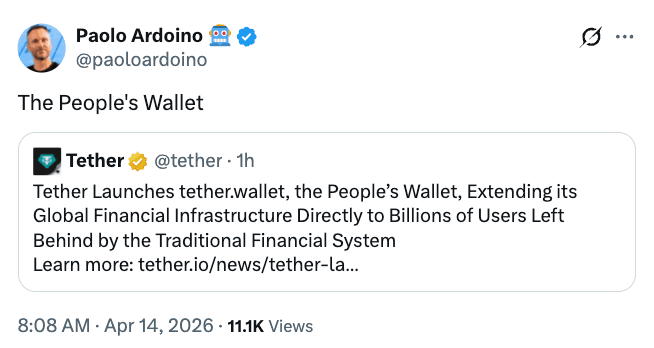
Source: Paolo Ardoino
“Private keys and recovery phrases are always in sole control of the user,” the company said, adding that the wallet’s self-custodial design aligns with Tether’s core principle of making financial systems “open, neutral, accessible, and in control of the user.”
“With more than 570 million people already using Tether’s technology, the next step is making that digital infrastructure more accessible and usable for end users,” Tether CEO Paolo Ardoino said, adding that the objective is to remove wallet complexities that have prevented broader adoption.
Related: Tether may delay fundraising if demand falls short at $500B valuation: Report
Private keys “safely backed to cloud”
At launch, the wallet supports USDT and XAUT on Ethereum, Polygon, Plasma and Arbitrum, while USAT is initially available exclusively on Ethereum. Bitcoin is supported both onchain and via the Lightning Network.
According to an X post by tether.wallet, the newly launched wallet allows users to control their private keys and “safely back up” to the cloud.
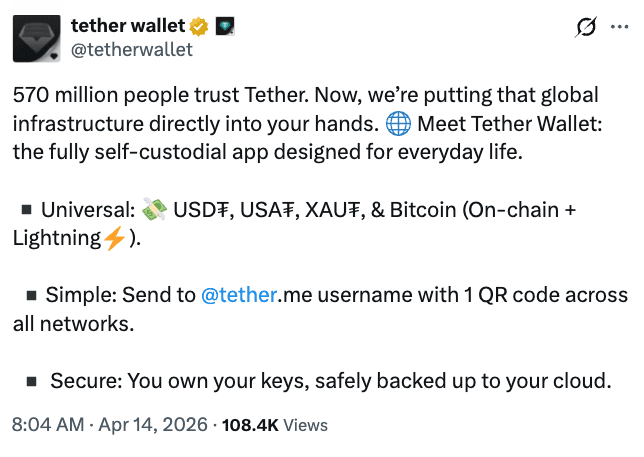
Source: tether.wallet
It’s unclear whether users can disable cloud-based private key backups. Cointelegraph will update the article pending Tether’s response.
Some users have opposed similar cloud-based key recovery solutions in the past, including on hardware wallets such as Ledger.
Magazine: Nobody knows if quantum secure cryptography will even work
Q&A
What cryptocurrencies can be stored in Tether's new wallet?
Tether's new wallet supports USDT, XAUt, USAT, and Bitcoin.
How does Tether.wallet handle transaction fees?
Transaction fees in Tether.wallet are paid directly in the asset being transferred, eliminating the need for separate network or gas tokens.
What is the significance of Tether's self-custodial wallet launch?
The launch represents Tether's major move into direct consumer wallet distribution, simplifying stablecoin and Bitcoin payments while testing user acceptance of self-custodial solutions.