Thailand's SEC is proposing rule changes to allow digital asset businesses to apply for derivatives licenses directly, eliminating the need for separate entities. This move aims to expand the derivatives market and enhance regulatory oversight.
Key points
Thailand SEC proposes rule changes for crypto derivatives licensing
Licensed digital asset businesses can apply for licenses directly
Changes aim to enhance regulatory oversight and manage conflicts of interest
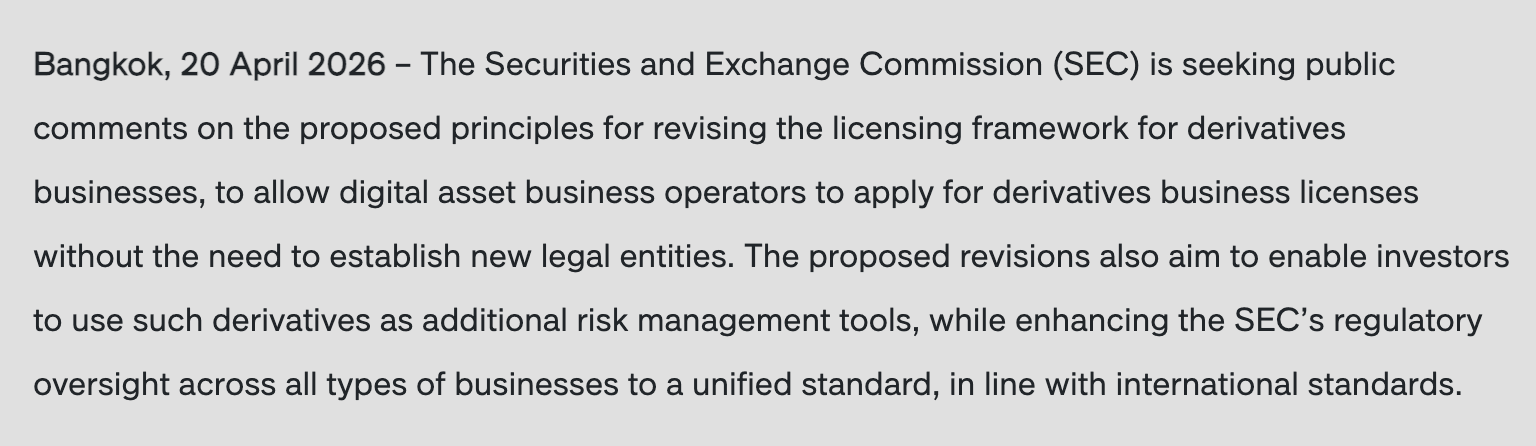
Thailand’s Securities and Exchange Commission (SEC) is seeking public comment on proposed rule changes that would allow licensed digital asset businesses to apply directly for derivatives licenses, removing the requirement to establish separate entities.
The proposed revisions would build on earlier changes recognizing digital assets as eligible underlying assets for futures contracts, expanding the scope of Thailand’s derivatives market while introducing additional requirements to manage conflicts of interest and strengthen oversight.
Thailand, CFTC, United States, Derivatives, Bitcoin Futures, Futures
The proposal could lower barriers for crypto companies to enter the derivatives market by allowing them to apply for licenses within existing entities, rather than establishing separate companies, while bringing those activities under tighter regulatory oversight.
The regulator said the changes are intended to provide investors with additional tools for hedging and portfolio management, as well as bringing standards for derivatives exchanges and clearing houses in line with international practices.
The proposed changes are open for public consultation until May 20, with feedback from industry participants expected to inform the final framework.
Crypto derivatives expand as US moves toward approval
Thailand’s proposal comes as crypto derivatives expand globally and momentum builds toward regulatory approval in the United States.
On Tuesday, Blockchain.com introduced perpetual futures trading in its self-custody wallet, allowing users to open leveraged positions using Bitcoin (BTC) as collateral without transferring funds to an exchange. Underpinned by Hyperliquid, the feature offers access to more than 190 markets with as much as 40x leverage.
Q&A
What are the proposed rule changes by Thailand's SEC regarding crypto futures?
The proposed changes would allow licensed digital asset businesses to apply for derivatives licenses directly, simplifying the licensing process.
How will the new regulations affect crypto companies in Thailand?
The new regulations could lower barriers for crypto companies by allowing them to operate under existing entities, thus facilitating easier entry into the derivatives market.
What is the significance of recognizing digital assets as eligible for futures contracts in Thailand?
Recognizing digital assets as eligible underlying assets for futures contracts expands Thailand's derivatives market and introduces stricter oversight to manage conflicts of interest.
Argentina Launched an AI to Predict the Future. It Couldn't Predict a Typo
Argentina launched the 'Digital Twin' initiative to simulate social policy impacts using AI, but its promotional video was mocked for grammatical errors. Privacy experts raised concerns about governance and potential surveillance issues.
See every story in Crypto — including breaking news and analysis.
Other exchanges have taken a similar approach. Earlier this year, both Kraken and Coinbase launched perpetual futures tied to equities for non-US users as part of a broader push toward 24/7, multi-asset trading.
While most of these products remain largely unavailable in the United States, that could change soon. In March, Michael Selig said the Commodity Futures Trading Commission is working to enable crypto perpetual futures, adding the agency could move on the products “within the next month or so.”
In the meantime, exchanges appear to be positioning for potential approval. Last week, Kraken parent Payward agreed to acquire Bitnomial, a US-regulated derivatives venue, in a move aimed at expanding access to products including perpetual futures for US clients.