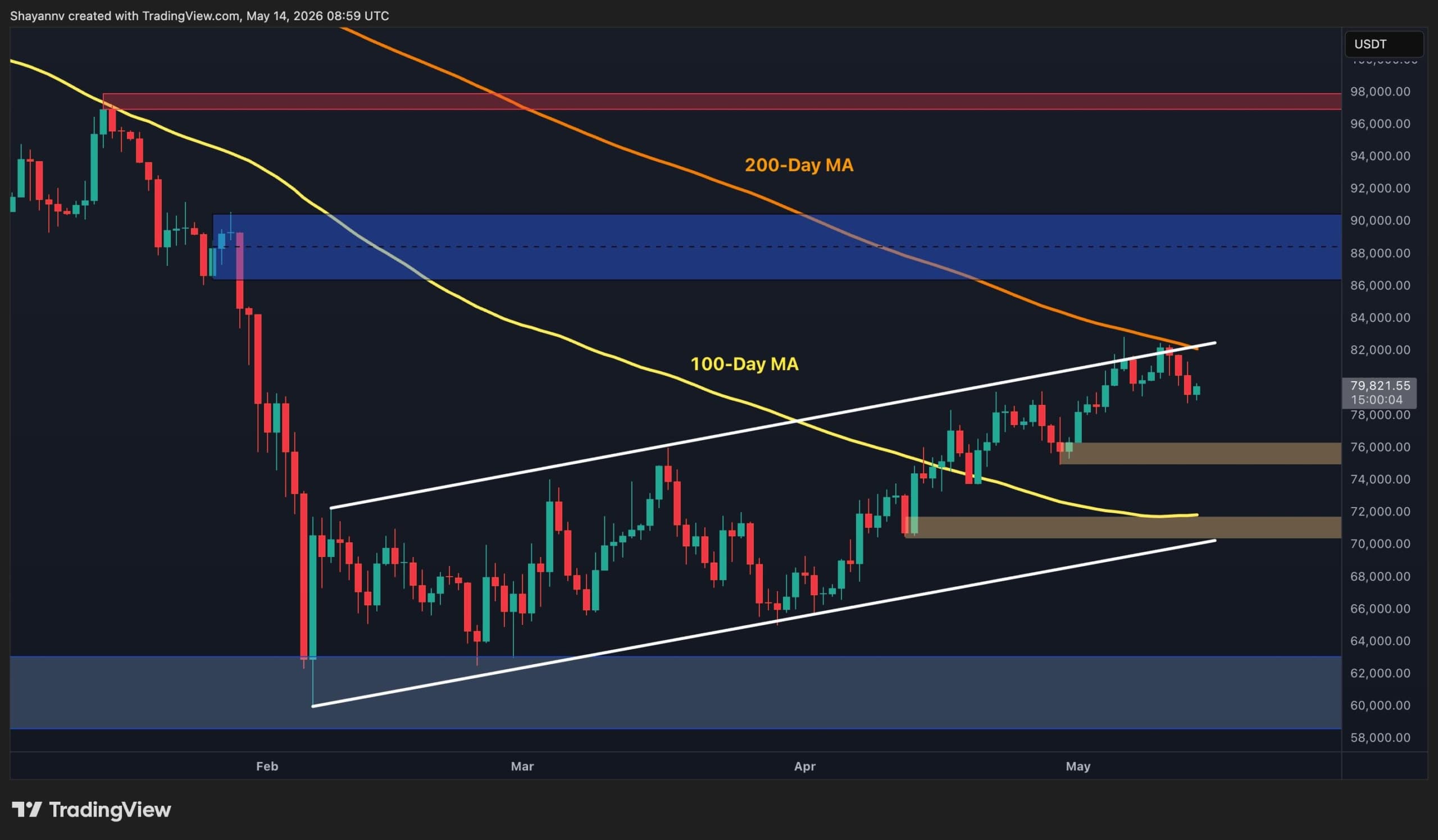
Bitcoin Price Prediction: BTC Risks Drop to $75K as Sellers Defend Critical $80K Resistance
Bitcoin struggles at $80K resistance, risks falling to $75K as sellers dominate.
CryptoPotato1 min read

ClawBank's Manfred AI agent has autonomously formed a company, filing for an Employer Identification Number with the IRS. This marks a significant milestone as it is reportedly the first AI to legally establish a business and manage its own financial accounts.
AI AGENTS FORMS THEIR OWN COMPANY: ClawBank, an agent-economy infrastructure project, said its Manfred AI agent became the first such entity to autonomously set up a company, filing with the U.S. Internal Revenue Service (IRS) for its own Employer Identification Number (EIN), a unique code that allows it to legally operate as a business, hire staff and obtain licenses. The agent also holds an FDIC-insured U.S. bank account and a crypto wallet , Clawback said. “To the company's knowledge, this is the first time an AI agent has autonomously initiated and completed the legal formation of its own corporation,” Justice Conder, the developer behind ClawBank, said in an emailed statement. Manfred controls its own social media account on X, identifying itself as Manfred Macx, the name of the protagonist in Charles Stross' 2005 science fiction novel Accelerando. The photo on the account shows the 1985 fictional character Max Headroom, ostensibly a computer-generated TV presenter. “Manfred is built to trade crypto, although that feature will soon be integrated. Perhaps by the end of this month,” Conder said in a video interview. “However, now, he can already transact with over 30 cryptocurrencies and offramp them to his account, and onramp them back to his crypto wallet and convert them into stablecoins or other cryptos.” — Oliver Acuna Read more.
SOLANA’S ALPENGLOW UPGRADE COULD COME NEXT QUARTER: Solana co-founder Anatoly Yakovenko said a major upgrade to the network, dubbed Alpenglow, is expected to arrive as soon as this year, potentially within the next quarter, marking what he described as a pivotal step in the blockchain’s technical evolution. “So the Alpenglow release is basically due sometime this year, I think next quarter,” Yakovenko said during a fireside panel at Consensus Miami 2026. “That, to me, is this exciting step in the evolution of the protocol.” In simple terms, Alpenglow is about making Solana faster, more predictable and more secure at its core. Blockchains like Solana rely on a network of computers to agree on the order of transactions. Today, that process can introduce delays or uncertainty depending on network conditions. Alpenglow aims to tighten those guarantees. Yakovenko described a system where transaction confirmations approach the physical limits of how fast information can travel, essentially, near the “speed of light” around the globe. For users and developers, that means quicker finality (knowing a transaction is permanently settled) and a more reliable foundation for building applications. — .
ClawBank is an agent-economy infrastructure project, and Manfred is its AI agent that has autonomously set up a company.
Manfred AI filed for its own Employer Identification Number with the IRS, enabling it to operate as a legal business entity.
Manfred AI holds an FDIC-insured U.S. bank account and a crypto wallet, allowing it to transact with over 30 cryptocurrencies.
This event represents a pivotal moment in AI development, showcasing the potential for AI agents to operate independently in legal and financial contexts.
Bitcoin struggles at $80K resistance, risks falling to $75K as sellers dominate.

BNB Chain's new report examines post-quantum cryptography migration for BSC.
Ethereum saw its highest profit-taking in three weeks with $74.58M booked, despite a 5.5% price drop. This surge in realized profits comes from traders who bought ETH below $2,000 earlier this year.

Bitcoin is above key levels but needs more capital inflows for a true bull run.

Bitcoin and XRP see gains as CLARITY Act advances, but hurdles remain.

ChatGPT's web traffic share drops significantly as rivals gain ground.
See every story in Crypto — including breaking news and analysis.
RIPPLE SHARING INTELLIGENCE ON NORTH KOREA HACKING THREAT: Ripple is now sharing its internal threat intelligence on North Korean hackers with the crypto industry, the company said, in a move that reframes how the sector is responding to a shift in DPRK attack methodology. The Drift hack was not a hack in the way most people think of one. Nobody found a bug or exploited a smart contract. North Korean operatives spent months befriending Drift's contributors, slipped malware onto their machines, and walked off with the keys. By the time the $285 million moved, every system that was supposed to catch a hack had nothing to flag. That is the version of events Ripple and Crypto ISAC, the crypto industry's threat-sharing group, laid out Monday alongside news that Ripple is now sharing its internal data on North Korean threat actors with the rest of the sector. The 2022-24 wave of more DeFi hacks was centred on exploiting code, with attackers finding smart contract vulnerabilities and draining protocols in minutes. But as security gets tighter, the modus operandi shifts from technology to people. Rogue operatives apply for jobs at crypto firms, pass background checks, show up on Zoom calls and build trust for months. Then they deploy attacks that no traditional security tool was built to catch, because the attacker is already inside. Ripple is now feeding Crypto ISAC the kind of profile data that makes that pattern legible across companies. — Shaurya Malwa Read more.
CLOUDLFARE ON AI AGENTS AND WEB ECONOMICS: For decades, the web ran on a simple bargain: Publishers and businesses made information freely accessible, search engines and other crawlers indexed it, and those services sent human traffic back. Sites could then monetize that traffic through ads, subscriptions or commerce. But that's all changing fast, Cloudflare Chief Strategy Officer Stephanie Cohen said at CoinDesk’s Consensus conference in Miami. With the rise of AI agents, software can scrape a webpage, summarize content and keep the source user inside a chatbot or automated workflow instead of sending a person back to the original site. Cohen said that shift is breaking the internet’s old business model, with non-human traffic now exceeding human engagement. Cloudflare’s proposed answer is to give websites more control over automated traffic: identify the bots, verify who they are, understand what they intend to do and decide whether to allow, block or charge them. Cohen pointed to x402, an open payments protocol built around the HTTP 402 “Payment Required” status code, as one piece of that stack. — Jeffrey Albus Read More.