This Is How Polkadot Was Exploited: Critical Safety Vulnerability

TL;DR
Polkadot faced a significant exploit that revealed a vulnerability in its token issuance on the Ethereum network, resulting in a massive price drop. An attacker minted one billion DOT and sold it for 108.2 ETH in a single transaction.
Key points
- Polkadot experienced a serious exploit on its Ethereum network
- An attacker minted about one billion DOT tokens
- The attacker dumped the tokens for 108.2 ETH
- The exploit revealed a weakness in token issuance control
- It occurred on the Ethereum-side implementation, not the native chain
Polkadot experienced a serious exploit that exposed a basic weakness in token issuance control on its Ethereum network. The exploit led to a catastrophic price drop, essentially bringing meme coin dynamics to the DOT token.
Background of attack
On-chain data indicates that an attacker minted about one billion DOT and instantly dumped the entire supply in a single transaction, extracting 108.2 ETH in value. It is important to realize that the exploit occurred on Polkadot's Ethereum-side token implementation rather than the company's native chain. This strongly implies that there is a problem somewhere in the mechanism that permits DOT to exist on Ethereum as a transferable asset, such as in a bridge contract, wrapper logic or mint authority permissions.
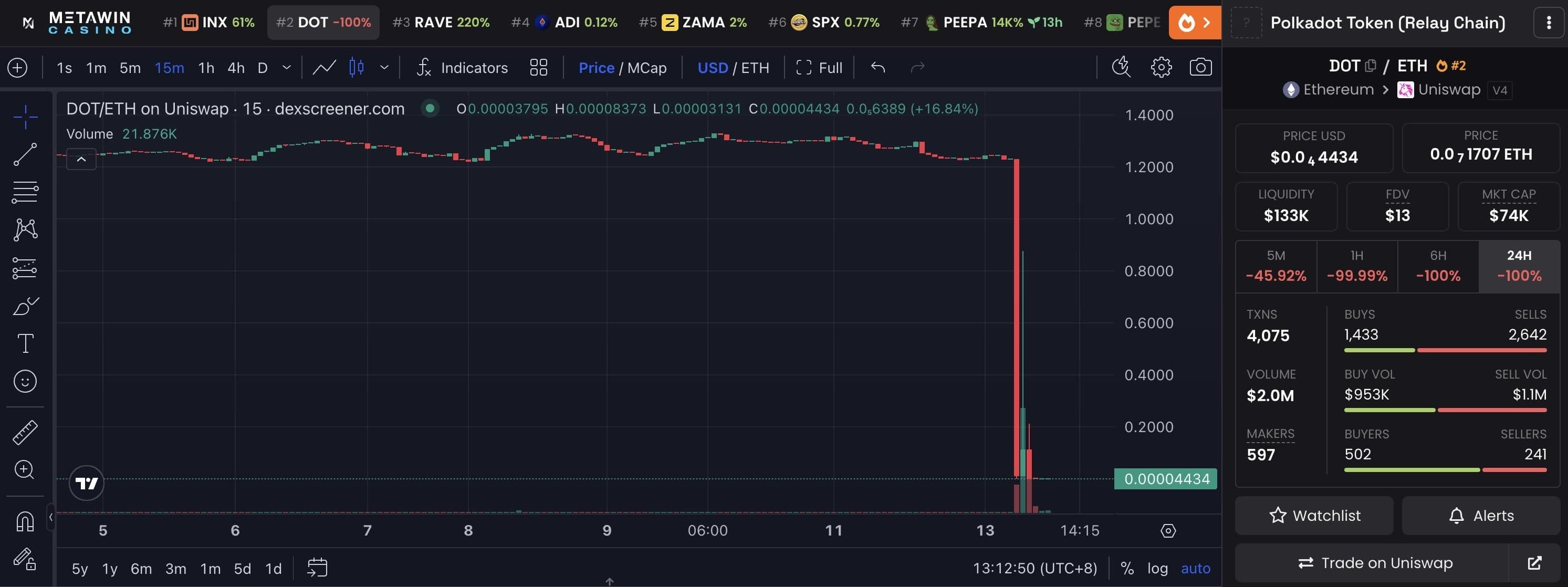
Source: DeFILiama via LookOnChain
To put it another way, this was not printing DOT out of thin air on a global scale, but it did work that way inside the Ethereum ecosystem. The attacker acted in a simple manner: mint, dump, exit. No prolonged draining, no attempt at obfuscation, just a quick extraction of the liquidity that is available.
Liquidity was low, which explains why the damage seems to be limited. The attacker could only make roughly $237,000 with one billion tokens before slippage eliminated any potential for additional profit.
Polkadot mint exploit
Nonetheless, the loss is not as bad as it appears. The artificial mint exposed how brittle off-chain representations of assets can be when contract security is weak, causing DOT's market cap on Ethereum to spike into ridiculous, pointless territory. The numbers were totally disconnected from reality for anyone depending solely on these metrics.
The root cause is what matters now. This represents a serious operational failure if there were to be a permission misconfiguration. The problem is more serious and may impact other wrapped assets that use comparable infrastructure if it is a smart contract vulnerability.
Predictable behavior ensued, with shrewd traders jumping in to buy the dip and handle the situation as though it were a meme coin wager. This type of response is common in environments with fragmented liquidity, where price discovery is disrupted.
The exploit revealed how risky Polkadot's Ethereum-side implementation might be but it did not actually break Polkadot. Any wrapped DOT on Ethereum should be considered a compromised risk until the precise vector is found and fixed.
Q&A
What vulnerability was exploited in Polkadot's Ethereum network?
The exploit exposed a weakness in the token issuance control, allowing an attacker to mint and dump one billion DOT.
How much ETH did the attacker extract from the Polkadot exploit?
The attacker extracted 108.2 ETH by dumping the minted DOT tokens.
Did the exploit occur on Polkadot's native chain or its Ethereum implementation?
The exploit occurred on Polkadot's Ethereum-side token implementation, not on its native chain.