News
Galaxy Digital and BitGo Clash in Court Over Failed $1.2 Billion Crypto Merger
BitGo and Galaxy Digital are in court over a failed $1.2 billion merger, with BitGo seeking $100 million in damages.
CryptoPotato1 min read

UAE investors are capitalizing on the AI sell-off by increasing their holdings in software and AI infrastructure, despite regional conflicts. This trend indicates a commitment to long-term digital asset themes rather than a retreat from risk.
United Arab Emirates investors are leaning into the artificial intelligence sell-off rather than running from it, despite the regional conflict testing the Gulf’s ambitions to become a global hub for AI and digital assets.
New eToro data shared with Cointelegraph on Wednesday show users in the UAE boosted holdings of software and AI infrastructure names whose share prices fell sharply in the first quarter, suggesting they used the downturn to “buy the dip” rather than broadly de-risk.
The pattern suggests UAE investors are staying exposed to long-term AI and digital-infrastructure themes even as the conflict raises fresh risks for data centers, logistics and cross-border technology build-outs in the Gulf. An April 13 report from Deutsche Bank said the shock is more likely to sharpen rather than derail demand for AI, cybersecurity and sovereign digital infrastructure in the region.
Related: Bitcoin falls to lower support as analysts say markets are ignoring key Iran issue
Josh Gilbert, market analyst at eToro, told Cointelegraph that UAE investors became more selective over where they took risk in Q1, and investor behavior was driven by long-term themes rather than a risk-off mindset.
He said the clearest signal was across AI infrastructure and software names, pointing to ServiceNow (+125%), Super Micro Computer (+65%), Adobe (+54%) and Oracle (+38%), which all saw significant increases despite market pressure.
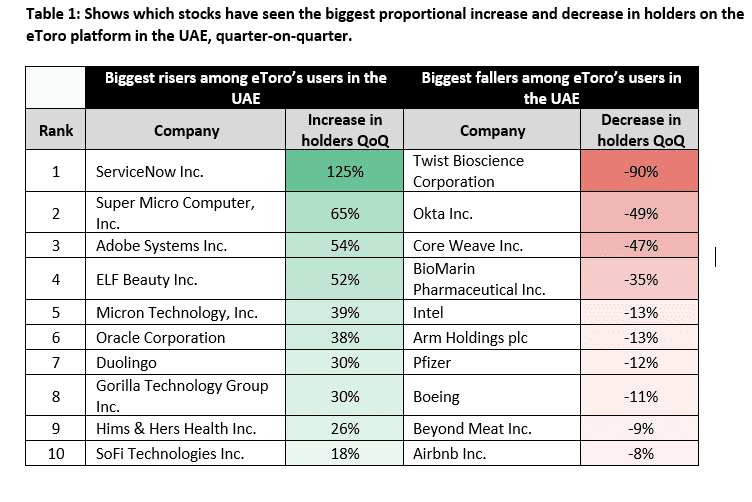
What UAE investors bought in Q1, 2026. Source: eToro
On the crypto side, he said that Strategy Inc. remained the eighth-most-held stock, indicating continued exposure to crypto-linked equities.
The resilience comes as the US-Israeli conflict with Iran has exposed new risks for Gulf tech infrastructure. Deutsche Bank cited reported strikes on Amazon Web Services data centers in the UAE and Bahrain and threats against the planned 1GW Stargate campus in Abu Dhabi.
Gilbert said the conflict was driving volatility, with sharp oil price swings that can ultimately affect tech valuations. Maintaining core exposure to diversified mega-cap tech while rotating within the sector suggests a more nuanced, risk-aware approach, he said.
UAE investors are increasing their holdings in software and AI infrastructure instead of selling off their assets.
The regional conflict is raising risks for data centers and logistics, but it is not deterring demand for AI and digital infrastructure.
The eToro data shows that UAE investors are becoming more selective and focusing on long-term themes rather than adopting a risk-off approach.
UAE investors are influenced by long-term themes in AI, cybersecurity, and digital infrastructure despite current market volatility.
BitGo and Galaxy Digital are in court over a failed $1.2 billion merger, with BitGo seeking $100 million in damages.

Based Apparel, linked to Kash Patel, goes offline after malware warnings.

How Kevin Warsh's Fed Chairmanship Could Change Bitcoin Forever
Fidelity's Jurrien Timmer suggests Bitcoin is in an early bull market, defying resistance.
SEC delays exemption for tokenized stocks due to issuer concerns.
Microsoft's Fara1.5 model outperforms OpenAI and Google in web browsing tests.
See every story in Crypto — including breaking news and analysis.
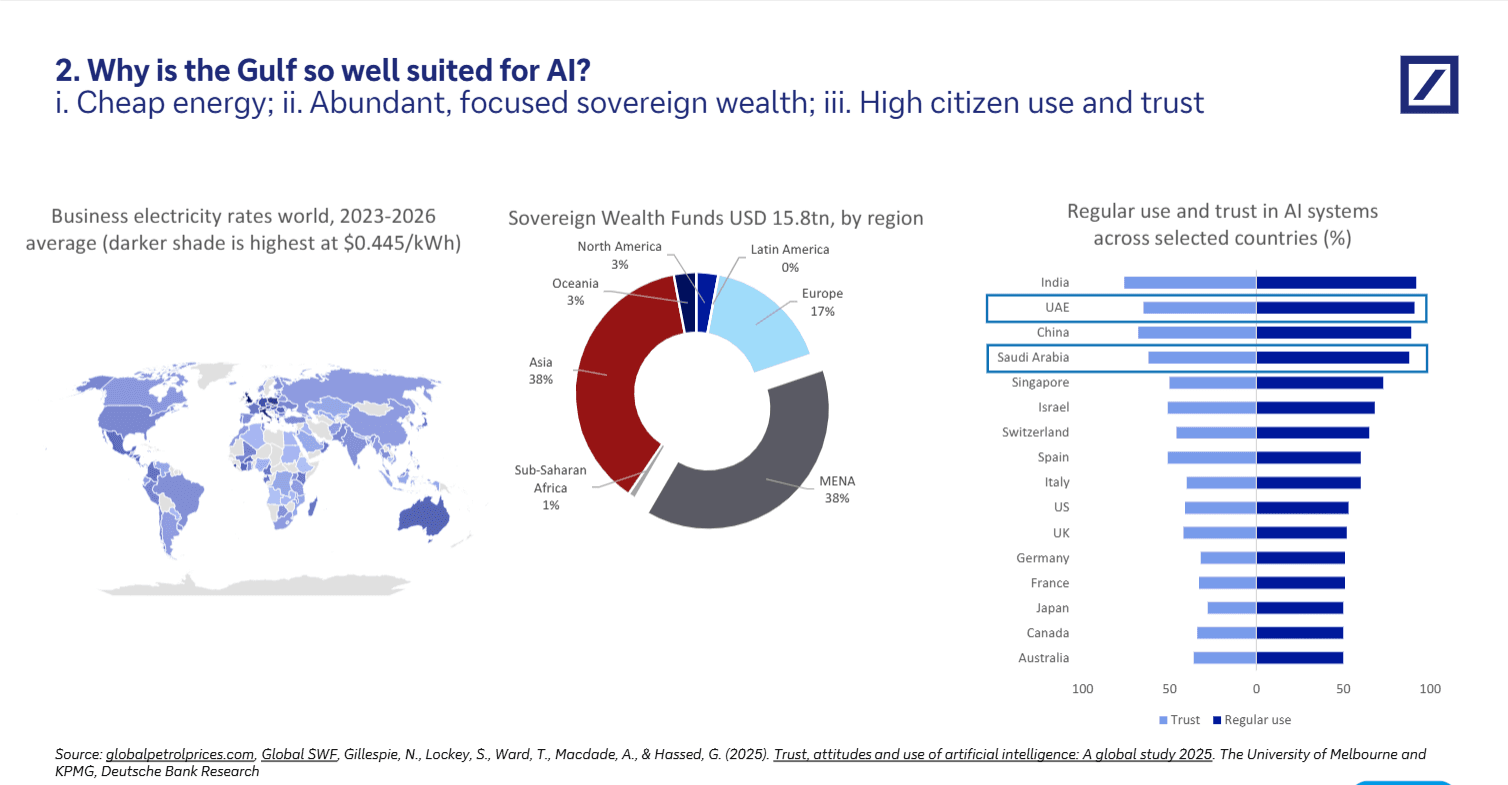
Why is the Gulf so well-suited for AI? Source: Deutsche Bank
Deutsche also highlighted that the Gulf, and the UAE in particular, is unlikely to abandon the AI race. The region benefits from cheap energy, an unusually dense pipeline of data center projects, and sovereign wealth funds that control about $5 trillion worldwide in 2025, with Abu Dhabi vehicles among the most aggressive backers of global AI deals, the report said.
On the ground in Dubai, crypto players say the conflict has slowed but not derailed the city’s hub ambitions. HashKey MENA’s managing director, Ben El-Baz, told Cointelegraph that operations remained “broadly functional,” helped by cloud-based trading and custody systems less dependent on a physical location, even though remote work and travel disruptions were unavoidable.
Other companies, including Binance, also continued normal operations, despite reports to the contrary. A Binance spokesperson told Cointelegraph employees were given the option of temporary relocation as a precautionary measure, but the “vast majority” chose to remain, while major conferences such as Token2049 were postponed.
Dubai-based investment firm, Ento Capital, says the conflict is “refining” rather than derailing the GCC story. Senior executive officer Hayssam El Masri told Cointelegraph that investors have shifted from “confidence-driven to risk aware,” but are generally not exiting the region. War-tested resilience and ongoing investment in AI, cloud and crypto infrastructure may ultimately strengthen the GCC’s long-term positioning, he said.
Dubai’s Virtual Assets Regulatory Authority (VARA) has continued to roll out its activity-based framework throughout the turmoil, including detailed guidance on token issuance and formal rules for crypto derivatives.
Sean McHugh, VARA’s head of market assurance, told Cointelegraph that in periods of stress, serious market participants do not seek “the lightest-touch jurisdiction, they look for the clearest one,” adding that Dubai’s combination of transparent licensing, visible supervision and active enforcement is meant to persuade institutions to treat the emirate as a strategic base rather than an opportunistic punt.