Visa deepens blockchain push with Tempo validator node launch

TL;DR
Visa has launched a validator node on the Tempo blockchain to verify and process transactions for real-time stablecoin payments. This initiative positions Visa as an 'anchor validator' alongside other early participants like Stripe and Zodia Custody.
Key points
- Visa launched a validator node on the Tempo blockchain
- The node is operated in-house using Visa's infrastructure
- Tempo is designed for real-time stablecoin payments
- Visa is positioned as an 'anchor validator' with Stripe and Zodia Custody
- Validators can earn stablecoin rewards for confirming transactions
Visa has launched a validator node on the Tempo blockchain, taking a direct role in verifying and processing transactions on a network designed for real-time stablecoin payments.
Visa said the node is operated in-house using its own infrastructure and was developed over six months working with Tempo’s engineering team, positioning the company as an “anchor validator” alongside early participants including Stripe and Zodia Custody.
The role places Visa in the transaction validation layer, where it helps order and confirm payments while supporting network security and performance during the network’s early phase.
Tempo is a Layer 1 blockchain designed for real-time payments and stablecoin-based transactions, with validators responsible for confirming transactions and maintaining the network’s ledger. Validators on the network can earn stablecoin-denominated rewards when selected to package transactions into blocks, according to the announcement.
The move adds to Visa’s existing blockchain activity, including its recently announced role as a validator on the Canton Network, where it works with financial institutions on privacy-focused onchain payment systems.
Related: Euro stablecoins dominate non-dollar market, Visa-backed report finds
Payment companies expand stablecoin infrastructure
As stablecoins gain traction in payments, major payment companies are expanding infrastructure that connects traditional finance with blockchain-based settlement.
In October 2024, Stripe finalized a $1.1 billion agreement to acquire stablecoin platform Bridge. The following year, it introduced stablecoin-based accounts for clients in more than 100 countries, allowing businesses to send, receive and hold US-dollar stablecoins similar to traditional bank balances.
Last month, Mastercard agreed to acquire stablecoin infrastructure company BVNK in a deal valued at up to $1.8 billion. BVNK enables businesses to send and receive stablecoin payments, convert between fiat and crypto, and operate across more than 130 countries.
Meanwhile, Visa has focused on building and operating its own systems. In July, the company expanded its settlement platform to support tokens such as PayPal USD (PYUSD) and Euro Coin (EURC), as well as networks including Stellar (XLM) and Avalanche (AVAX).
In March, it also expanded its stablecoin card partnership with Bridge to 18 countries, with plans to reach more than 100 markets by year-end.
According to DefiLlama data, stablecoin market capitalization stood at nearly $319 billion at the time of writing, up from about $307.5 billion at the start of the year.
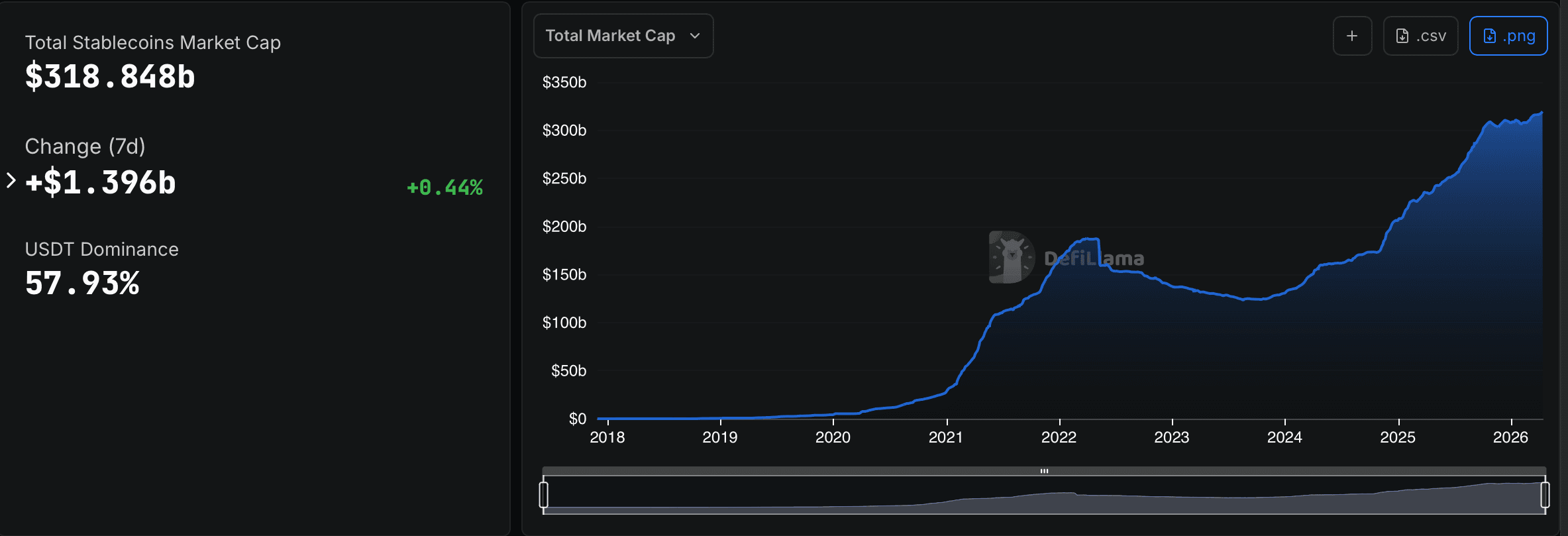
Stablecoin market cap. Source: DefiLlama
Magazine: Singapore is no ‘crypto hub’ — but it is serious about stablecoins: StraitX CEO
Q&A
What is the purpose of Visa's validator node on the Tempo blockchain?
Visa's validator node on the Tempo blockchain is designed to verify and process transactions, enhancing network security and performance.
Who are the other participants alongside Visa in the Tempo blockchain?
Other participants alongside Visa in the Tempo blockchain include Stripe and Zodia Custody.
How does Visa's validator node contribute to the Tempo blockchain's operations?
Visa's validator node contributes by ordering and confirming payments, which is crucial for maintaining the network's ledger during its early phase.