XRP Folds Under No Pressure Whatsoever, You Need 62 Days to Withdraw Ethereum (ETH), Hyperliquid (HYPE) Paints Falling Star: Crypto Market Review | Cryptalytic
XRP has failed to break through a weak resistance level, indicating weak demand. The asset continues to be trapped in a downtrend with no significant recovery attempts.
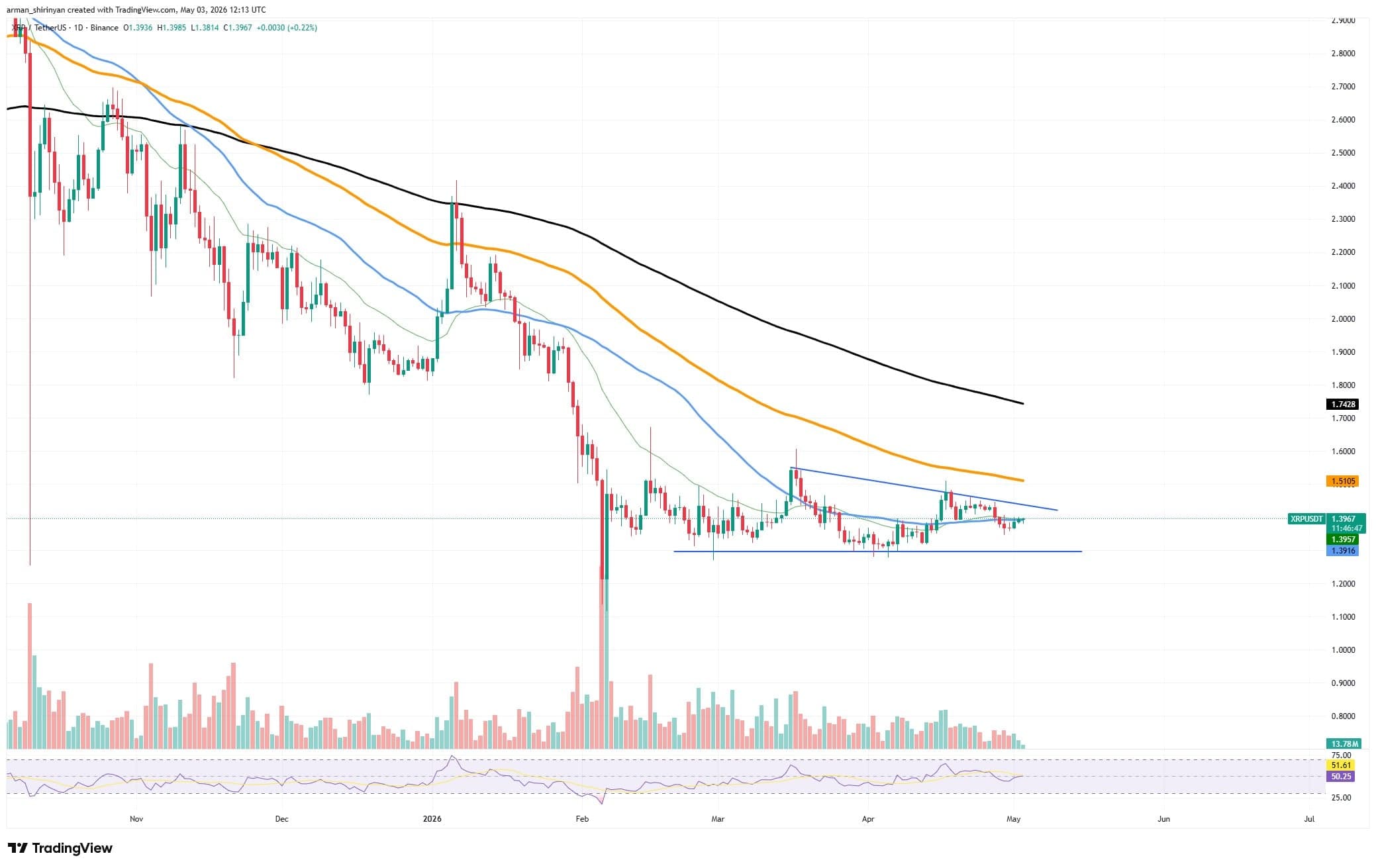
The issue is that XRP was rejected at a level that shouldn't have been a significant barrier. The asset rolled over almost immediately after failing to overcome a comparatively weak descending resistance, indicating that buyers are not in control even under low pressure.
According to the chart, XRP has been trapped in a more general downtrend for months, with each attempt at recovery being thwarted by lower highs. The same script was used in the most recent action. Instead of consolidating or building, the price printed a swift rejection and began drifting lower once more, as it got closer to the declining trendline and the cluster around the 50 EMA.
There was only a subdued fade, no real struggle against resistance, and no increase in volume. Such actions are important. The inability of an asset to overcome small resistance levels typically indicates weak underlying demand. Strong markets either pass through these zones or, at the very least, try them several times before failing. That was not even possible for XRP; it folded upon first contact.
The structure is currently bearish. Only the horizontal support in the $1.30-$1.32 range prevents the price from plunging further. However, repeated tests at that level without significant recoveries weaken the floor and are not a bullish indication. There won't be much structure until lower liquidity zones if that support falters, which could lead to a more dramatic decline than most anticipate.
Moving averages don't help either. The wider downtrend is being strengthened by the 26 and 50 EMAs, which are still above price and serving as dynamic resistance. Any increase in value is probably going to be fleeting until XRP firmly regains those levels.
The same indecision that is trending toward weakness is reflected in momentum indicators. Despite numerous opportunities, the RSI is flatlining in neutral territory, indicating no significant buying pressure. XRP is not responding as an asset getting ready for a breakout at this time. It is acting as if it is gradually losing support.
Q&A
Why did XRP fail to break through its resistance level?
XRP was unable to overcome a weak descending resistance, suggesting that buyers lack control even under low pressure.
What does XRP's recent price action indicate about market demand?
The swift rejection and lack of struggle against resistance indicate weak underlying demand for XRP.
How long has XRP been in a downtrend?
XRP has been trapped in a general downtrend for several months, with repeated failures to recover.
What is the significance of the 50 EMA in XRP's price movement?
The 50 EMA serves as a key level of support or resistance, and XRP's price action near this level has shown a tendency to drift lower.
See every story in Crypto — including breaking news and analysis.
Ethereum validators queue turmoil
The majority of the market is not pricing this in yet, as indicated by Ethereum's validator dynamics. Entry wait times are once again exceeding 60 days, and the validator queue has increased once more. This indicates an influx of new validators, but more significantly, withdrawals are becoming more difficult, and exits are increasing as well.
There is a noticeable shift in the data. The entry queue has abruptly reversed, pushing back toward 3,500+ validators waiting after continuously decreasing through March. The exit queue is growing and is no longer insignificant, suggesting that some participants are actively trying to get out of their staking positions. Entry and exit lines that grow at the same time typically indicate uncertainty rather than confidence.
Compare that to the price chart. Every recent attempt to move higher has been capped by a descending trendline, as ETH grinds into a resistance cluster around the 100 EMA. Technically speaking, the price structure is still recovering from the decline in February, but momentum is waning in crucial areas.
The issue is that big stakers cannot immediately leave if they so choose. Delayed sell pressure results from a withdrawal timeline of 62 days. You get a pipeline of future supply that is ready to enter the market rather than an instant surrender. Because any upward move runs the risk of being met by unlocked liquidity weeks later, that overhang typically suppresses rallies.
We are probably witnessing a controlled grind higher into resistance rather than a significant reversal of the trend. The key levels are still simple. To verify strength, ETH must break and hold above the 100 EMA and declining resistance. If this fails, the $2,100–$2,200 range, which has been serving as a local demand area, becomes accessible.
Hyperliquid cycle ends
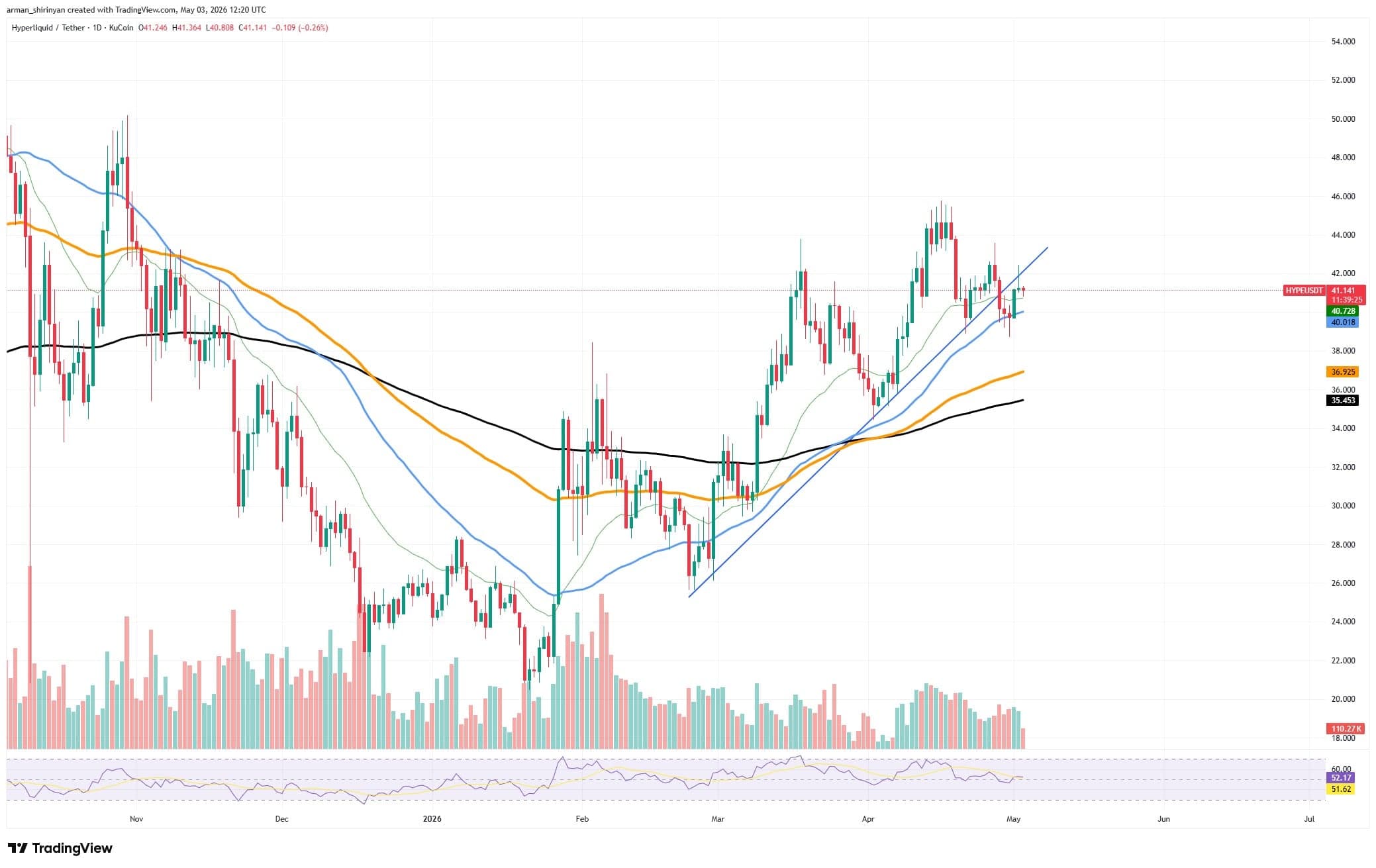
Right where it counts, Hyperliquid is displaying a classic reversal signal. HYPE has printed what appears to be a textbook falling star close to local highs. Following a recovery rally from the March lows, this pattern usually denotes exhaustion rather than continuation.
With the help of short-term moving averages and a steep ascending structure, the price pushed hard toward the $44-$46 range. Although momentum was strong, the most recent candle, which has a long upper wick and a small body, indicates that buyers drove the price higher but were unable to hold it. Sellers moved swiftly to force a close back close to the lower range of the session.
You don't ignore rejection like that, especially after a long-term move. HYPE is currently at a crossroads in terms of structure. Although it is under test, the rising trendline that has sustained the rally is still in place. The move from late March begins to resemble a completed impulse rather than the start of a long-term uptrend if price loses that support.
With the price above the 26 and 50 EMAs, the moving averages continue to show a short-term bullish trend, but that support is getting smaller. The 100 EMA is still below and rising, which might serve as a backup cushion. However, if the price rotates downward with momentum, that level turns into a magnet rather than support.
Moreover, volume does not prove strength. The breakout narrative is undermined by the lack of a clear increase in participation that accompanied the rally into resistance. In the meantime, momentum appears to be stalling rather than accelerating, as the RSI flattens close to mid-to-upper levels.
A pullback or consolidation stage is frequently preceded by a falling star at local highs. Anticipate a move toward the $38-$36 range, where the 100 EMA and stronger structural support converge, if the rising trendline breaks.