A Blues-Singing AI Frog Is Taking Over TikTok Brazil
TL;DR
The TikTok account IABatida has transformed the classic Brazilian nursery rhyme 'O Sapo não lava o pé' into a 1950s blues song featuring AI-generated frogs. The account has gained significant popularity with 326,000 followers and 6.7 million likes.
Key points
- IABatida created a blues version of a classic Brazilian nursery rhyme
- The account has 326,000 followers and 6.7 million likes
- The performance features AI-generated frogs
- The nursery rhyme is about a frog that doesn't wash its feet
- The Baby Shark remix received 1.6 million likes
In brief
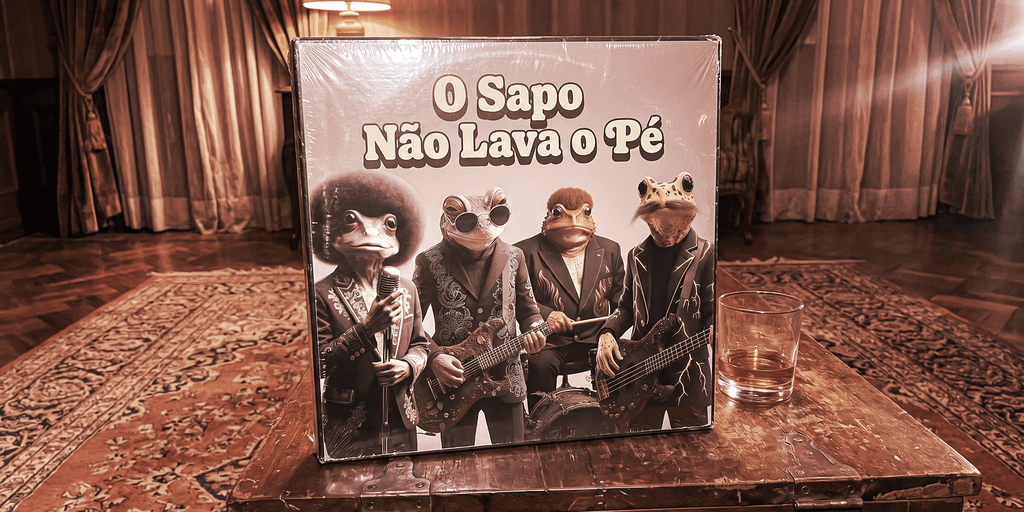
- TikTok account IABatida turned "O Sapo não lava o pé," a classic Brazilian nursery rhyme, into a smoky 1950s blues number performed by AI-generated frogs.
- The channel has 326,000 followers and 6.7 million likes, with its Baby Shark 50's remix alone pulling in 1.6 million likes.
- The format slots cleanly into the AI-native meme lineage that runs from "Make It More" through Studio Ghibli filters to Italian brainrot.
"O Sapo não lava o pé" (the frog doesn't wash its feet) is the kind of song every Brazilian child learns before they can read. It's about a frog who refuses to wash his feet. That's the whole plot.
This week, an account called IABatida turned that nursery rhyme into a 1950s-style blues track, performed by a band of AI-generated frogs in a smoky lounge. The vocals are gravelly. The guitar is warm. There's a stand-up bass.
It is, somehow, very good.
The video is labeled as AI-generated and has racked up more than 1.5 million likes on TikTok in a few days, with a parallel YouTube Shorts version pulling its own crowd. Brazilian commenters keep arriving in shifts to say the same thing in different ways: This should not work, but it does.
IABatida ("AI Beat" in Portuguese) has built an entire schtick out of running children's songs and pop classics through AI as if they were recorded in another era. The account sits at 328,000 followers and 6.7 million total likes. Its 50s Motown-style cover of "Baby Shark" has 1.6 million likes on its own. An indie-rock version of the same song has another 388,900.
The trick is that the music is not bad. The arrangements have actual structure—choruses, bridges, restrained solos, and voices that actually sound pretty nice. The visuals match the era. The whole thing feels studied, not slopped together.
And that’s the point. The frog video belongs to a now-familiar species of internet artifact: the AI-native meme. Not a meme made with AI, but a meme that exists because AI exists, and would not be possible without it.
Decrypt has been tracking this lineage for a while. It probably started in late 2023 with the "Make It More" trend, where users asked ChatGPT to turn a normal image into something progressively more absurd until DALL-E gave up.
Then came "Ghibligeddon" in March 2025, when GPT-4o's image generator drove a million people to sign up for ChatGPT in a single hour to turn their selfies into Studio Ghibli stills. Sam Altman publicly begged users to please chill while OpenAI's GPUs melted.
Then there's Italian brainrot—the genre that gave the world Tralalero Tralala, a three-legged shark in Nike sneakers; Bombardiro Crocodilo, a crocodile fused with a WWII bomber; and Ballerina Cappuccina, a ballerina with a cappuccino cup for a head. Tralalero Tralala first surfaced in January 2025 from a since-banned TikTok account. Ballerina Cappuccina followed in March 2025. By spring of that year, Italian brainrot characters were appearing in Ryanair ads and Loewe campaigns.
Other AI-native meme trends include the “pack” trend and the “dollification” trend started by Google after the release of Nano Banana.
From photo to figurine style in just one prompt.
People are having fun turning their photos into images of custom miniature figures, thanks to nano-banana in Gemini. Try a pic of yourself, a cool nature shot, a family photo, or a shot of your pup.
Here’s how to make your own 🧵 pic.twitter.com/e3s1jrlbdT
— Google Gemini (@GeminiApp) September 1, 2025
What IABatida is doing fits the pattern but flips one variable. Italian brainrot mostly leans on the joke that AI generates incoherent nonsense and we love it anyway. The frog blues works, arguably, in the opposite direction. The joke is that the AI is competent. Suspiciously competent.
You watch the video expecting the punchline to be how janky it looks. Instead you sit there for forty seconds wondering whether you should pour yourself a drink.
Then the song gets stuck in your head.
That's the new shape of the AI meme economy in 2026. Generators like Suno, Udio, and Google's Lyria 3 can now produce three-minute songs with coherent structure from a one-line prompt. Image and video models can render a frog quartet in period-correct lighting without anyone having to model a single mesh.
The barrier to making something that looks and sounds like an actual production is now roughly the time it takes to type one paragraph.
IABatida's back catalog already covers Aladdin's "Arabian Nights," the Brazilian children's classic "Pintinho Amarelinho," and multiple Baby Shark variants in styles ranging from 50s Motown to indie rock. The frog is just the latest entry. The next cover drops whenever the algorithm cools down.
Q&A
What is the nursery rhyme 'O Sapo não lava o pé' about?
'O Sapo não lava o pé' tells the story of a frog that refuses to wash its feet, a song familiar to many Brazilian children.
How popular is the TikTok account IABatida?
IABatida has 326,000 followers and has received 6.7 million likes on its videos.
What style of music did IABatida use for the AI-generated frog performance?
IABatida turned the nursery rhyme into a smoky 1950s blues track performed by AI-generated frogs.
What other content has IABatida produced that gained attention?
IABatida's Baby Shark 50's remix has garnered 1.6 million likes, showcasing its appeal in the AI-native meme culture.