
BASIS.pro Is Live: Base58Labs Officially Launches Crypto Arbitrage Platform
BASIS.pro is now live! Discover the new crypto arbitrage platform.
CryptoPotato1 min read
The legal battle over regulating prediction markets may escalate to the US Supreme Court after a recent appeal by Kalshi against Nevada's ban on its event contracts. A federal court previously blocked Arizona from enforcing its gambling laws on Kalshi's contracts.
Mentioned in this story
Some legal experts speculated that the state vs. federal jurisdiction battle over regulating prediction markets companies could soon be headed to the United States Supreme Court.
On Thursday, the US Court of Appeals for the Ninth Circuit heard oral arguments from lawyers representing prediction markets platform Kalshi and Nevada authorities over the state's ban on the prediction markets' event contracts. The appeal was over a lower court decision preventing Kalshi from offering certain event-based contracts in Nevada, based on claims that the company needed a gaming license.
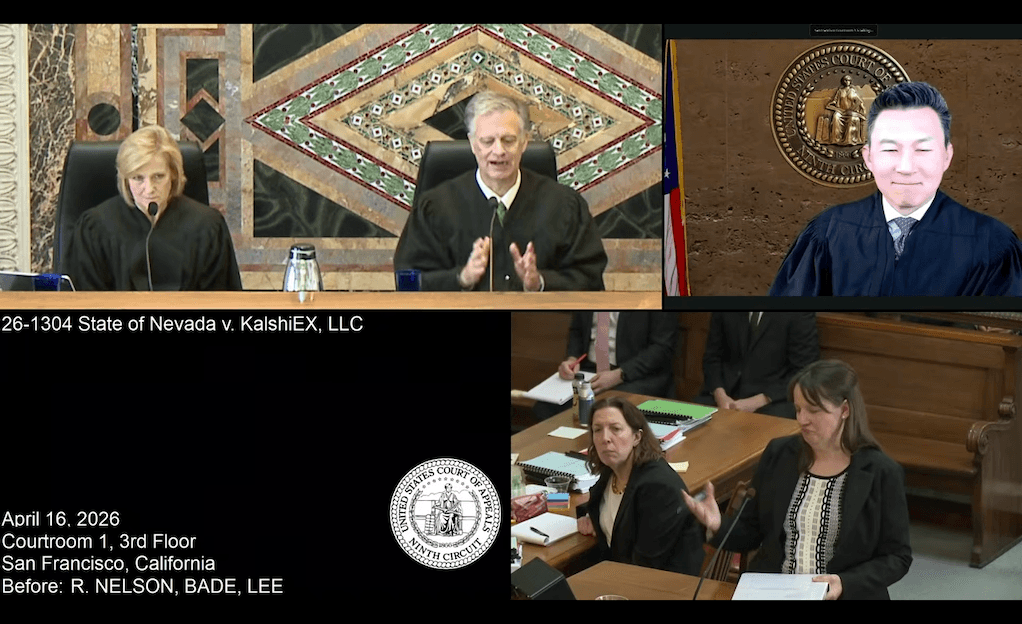
Thursday oral arguments by Kalshi and the State of Nevada. Source: US Court of Appeals, Ninth Circuit
The appellate judge overseeing Thursday’s oral arguments and the lawyer for Kalshi acknowledged that there had been several state-level enforcement actions against the company and other prediction market platforms, including criminal charges filed in Arizona. However, last week a federal court blocked Arizona authorities from enforcing the state’s gambling laws on Kalshi’s event contracts.
“I think the body of case law does demonstrate that what we really need to avoid here is having a state and a federal court considering exactly the same issue at exactly the same time and potentially reaching different outcomes,” said Colleen Sinzdak, representing Kalshi.
Related: CFTC probes oil futures trades tied to Trump's moves in Iran: Report
Central to Kalshi’s argument was that the platform’s event contracts were “swaps” falling under the purview of the Commodity Futures Trading Commission (CFTC) rather than state gaming authorities. CFTC Chair Michael Selig has backed this position in the case of Crypto.com’s prediction markets against Nevada authorities.
Kalshi is appealing a lower court decision that prevents it from offering certain event-based contracts in Nevada due to a state ban.
If the appeal progresses to the US Supreme Court, it could set a significant precedent for how prediction markets are regulated at both state and federal levels.
Kalshi has faced several state-level enforcement actions, including criminal charges in Arizona, but a federal court recently blocked Arizona from enforcing its gambling laws on Kalshi.
BASIS.pro is now live! Discover the new crypto arbitrage platform.

Charles Hoskinson decries removal of Section 604 as a threat to open-source development.

Bitcoin battles key resistance levels at $82,000–$82,500 as it seeks a breakout.

Exodus Movement sells over 1,000 Bitcoin, reducing reserves by 63% as revenue drops significantly.

CoinMarketCap warns crypto users about fake 'CMC Tokens' scams!

XRP breaks $1.46 despite futures selling; market dynamics reveal complexities.
See every story in Crypto — including breaking news and analysis.
The appellate court did not immediately announce a decision following oral arguments. Any ruling could affect how state courts treat prediction market platforms like Kalshi and Polymarket as policymakers come to terms with the growing market, expected to reach $1 trillion by 2030.
Coinbase chief legal officer Paul Grewal, whose company was not a party to the Kalshi proceedings but has a stake in the prediction markets fight, speculated that the case could go the US Supreme Court.
“The questions at oral argument are an unreliable signal in predicting the leanings of a court,” said Coinbase chief legal officer Paul Grewal in a Thursday X post following the oral arguments. “Either way, I stand by my longstanding prediction— the Supreme Court will resolve whether sports [contracts] on [Designated Contract Markets] are swaps subject to the exclusive jurisdiction of the CFTC.”
The US Supreme Court gave states the authority to regulate sports gambling in its 2018 decision in Murphy v. National Collegiate Athletic Association.