The BIS warns that US dollar stablecoins could threaten financial stability and economic policy if they grow significantly. General manager Pablo Hernández de Cos emphasized the need for tighter global coordination and regulation of these assets.
Key points
BIS warns of risks from US dollar stablecoins
Stablecoins may threaten financial stability
Need for global coordination on stablecoin regulation
Mentioned in this story
Bank for International SettlementsPablo Hernández de Cos
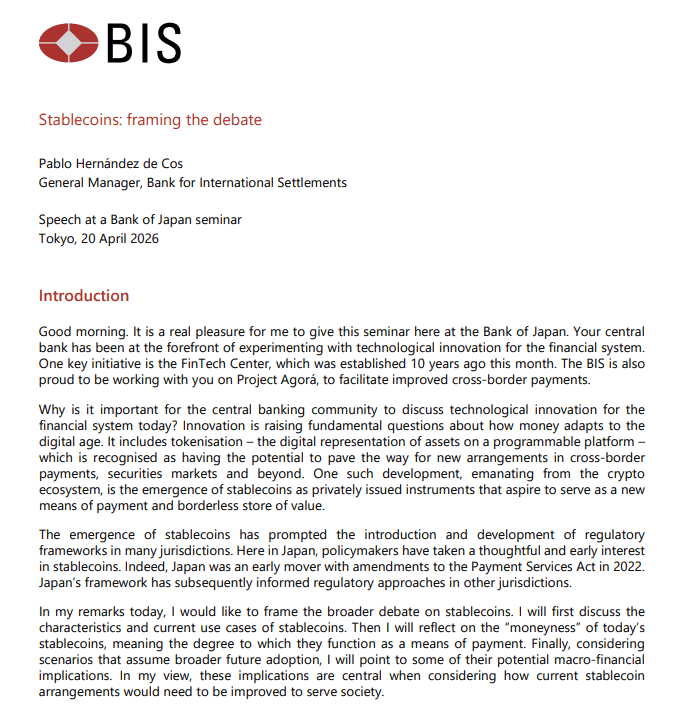
The Bank for International Settlements (BIS) general manager, Pablo Hernández de Cos, called for tighter global coordination on stablecoins Monday, warning that US dollar-denominated tokens could have “material consequences” for financial stability and economic policy if they grow large enough to rival traditional money.
Speaking at a Bank of Japan seminar in Tokyo, he said current stablecoin arrangements fall short of what is needed for a widely used means of payment, even if they offer faster cross-border transfers and integration with smart contracts.
De Cos said the largest US dollar stablecoins, such as USDt (USDT) and USDC (USDC), share characteristics with investment products rather than cash-like money, pointing to fees and conditions on primary market redemptions and episodes where their prices diverge from par in secondary markets.
In his view, these features make the tokens behave more like exchange-traded funds (ETFs), while still creating run and contagion risks because issuers hold short-term government debt and bank deposits as reserve assets. In a stress episode, he warned, rapid outflows from stablecoins could force sales of those reserves into already strained markets or transmit funding pressure to banks.
The warning comes as policymakers globally debate how to regulate fast-growing stablecoins and other tokenized money-like instruments.
Coinbase, Japan, Switzerland, ECB, United Kingdom, BIS, Stablecoin
He added that the use of public, permissionless blockchains and unhosted wallets means a significant share of activity sits outside conventional Anti-Money Laundering and Counter-Terrorism Financing controls, making stablecoins attractive for illicit use unless bespoke safeguards are implemented at on- and off-ramps.
Europe sharpens its stablecoin stance
Q&A
What are the potential risks of US dollar stablecoins according to the BIS?
The BIS warns that US dollar stablecoins could create material risks to financial stability and economic policy, especially if they rival traditional money.
How do US dollar stablecoins differ from traditional currencies?
US dollar stablecoins, like USDt and USDC, behave more like investment products due to fees and conditions, rather than functioning as cash-like money.
What actions are being discussed globally regarding stablecoin regulation?
Policymakers worldwide are debating how to regulate the fast-growing stablecoin market and other tokenized money-like instruments to ensure financial stability.
See every story in Crypto — including breaking news and analysis.
The speech comes as European policymakers push for tighter control of non-euro stablecoins and other tokenized money-like instruments.
Earlier this month, Bank of France First Deputy Governor Denis Beau urged the European Union to go beyond the original Markets in Crypto Assets Regulation text by limiting the use of non-euro-denominated stablecoins in everyday payments, tightening rules on issuing the same coin inside and outside the bloc to reduce regulatory arbitrage in times of stress.
In parallel, the European Central Bank has contrasted euro stablecoins with tokenized money market funds, noting that both perform liquidity transformation and are exposed to run risk, but operate under different transparency, liquidity management and regulatory regimes that can shape how stress feeds into funding markets.
Other major jurisdictions are also recalibrating their approaches. In the United Kingdom, members of the House of Lords questioned Coinbase in March over whether stablecoins could drain commercial bank deposits, trigger Silicon Valley Bank-style runs and facilitate crime, as the government finalizes a bespoke regime for fiat-backed tokens.
In Switzerland, UBS and several domestic peers launched a franc-denominated stablecoin pilot in a sandbox environment on April 8, in an effort to explore blockchain-based franc payments while keeping the instruments firmly anchored in the regulated financial system.