
Ethereum Pullbacks Spark Accumulation Activity – Here’s Why
Ethereum's recent price drop triggers accumulation activity among investors.
NewsBTC1 min read
Bitcoin rose 2.7%, breaking a seven-month resistance level, with a 69% chance of reaching $84K next. The surge was triggered by Iran's announcement regarding the Strait of Hormuz, impacting oil prices and risk assets.
Mentioned in this story
Bitcoin is surging today on a geopolitical trigger few predicted: Iran today announced the Strait of Hormuz (or Strait of Iran, as President Donald Trump now calls it) will remain fully open during the ongoing ceasefire. It sent oil prices tumbling and risk assets surging in tandem.
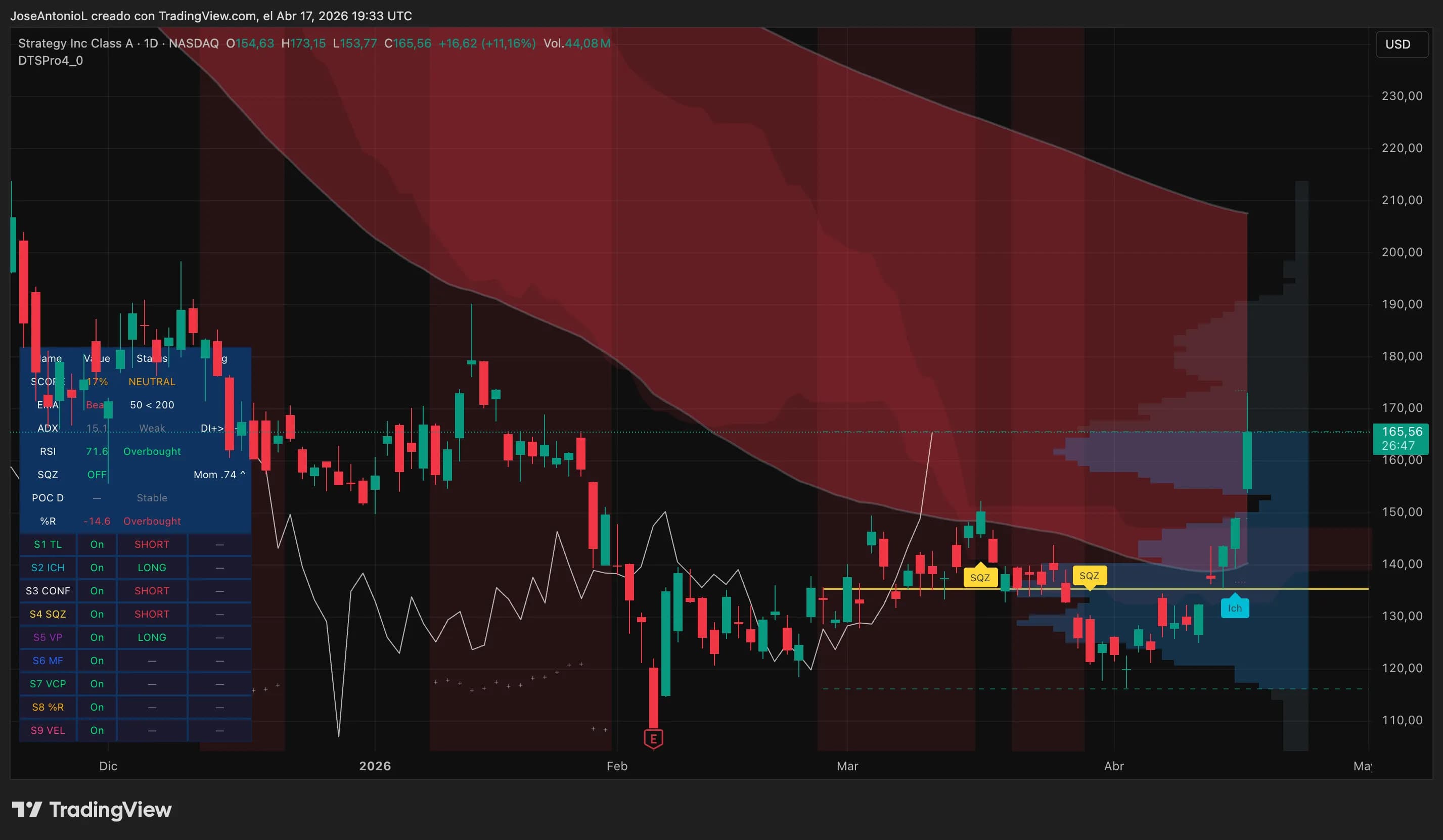
Bitcoin climbed above $78,000 intraday on the news before pulling back slightly, while digital asset treasury stocks like Strategy surged more than 10% as BTC's rise pushed its holdings back out of the red.
The macro environment had been brutal for most of 2026 with Middle East tensions, inflation fears, a strong dollar, and tight liquidity keeping Bitcoin locked in a grinding descent from its October 2025 peak of $126,000.
Bulls are praying that changes this week.
Today's candlestick on the Bitcoin charts is significant. Bitcoin opened at $75,172 and traders pushed the daily candle up to $77,205—a 2.7% gain on the session, with an intraday high of $78,384.
That move, modest as it sounds, was key to solidifying the thesis that the descending resistance trendline that had been rejecting Bitcoin at every rally attempt since October 2025 has been, finally, invalidated. For seven months, that line was gravity. This has been the first week Bitcoin trades over that line since the bearish pattern began.
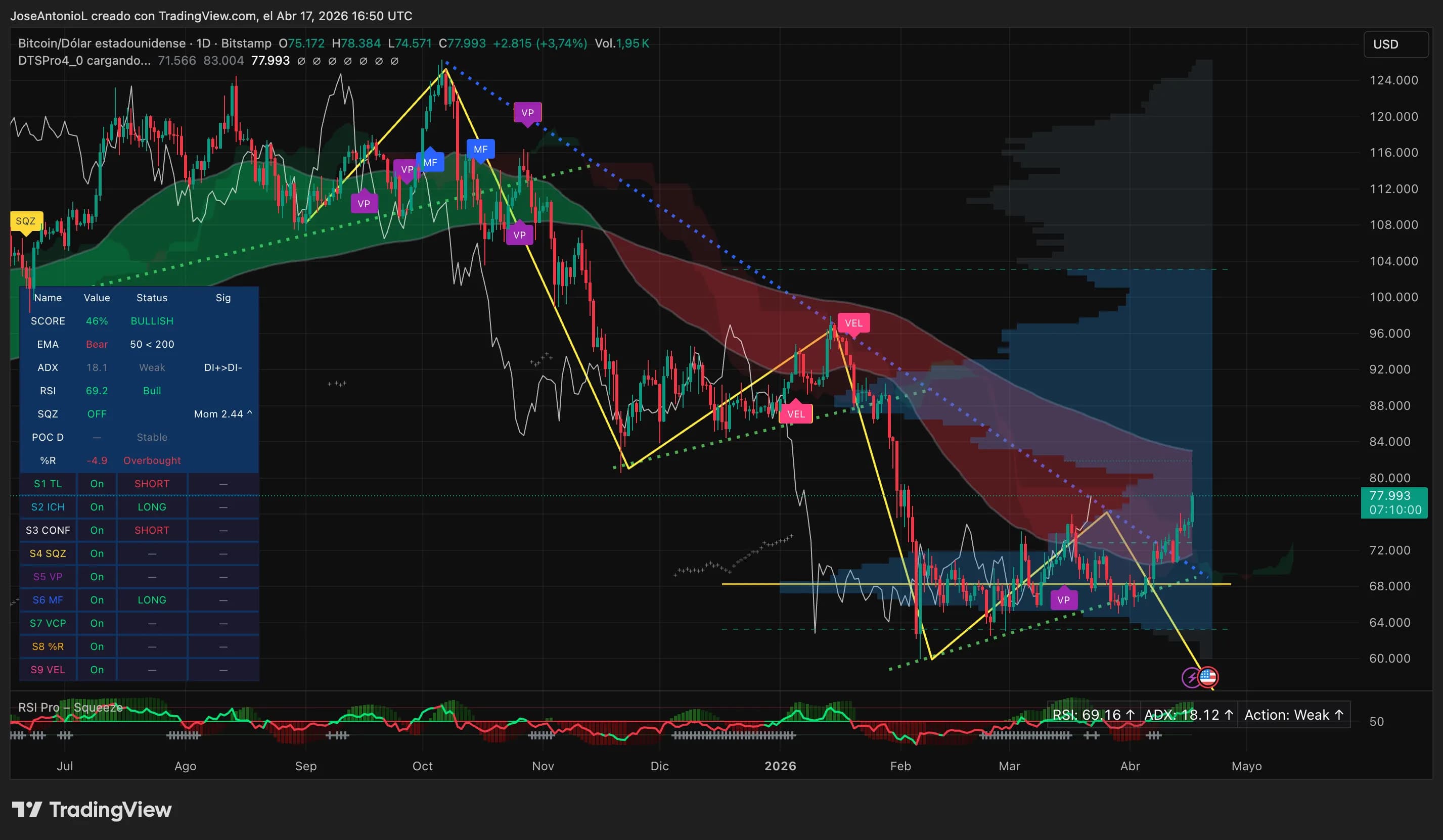
Since the $126,000 all-time high, Bitcoin has traced a textbook descending channel—lower highs, lower lows, and a string of failed breakout attempts, each capped harder than the last. The yellow trendlines on the chart above show that, for months, Bitcoin registered a compression structure where each bounce got shallower, and each support got tested deeper.
Bitcoin's price surge was triggered by Iran's announcement that the Strait of Hormuz will remain open during the ceasefire, impacting oil prices.
Traders estimate a 69% chance of Bitcoin hitting $84,000 next.
Traders give only a 6.2% chance for Bitcoin to reach a new all-time high before July.
Bitcoin's rise led to a more than 10% increase in digital asset treasury stocks like Strategy, as BTC's performance improved their holdings.
Ethereum's recent price drop triggers accumulation activity among investors.
Shiba Inu (SHIB) experiences a sharp increase in exchange outflows as traders move to self-custody.

XRP Ledger sees a mysterious spike of 300,000 new users, raising suspicions.

Cardano's Charles Hoskinson audits 11,000 DAOs to address governance by 2027.

Bitcoin rebounds to over $74K as total crypto market cap rises by $80 billion.

Wietse Wind warns XRP community about rising scams targeting Xaman wallet users.
See every story in Crypto — including breaking news and analysis.
If the trend had continued uninterrupted, the math was pointing toward $50,000–$55,000 as the logical next support zone. That scenario is now delayed, if not cancelled.
Indicators are also looking promising for bulls. The Exponential Moving Averages, which give traders a sense of the underlying trend based on smoothed price history, are still bearish with the 50-day EMA sitting below the 200-day EMA—a pattern that traders refer to as a death cross.
This matters because traders read the death cross as a bearish structural signal: The short-term trend is still weaker than the long-term average, meaning the recovery hasn't been deep or sustained enough to flip the larger trend. The death cross doesn't mean Bitcoin falls from here. It means bulls still have a mountain to climb before this is officially a new uptrend.
But it is the first time since January that the gap between both averages starts to compress.
The Average Directional Index, or ADX, reads 18.1, which means the current bearish trend is weak. ADX measures trend strength, not direction. A reading below 25 typically tells traders that the market lacks conviction and prices can move, but there's no real engine behind them yet. Considering the markets have been bearish for almost half the year, a weak ADX means this trend may either be fading away or traders are accumulating as much as possible in this zone.
The Relative Strength Index, or RSI, is at 67.7, which means Bitcoin is overbought but still in a manageable zone. RSI measures the speed and magnitude of price changes on a scale of 0–100. Above 70 is traditionally considered overbought—territory where traders begin locking in profits. At 67.7, Bitcoin is close to that line but hasn't crossed it yet, leaving some room for continuation before the technical pressure to sell intensifies.
The vertical lines in the background in the Bitcoin chart above show the squeeze momentum indicator (which tells when prices compress before a major spike in either direction) has been released, with positive momentum.
On Myriad, a prediction market developed by Decrypt's parent company Dastan, traders are leaning bullish on Bitcoin's next major move. Right now, Myriad traders are placing 69% odds on Bitcoin hitting $84K before dropping to $55K. The gap in favor of a Bitcoin pump is the widest it's been since the market debuted back in early February.
But the same crowd is sober about timelines. A separate Myriad market gives Bitcoin only a 6% chance of hitting a new all-time high before July.
Overall, in an optimistic scenario, Bitcoin holds above the broken trendline (now acting as support around $74,000–$75,000), and the ADX begins climbing above 20–25. If bears take over again, a new rejection, combined with RSI rolling over from near-overbought levels, sends Bitcoin back to test the support area. A break below that turns the broken resistance back into resistance, invalidating the breakout.
Disclaimer
The views and opinions expressed by the author are for informational purposes only and do not constitute financial, investment, or other advice.