
XRP Plunges to 6-Week Low as Fading Whale Activity Spells Further Trouble Ahead
XRP drops to a six-week low of $1.33 as whale activity declines significantly.
CryptoPotato1 min read
Bitcoin has reclaimed the $74,000 mark amid strong ETF inflows, but miner selling indicates ongoing bear market pressures. The cryptocurrency remains sensitive to broader market trends, particularly the S&P 500.
Key takeaways:
Bitcoin (BTC) reclaimed the $74,000 level on Monday following slight gains in the S&P 500 index after US President Donald Trump ordered a US blockade of the Strait of Hormuz. Traders appear to be gradually gaining confidence following strong net inflows into US-listed spot Bitcoin exchange-traded funds (ETFs) and continued accumulation by Strategy (MSTR US) but is the bear market over?
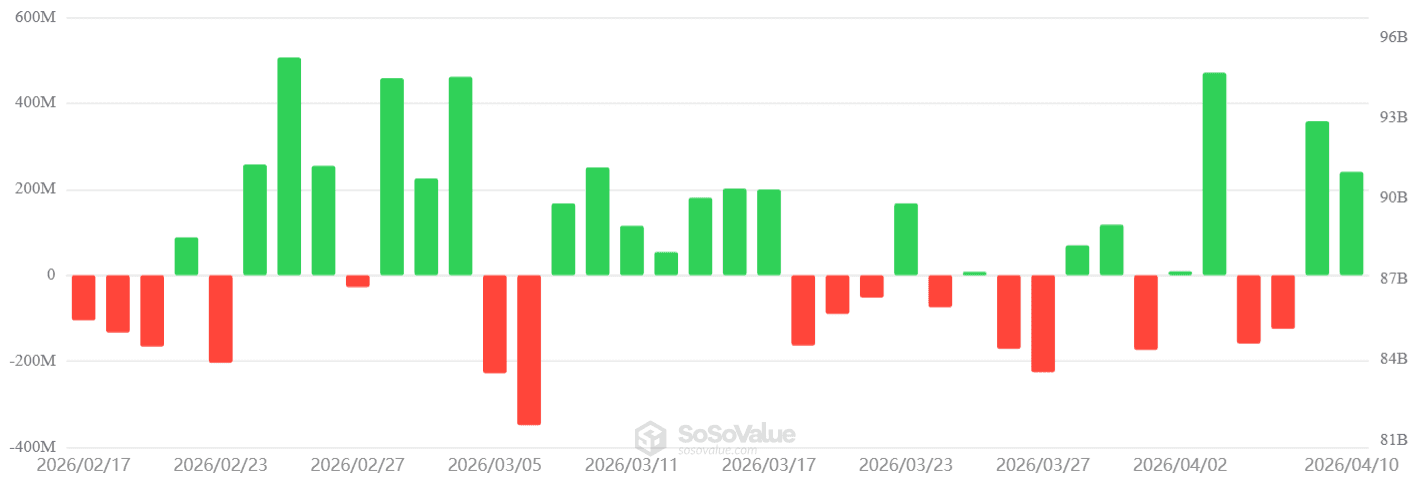
US-listed Bitcoin ETFs daily net flows, USD. Source: SoSoValue
The US-listed spot Bitcoin ETFs accumulated $615 million in net inflows between Thursday and Friday, reversing the trend from the previous two days. In parallel, Strategy announced it had acquired 13,927 BTC over the past week. The $1 billion in purchases were funded through its yield-bearing instrument, Stretch (STRC US).
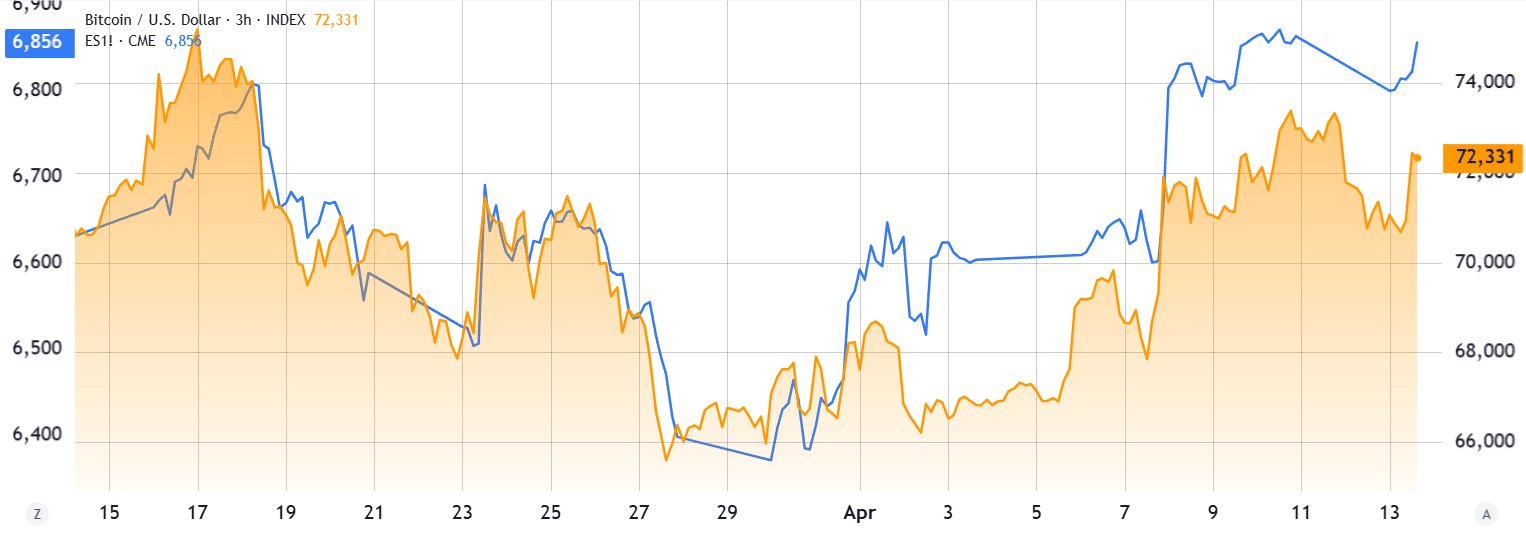
S&P 500 futures (left) vs. Bitcoin/USD (right). Source: TradingView
Despite growing demand from institutional investors, Bitcoin remains highly correlated with the S&P 500 and the broader macroeconomic movements of the US economy. Bitcoin dropped to $70,500 over the weekend after the failed US-Iran ceasefire negotiations. However, Brent crude oil prices eventually retreated to $99 on Monday, paving the way for gains in risk assets, including Bitcoin.
Bitcoin displayed strength at $74,000, but derivatives metrics have yet to flip bullish.
Bitcoin has recently reclaimed the price of $74,000.
Strong net inflows into US-listed Bitcoin ETFs are boosting trader confidence, despite ongoing market pressures.
Bitcoin's price is influenced by its correlation with the S&P 500 and global macroeconomic developments.
Despite the recent price increase, miner selling suggests that the bear market may still persist.
XRP drops to a six-week low of $1.33 as whale activity declines significantly.

Dogecoin price drops to monthly lows, but whales are loading up on DOGE.

Bitcoin's price plummets to $75K amid major sell-offs by Trump Media and Mark Cuban.

Hyperliquid is evolving into a core infrastructure layer for crypto finance with the introduction of HIP-4.

Glassnode reports Bitcoin options traders are defensive as BTC drops below $78K.
Is XRP capable of achieving the same price success as Hyperliquid's HYPE token?
See every story in Crypto — including breaking news and analysis.
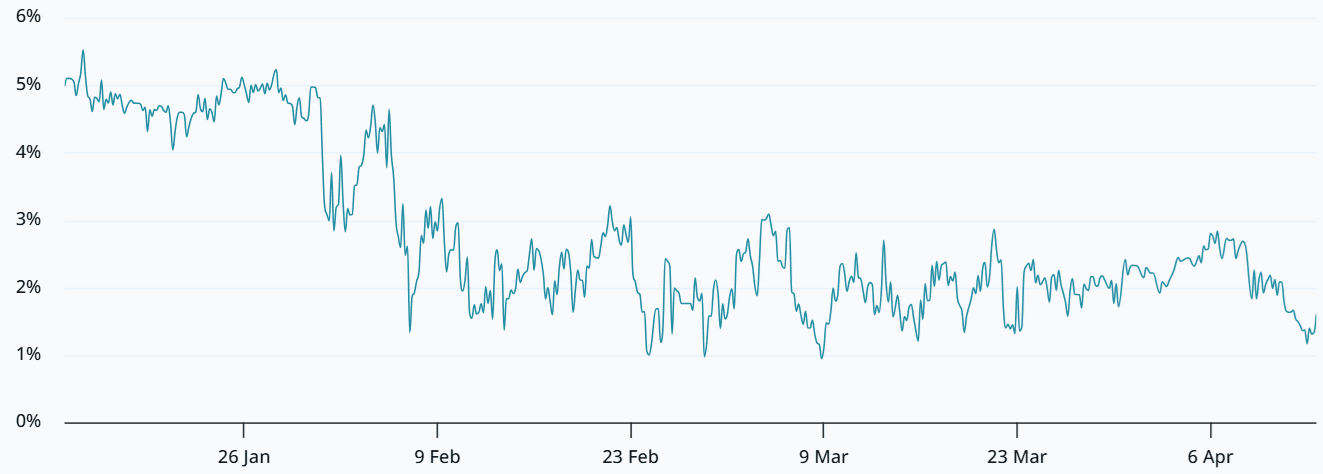
Bitcoin 2-month futures annualized premium. Source: laevitas
Bitcoin monthly futures traded at a 2% annualized premium relative to regular spot markets, indicating a lack of demand for bullish leverage. Under neutral conditions, the indicator should hold between 4% and 8% to compensate for the cost of capital. Regardless of performance over the past couple of weeks, Bitcoin is down 18% in 2026, while the S&P 500 remains relatively flat year-to-date.
While it is impossible to pinpoint the rationale for the sharp Bitcoin correction in late January, the lack of support from US lawmakers regarding the regulatory landscape likely played an important role. US Senator Cynthia Lummis has urged her colleagues to approve the CLARITY Act, which could define how stablecoin issuers operate and establish thresholds for tokens to be deemed decentralized.
The bill is currently facing a critical window in the Senate Banking Committee. Major exchanges have recently voiced concerns about late-stage additions to decentralized finance (DeFi) restrictions and the exact scope of tokenized assets. US Securities and Exchange Commission (SEC) Chairman Paul Atkins has also stated that "it is time" for Congress to advance with the regulation.
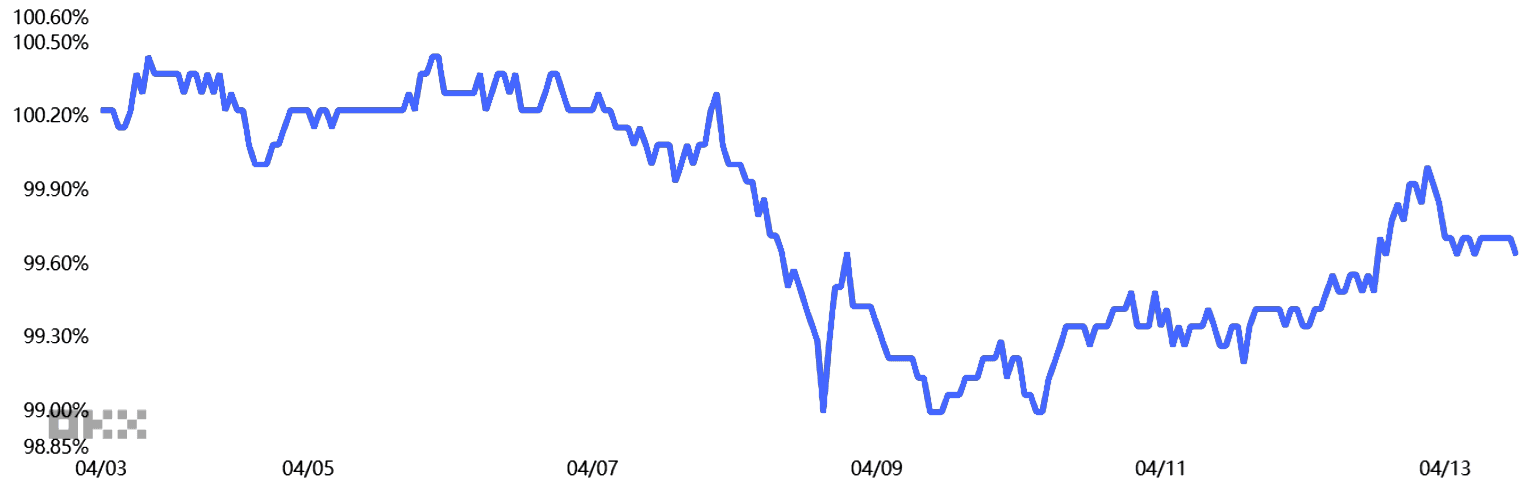
USD stablecoin premium/discount relative to USD/CNY rate. Source: OKX
USD stablecoins traded at a 0.4% discount to the official US dollar-to-yuan exchange rate on Monday, a typical sign of excessive demand to exit cryptocurrency markets. Balanced demand usually results in a 0.5% to 1.5% premium to compensate for the costs of traditional FX remittance and the regulatory friction caused by China's capital controls.
Given the strong correlation with traditional markets and weak derivatives metrics, there is no basis to claim that Bitcoin’s bear market is over based solely on ETF inflows and accumulation from a handful of companies, especially as publicly listed miners have recently reduced their positions.
MARA Holdings (MARA US) sold 15,133 BTC, while Riot Platforms (RIOT US) reduced its exposure by 2,325 BTC and Cango (CANG US) sold 2,000 BTC in the past 30 days.
For now, Bitcoin’s path to $80,000 is largely dependent on a more favorable risk perception, although short-term momentum relies mostly on the status of the US and Israel-Iran War.