
Crypto trader sees Hyperliquid, AI tokens leading next altcoin rally
Hyperliquid's HYPE token hits all-time high as traders shift focus.
CoinDesk1 min read

The CLARITY Act is set to finalize cryptocurrency regulation in the U.S., addressing the classification of digital assets as securities or commodities. Senate negotiators have agreed on stablecoin yield language, moving the legislation forward.
Cryptocurrency regulation in the United States is entering a more structured phase, as lawmakers move to resolve key gaps in legislation and shift away from years of fragmented oversight driven by enforcement actions.
A new development reported by Punchbowl News shows Senate negotiators have reached an agreement on stablecoin yield language within the proposed CLARITY Act, addressing one of the most contentious issues holding back progress.
The proposed CLARITY Act, already approved by the House, aims to resolve one of the industry’s biggest challenges: determining whether a digital asset is a security or a commodity.
Under this framework, decentralized tokens with no central control would fall under the jurisdiction of the Commodity Futures Trading Commission, while assets tied to investment expectations or centralized development would remain under the Securities and Exchange Commission.
This distinction is intended to eliminate regulatory overlap and provide businesses with clearer compliance pathways.
The compromise, led by Senators Thom Tillis and Angela Alsobrooks, introduces restrictions on rewards tied to stablecoins.
Under the new language:
This clarification directly builds on the GENIUS Act, which banned interest payments by issuers but left ambiguity around secondary market practices.
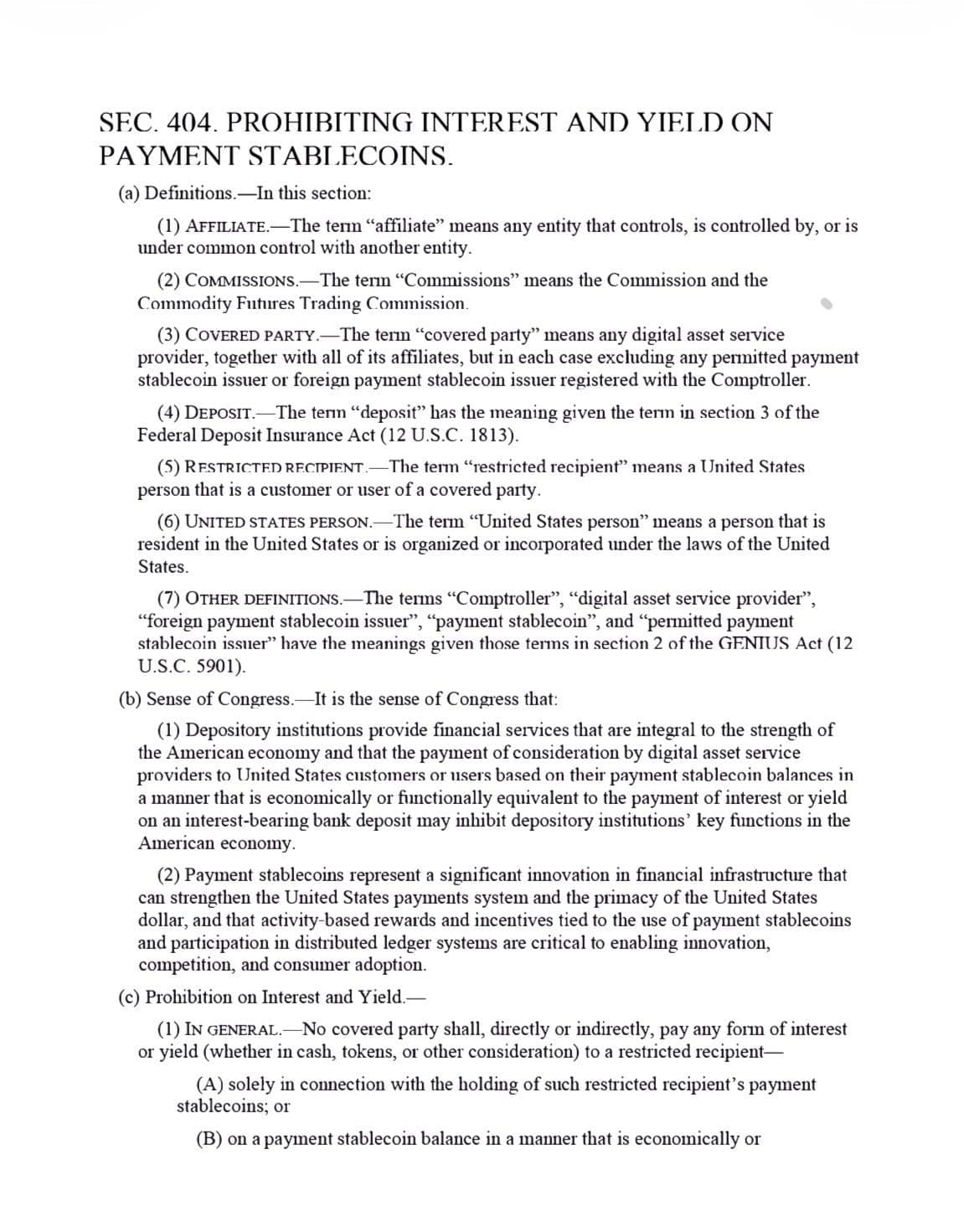
Source: X
The agreement removes a major obstacle that had delayed broader legislative progress. Senate Banking Committee Chairman Tim Scott is now targeting a potential markup of the CLARITY Act in May.
If advanced, the bill would:
Industry groups have long argued that these definitions are essential to replace “regulation by enforcement” with predictable legal standards.
The CLARITY Act aims to provide a clearer framework for classifying digital assets, distinguishing between securities and commodities.
The Act includes specific provisions for stablecoin yield language, which addresses regulatory concerns and aims to facilitate their growth.
Decentralized tokens will be regulated by the Commodity Futures Trading Commission, while assets with investment expectations will fall under the Securities and Exchange Commission.
Hyperliquid's HYPE token hits all-time high as traders shift focus.

Charles Hoskinson hails approval of treasury proposals aimed at enhancing Cardano.

Bitcoin struggles below $80,217 cost basis as realized losses climb.

Chainlink reveals major expansion across five blockchain networks!

Discover 3 Wacky Skills You Can Use with Hermes AI!

Bitcoin ETF outflows total $1.26 billion, hinting at potential buying opportunities, says Santiment.
See every story in Crypto — including breaking news and analysis.
The latest development reflects a broader shift in U.S. policy. With the GENIUS Act already in force and the CLARITY Act progressing, lawmakers are building a coordinated framework that addresses stablecoins, market structure, and investor protections.
At the same time, debates continue around other elements of crypto policy, including decentralized finance safeguards and restrictions on a potential central bank digital currency.
The Clarity Act cleared a major hurdle: stablecoin yield.
Compromise text was released overnight & while it bans passive yield, it still has room for "activity based" rewards.
The Senate Banking Committee can now schedule a markup hearing for the first time.
What's still…
— Nic (@nicrypto) May 2, 2026
The stablecoin yield compromise signals growing alignment between policymakers and industry concerns. By closing one of the most debated loopholes in existing legislation, it brings the U.S. closer to a comprehensive regulatory system.
While key provisions are still under negotiation, the direction is increasingly clear: digital assets are being integrated into formal financial regulation, with defined rules replacing uncertainty.
Overall, the United States is moving toward a coordinated regulatory system that defines responsibilities across federal agencies while maintaining space for innovation.