DOGE Price Dumps to Monthly Lows but Dogecoin Whales Load Up
Dogecoin price drops to monthly lows, but whales are loading up on DOGE.
CryptoPotato1 min read

Scammers are posing as Iranian authorities, demanding cryptocurrency payments from shipping companies for safe passage through the Strait of Hormuz. Maritime risk company Marisks has warned that these messages are fraudulent and do not originate from official sources.
Mentioned in this story
Fraudulent actors posing as Iranian authorities have reportedly sent messages to shipping companies whose vessels remain stranded west of the Strait of Hormuz, demanding payment in cryptocurrency for safe passage.
On Monday, maritime risk company Marisks issued a warning saying unknown groups had contacted shipowners claiming to represent Iranian security services and requesting transit “fees” in Bitcoin (BTC) or USDt (USDT) in exchange for clearance through the strait, according to Reuters.
“These specific messages are a scam,” Marisks reportedly said, adding that they do not originate from Iranian authorities. Tehran has not publicly commented on the claims.
The alerts come as the strategic waterway remains largely closed following the outbreak of conflict in the Middle East. The Strait of Hormuz, a critical chokepoint for global energy flows, previously handled around one-fifth of the world’s oil and liquefied natural gas exports before hostilities escalated in the region.
Earlier this month, reports said Iran was considering charging ships passing through the Strait of Hormuz a tariff payable in Bitcoin, with empty tankers allowed free passage while others could be charged around $1 per barrel of oil.
Related: Iran views BTC as strategic asset, but USDt still dominates oil tolls: BPI
The reported scam messages instruct recipients to submit documentation for verification before being assigned a “fee” payable in cryptocurrency, after which safe transit would allegedly be granted at a pre-agreed time.
In one example cited by Marisks, the message stated that Iranian security services would assess eligibility before determining payment in BTC or USDt, framing crypto transfers as a condition for unimpeded passage.
Scammers are demanding payments in cryptocurrency, specifically Bitcoin or USDt, for safe passage through the Strait of Hormuz.
The Iranian government has not publicly commented on the claims of the scam messages sent to shipping companies.
The Strait of Hormuz is a critical chokepoint for global energy flows, previously handling about one-fifth of the world’s oil and liquefied natural gas exports.
Dogecoin price drops to monthly lows, but whales are loading up on DOGE.

Bitcoin's price plummets to $75K amid major sell-offs by Trump Media and Mark Cuban.

Hyperliquid is evolving into a core infrastructure layer for crypto finance with the introduction of HIP-4.

Glassnode reports Bitcoin options traders are defensive as BTC drops below $78K.

Is XRP capable of achieving the same price success as Hyperliquid's HYPE token?

Exploring the reasons Solana is struggling against Ethereum's growth.
See every story in Crypto — including breaking news and analysis.
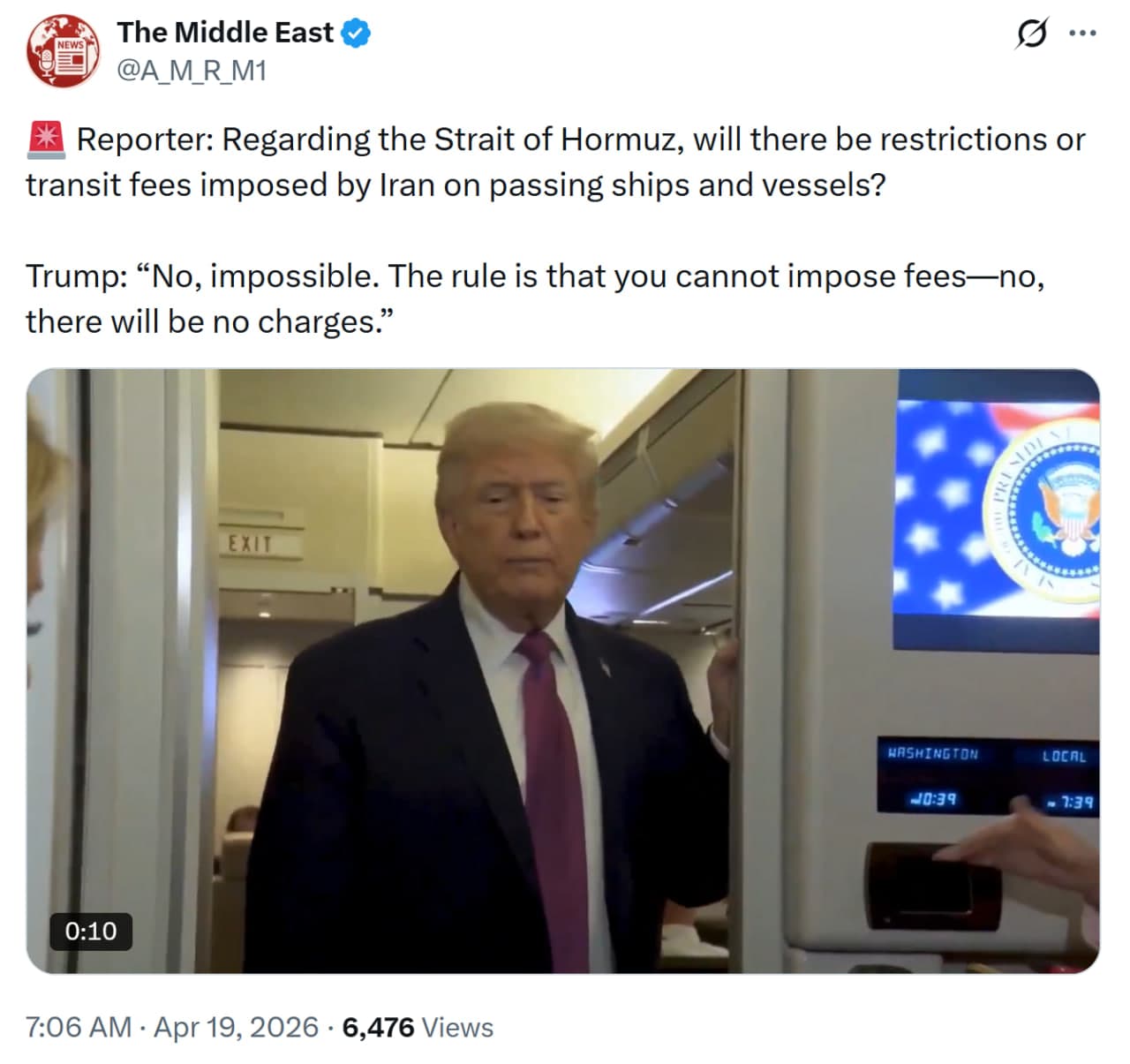
Trump says he won’t allow Iran to impose tolls on ships. Source: The Middle East
The company also suggested that at least one vessel recently targeted by gunfire while attempting to exit the strait may have received such fraudulent instructions, though the information has not been independently verified.
Cointelegraph reached out to Marisks for comment but did not receive an immediate response.
Shipping companies considering paying transit fees in cryptocurrency to Iran could face serious sanctions exposure, according to Chainalysis senior intelligence analyst Kaitlin Martin.
She told Cointelegraph that any payments linked to Iranian-controlled waterways could be treated as “material support,” potentially violating US and international sanctions targeting entities such as the Islamic Revolutionary Guard Corps.