
TRUMP token down 5% as namesake handset begins shipping next week
TRUMP token drops 5% as Trump Mobile's T1 handset begins shipping next week.
CoinDesk1 min read

Moody's analyst states that stablecoins currently have a limited impact on banks, with a market cap exceeding $300 billion. However, as stablecoins and tokenized real-world assets grow, banks may face increased competition and market share erosion.
The impact of stablecoins on the banking sector appears “limited” at the current phase of the adoption cycle, but banks could face increasing competition and an erosion of market share as the stablecoin sector and tokenized real-world assets (RWAs) grow in market capitalization.
“So far, the use of stablecoins remains limited, but their market capitalization exceeded $300 billion at the end of last year,” Abhi Srivastava, associate vice president of Moody’s Investors Service Digital Economy Group, told Cointelegraph.
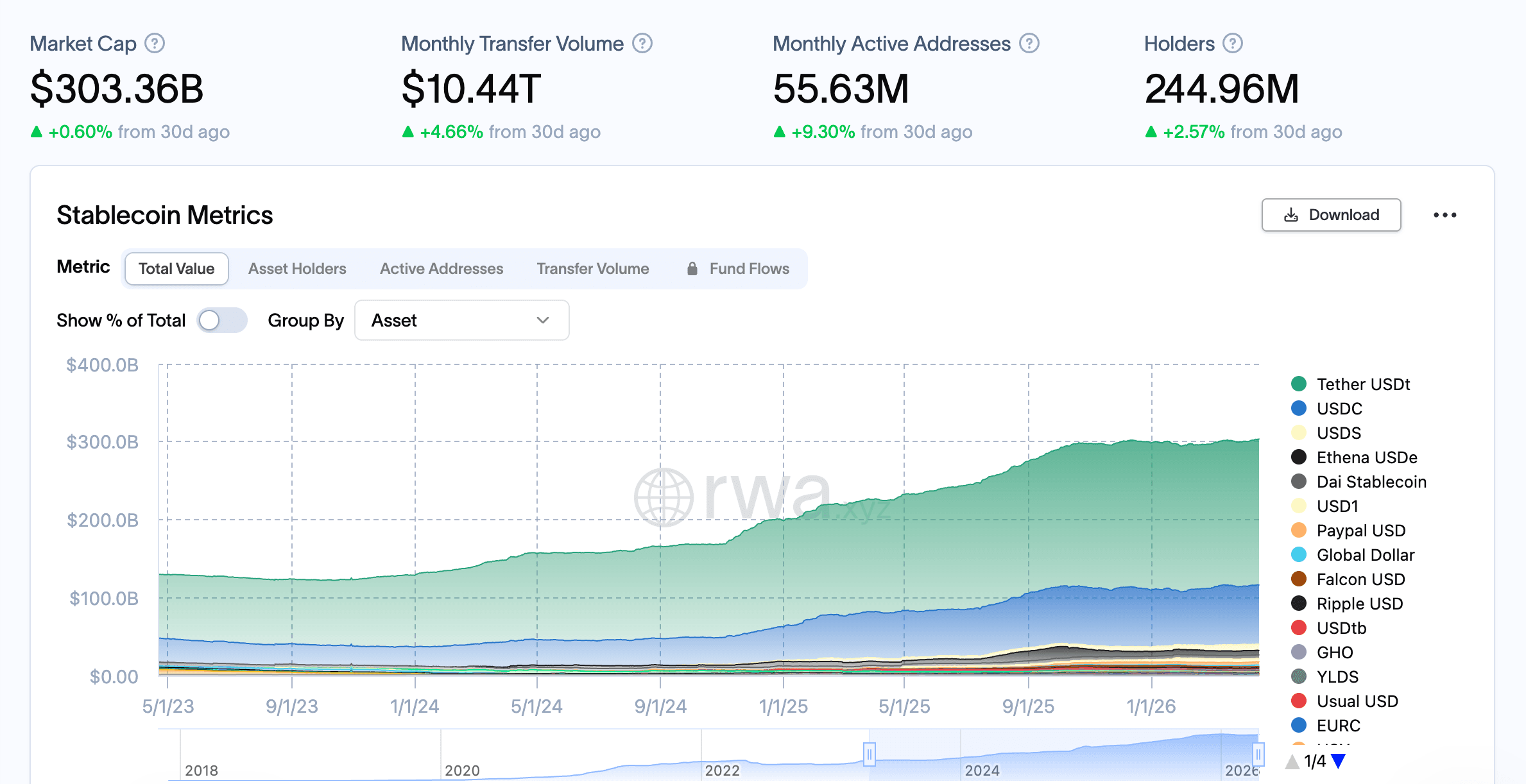
The stablecoin market cap has surged past $300 billion. Source: RWA.xyz
The role of stablecoins in payments, cross-border commerce and onchain finance is “expanding,” despite their currently limited role, Srivastava said, adding that existing payment systems in the US are already “fast, low-cost and trusted.” He said:
“For the banking sector, at this stage, disruption risk appears limited. In the near term, US rules that prohibit stablecoins from paying yield mean they are unlikely to replace traditional deposits at scale domestically.”
However, over time, growing adoption of stablecoins and tokenized RWAs, traditional or physical financial assets represented on a blockchain by a token, could place “pressure” on the banking sector, leading to deposit outflows and reduced lending capacity, he said.
Stablecoin regulatory policy has become a hot-button issue among crypto industry executives and those in the banking sector, with fears that yield-bearing stablecoins could erode banking market share proving to be a stumbling block for the CLARITY crypto market structure bill in Congress.
Related: Stablecoins behave like FX markets as liquidity splits: Eco CEO
The market capitalization of stablecoins has exceeded $300 billion.
While stablecoins have a limited impact now, they could increase competition and erode banks' market share as their adoption grows.
Stablecoins are expanding their role in payments, cross-border commerce, and onchain finance, despite their limited current usage.
TRUMP token drops 5% as Trump Mobile's T1 handset begins shipping next week.

Bitcoin falls below $80K as Xi warns Trump about Taiwan tensions

Arthur Hayes claims Zcash is his biggest crypto position outside Bitcoin, citing privacy demand.

XRP price continues to decline, trading below $1.450 as buyers remain sidelined.

Dogecoin TD Sequential sell signal suggests a price correction may be ahead.

MARA Holdings faces stock decline after selling $1.5 billion in Bitcoin.
See every story in Crypto — including breaking news and analysis.
The Digital Asset Market Clarity Act of 2025, also known as the CLARITY Act, is a comprehensive crypto market regulatory framework that establishes an asset taxonomy, regulatory jurisdiction and oversight over the crypto markets.
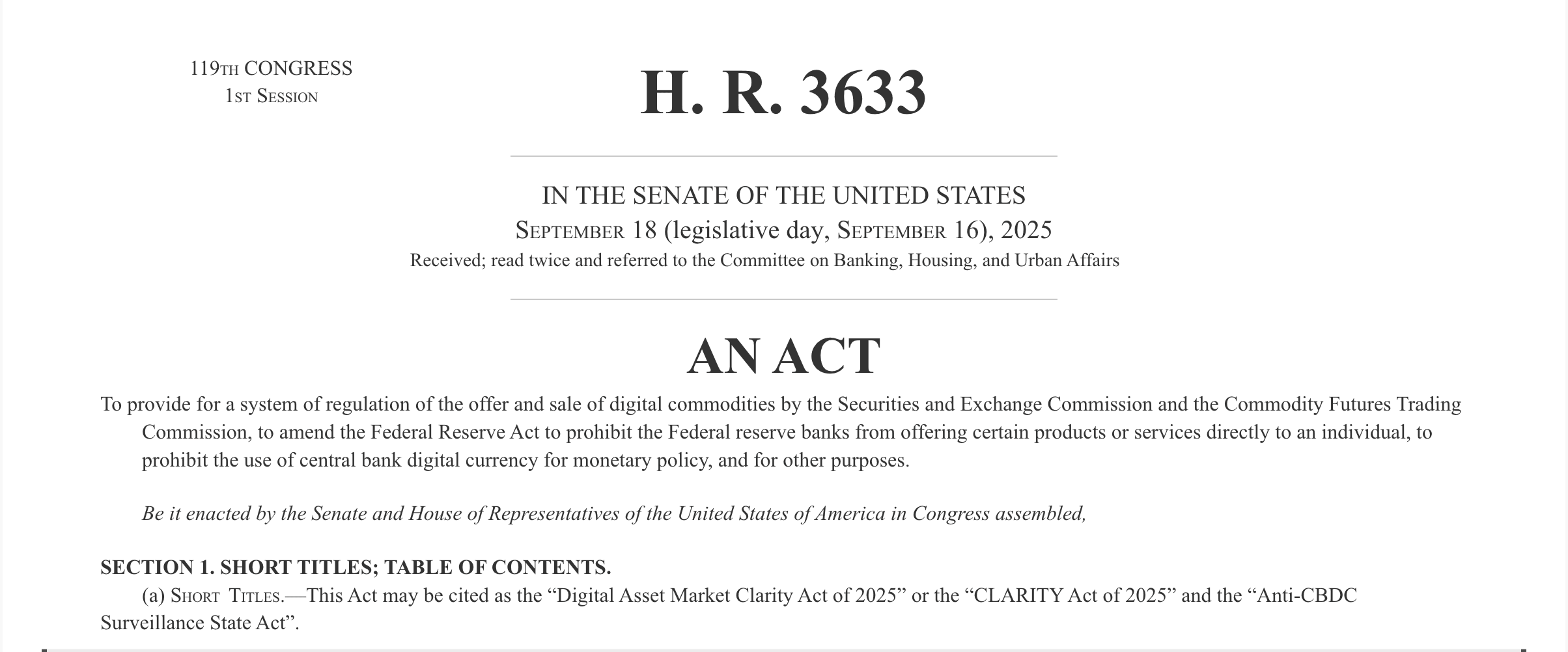
The CLARITY crypto market structure bill. Source: US Congress
It is now stalled in Congress after a group of crypto industry companies, led by cryptocurrency exchange Coinbase, publicly stated opposition to earlier drafts of the bill.
A lack of legal protections for open-source software developers and a prohibition on yield-bearing stablecoins were among some of the most contentious issues cited by crypto industry opponents of the legislation.
Several attempts have been made by US lawmakers and the White House to negotiate a bill acceptable to both the crypto industry and the bank lobby.
Earlier this month, North Carolina Senator Thom Tillis said he plans to release an updated draft bill proposal that would be acceptable to both sides; however, the bill has reportedly received pushback, according to Politico, and has yet to be publicly released.
However, other crypto industry executives and market analysts have warned that if the CLARITY Act fails to pass, it could open the crypto industry up to future regulatory crackdowns by hostile lawmakers and officials.