
XRP gives back gains after Senate crypto bill sparks 5% rally
XRP retreats after a 5% rally as Senate's CLARITY Act discussions loom.
CoinDesk1 min read

The CBOE Volatility Index (VIX) has dropped over 45% in three weeks, signaling potential bullish momentum for Bitcoin. Analysts suggest Bitcoin could rise towards $82,700 if this trend continues.
The CBOE Volatility Index (VIX), a preferred Wall Street metric to measure investor sentiment and market risk, dropped by over 45% in under a month. For Bitcoin (BTC), this could be a significant bullish signal.
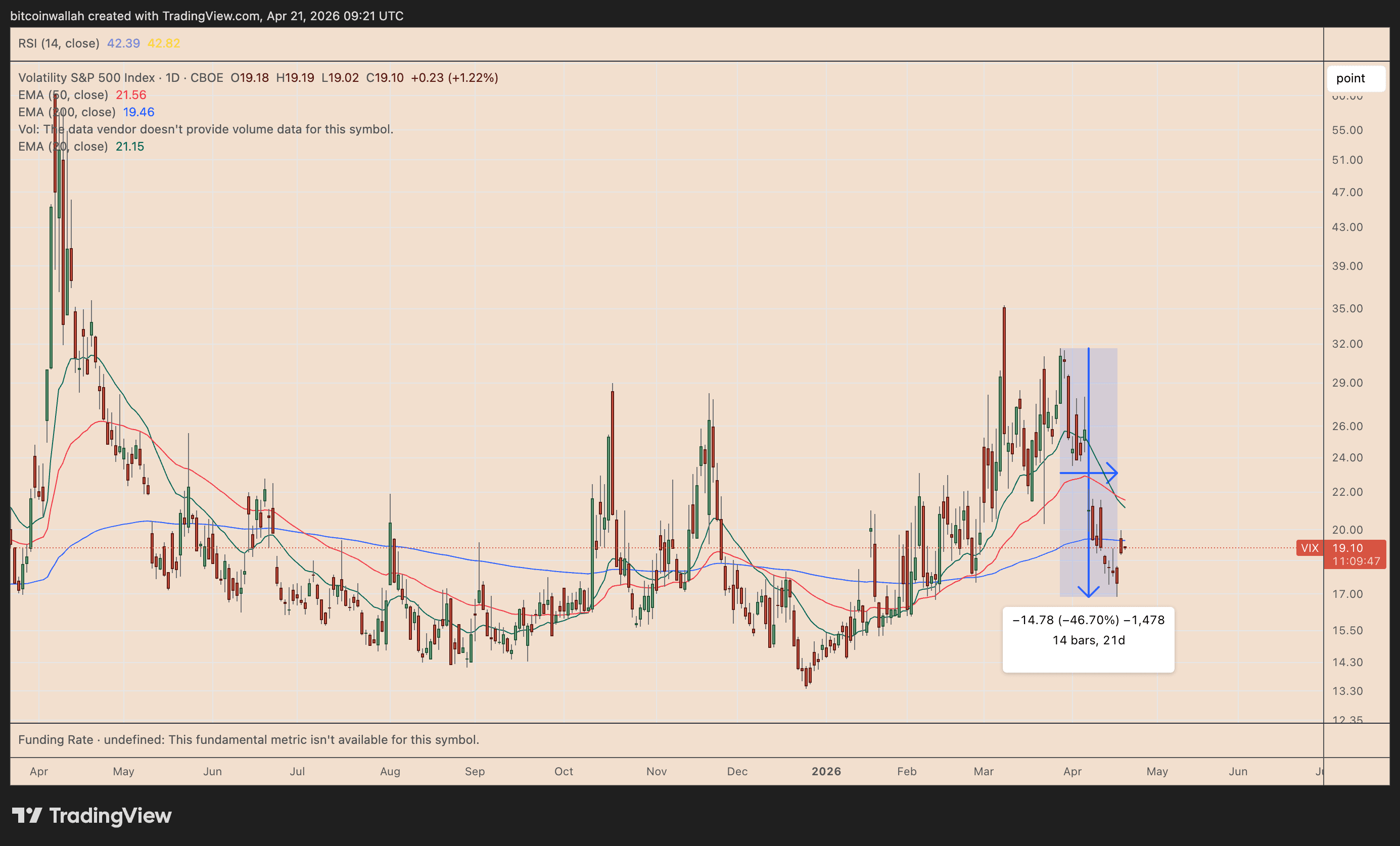
VIX daily performance chart. Source: TradingView
Key takeaways:
Often called Wall Street’s “fear gauge,” the VIX tracks how much volatility traders expect in the S&P 500 index over the next 30 days.
When the index rises, it usually signals rising stress and risk aversion across markets. When it falls, it suggests investors are becoming more comfortable owning riskier assets such as stocks and crypto.
History suggests that a VIX drop of 40% or more is bullish for Bitcoin.
For instance, BTC rallied approximately 40% during April 2025–May 2025, with its gains aligning with the VIX’s 70% dip.
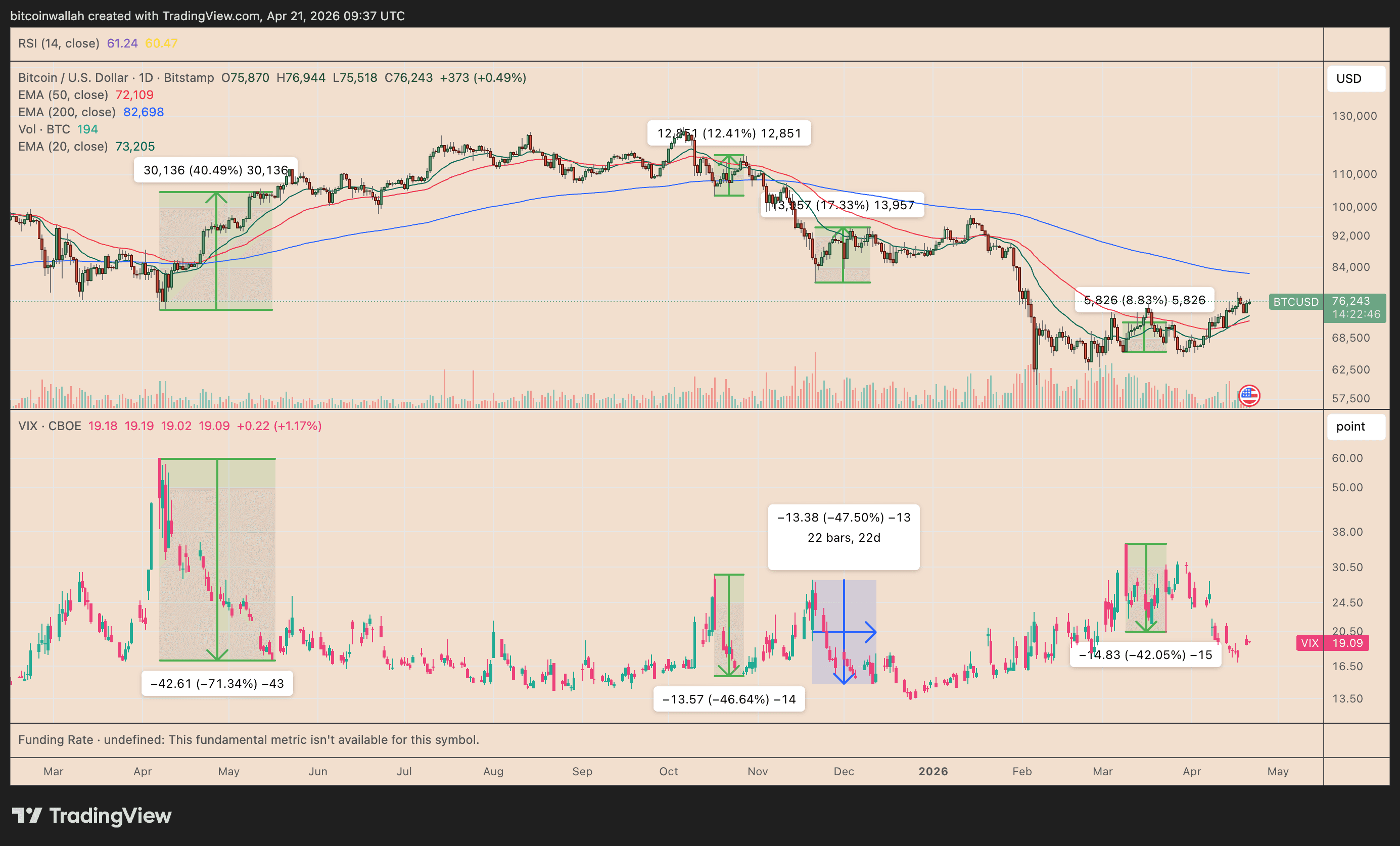
BTC/USD and VIX daily chart. Source: TradingView
Similarly, a 46% VIX drop during the October–November 2025 period coincided with a 12% BTC gain.
Even the recent 42%–47% VIX decline has coincided with an 8%–9% BTC price rebound, improving the bullish backdrop for Bitcoin in the coming days.
BTC’s next upside target appears to be around the 200-day exponential moving average (200-day EMA, the blue line) at around $82,700 by early May.
A rising VIX is typically bearish for risk assets like Bitcoin. However, that correlation broke briefly in March, according to a chart highlighted by wealth management firm Swissblock.
A 45% drop in the VIX indicates reduced market volatility, which could signal a bullish trend for Bitcoin prices.
If the VIX continues to underperform, Bitcoin could rise towards a target of $82,700.
Investor sentiment, as measured by the VIX, can significantly influence Bitcoin's price movements, with lower volatility often leading to increased buying activity.
XRP retreats after a 5% rally as Senate's CLARITY Act discussions loom.

Dogecoin and Bitcoin face resistance at their 200-day moving averages, indicating a technical deadlock.

Bitcoin Struggles Above $80K Amid Institutional Sell-Offs and Rising Yields

XRP surges as the most traded crypto on Upbit, signaling a major shift in the market.

Learn how to swap Monero (XMR) securely using StealthEX.

Dune Analytics lays off 25% of staff to focus on AI and institutional crypto.
See every story in Crypto — including breaking news and analysis.
BTC and VIX rose in tandem during the US–Iran escalation in March. In comparison, the broader risk market, including US equities, underperformed.
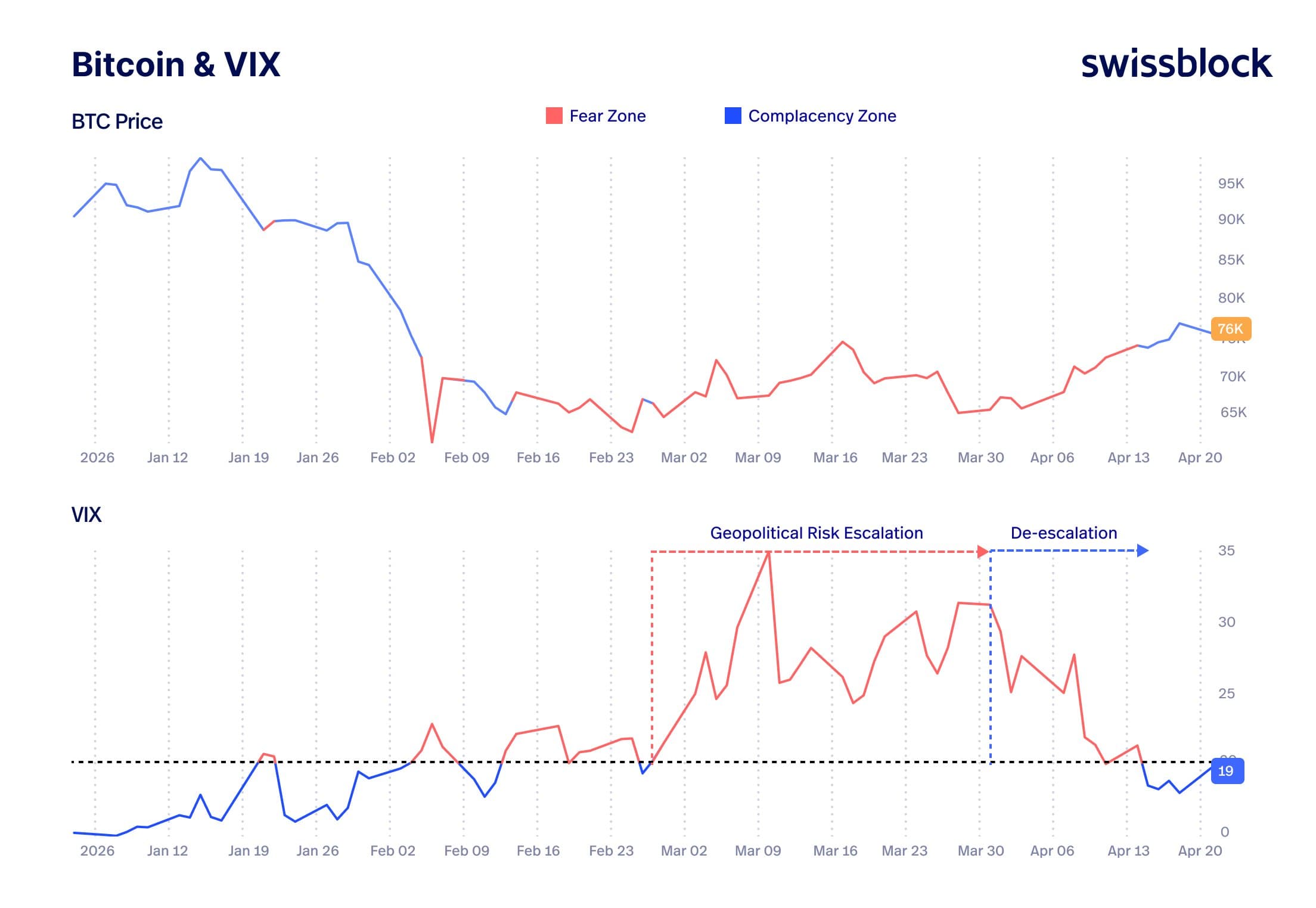
Bitcoin and VIX performance comparison. Source: Swissblock
One potential catalyst behind Bitcoin’s resilience may have been Strategy’s aggressive BTC buying, which has absorbed the equivalent to nearly 30 weeks of new coin supply since March.
“Bitcoin has already shown inherent strength in a very complex environment”, Swissblock said, adding:
“Do not be surprised if it starts to outperform on its own again.”
Nonetheless, any slowdown in Strategy’s buying could weaken Bitcoin’s support during periods of rising VIX, increasing the risk of downside.
Multiple analyses suggest BTC may drop below $50,000 in 2026.