
Historical Performance Says Bitcoin Price Will Not Bottom Until It Touches This Level
Analyst predicts Bitcoin won't bottom until it hits EMA 300 level.
NewsBTC1 min read

The XRP Ledger has partnered with Boundless to implement bank-grade privacy features, allowing confidential transactions for banks and asset managers. This integration aims to facilitate sensitive institutional use cases while maintaining regulatory compliance.
The XRP Ledger (XRPL) used by blockchain payments company Ripple has tapped Boundless, a zero-knowledge infrastructure provider, to let banks and asset managers execute confidential yet compliant transactions directly on the network, according to a Tuesday release shared with Cointelegraph.
Boundless chief executive Shiv Shankar told Cointelegraph the design aims to shield details like transaction size, frequency and counterparties from public view, while still allowing regulators to audit activity via selective disclosure and role-based access controls.
Boundless’ integration is meant to enable a range of institutional use cases that have historically been challenging to run on fully transparent ledgers. Those include cross-border business-to-business payments, treasury and capital management, over-the-counter positions, tokenized asset issuance and decentralized exchange or lending activity, where order flow and positions are highly sensitive, according to Shankar.
For public blockchains, that trade-off between transparency and confidentiality has become a central barrier to institutional adoption, as banks and asset managers seek to protect trading strategies and client activity without falling out of step with regulatory oversight.
The move positions XRPL in an increasingly competitive race to deliver bank-grade privacy on public blockchains, as institutions push to avoid what Shankar described as the “transparency tax” of fully visible onchain activity.
In March, cryptography company Zama integrated its fully homomorphic encryption (FHE) stack with institutional tokenization platform T-REX, pitching its technology as a confidentiality layer for ERC-3643 securities (tokenized financial instruments that embed compliance rules into the token standard) on upcoming T-REX public networks.
Related:Moody’s brings credit ratings onchain with Canton Network integration
Other projects are betting on different flavors of zero-knowledge technology, including zkSync’s Prividium environment, which aims to anchor private institutional execution to Ethereum via ZK proofs while keeping raw transaction data off public view.
Boundless' integration with the XRP Ledger aims to enable confidential transactions for banks and asset managers while ensuring compliance with regulatory oversight.
The XRP Ledger ensures privacy through zero-knowledge technology, which shields transaction details from public view while allowing selective disclosure for regulators.
The new privacy features can benefit cross-border payments, treasury management, over-the-counter positions, and tokenized asset issuance, among others.
Analyst predicts Bitcoin won't bottom until it hits EMA 300 level.

We asked AI if XRP can surpass $2 again. The answers were surprising!
XRP Ledger Foundation hints at upcoming version 3.2.0 release.

Bitcoin's recent momentum signals a potential downturn as it weakens. What does this mean for investors?

Bitcoin drops to over $74,000 and Ethereum dips to $2,000 this weekend.

Bitcoin's price drops to $74K as bearish market trends intensify.
See every story in Crypto — including breaking news and analysis.
Shankar said that projects like zkSync require institutions to launch their own layer-2s, which involves greater investment and overhead. In contrast, Boundless deploys solutions via smart contracts, which he said allows institutions to “stay where the liquidity is” (on Ethereum), and “gain more flexibility on where they deploy their products.”
Shankar said the design aims to replicate the selective disclosure controls of traditional finance in an onchain environment, rather than forcing institutions to choose between privacy and compliance.
The rollout highlights how privacy is becoming a feature of base-layer and tokenization infrastructure rather than an optional add-on.
The tokenized asset market reached $29.25 billion in April 2026, up 7.9% in a month, according to data from RWA.xyz.
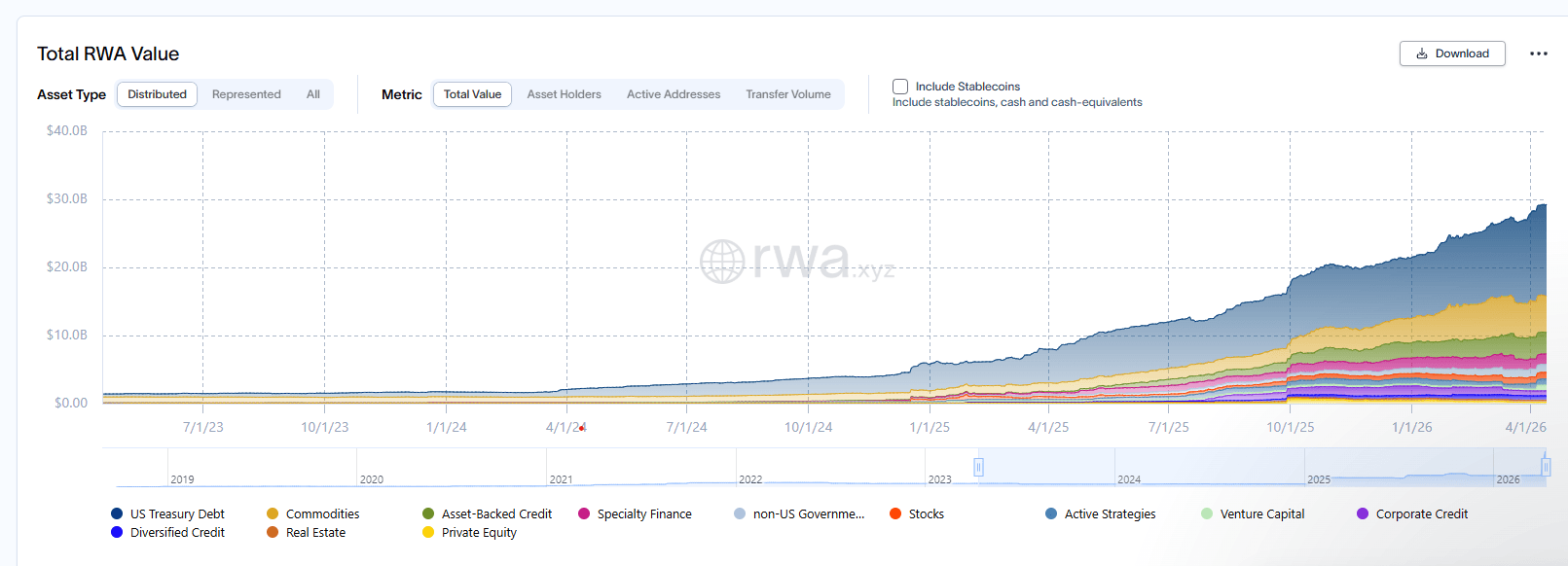
Total RWA value. Source: RWA.xyz
As more real-world assets migrate onchain and traditional players experiment with tokenized funds, deposits and securities, pressure is mounting on networks to accommodate both institutional secrecy and supervisory oversight.